Answering the need for a versatile 110V MIG welder with gas capability, these top picks balance flexibility, ease of use, and solid performance for hobbyists and small- shop projects. Best for beginners and DIYers is the ARCCAPTAIN 165A MIG Welder with synergy and dual voltage. For users who value smart control and a robust 160A output, YESWELDER and YESWELDER brands show strong all-around options. The list below highlights which models are best for home repairs, auto work, and small fabrications, and why each stands out.
The following table summarizes the chosen products, focusing on suitability, key strengths, and potential caveats. This quick guide helps buyers compare at a glance before reading detailed sections.
| Product | Best For | Notable Limitation | |
|---|---|---|---|
| ARCCAPTAIN 165A MIG Welder | Beginners to intermediate welders needing 110V/220V flexibility | 4-in-1 versatility, synergy control, large LED display, 2T/4T modes | Requires WP-17V TIG torch separately for Lift TIG |
| YESWELDER 160A MIG Welder | Auto enthusiasts and DIYers seeking smart control | Synergic control, dual voltage, capable of multiple processes | Torch for TIG lift may be purchased separately |
| Ehomful 145A 4-in-1 MIG Welder | Beginner-friendly users needing strong digital readout | Synergic control, HD digital screen, dual voltage | Lift TIG torch not included by default |
| YESWELDER 135A MIG Welder | Budget-conscious starters with light-duty needs | 3-in-1 versatility, synergic control, feasible for thin materials | Lower amperage limits heavier welds |
| S7 200A 4-in-1 MIG Welder | DIYers with a broader workspace and variable voltages | 4-in-1 capabilities, strong dual voltage, beginner-friendly | Higher power model may be heavier to move |
ARCCAPTAIN 165A MIG Welder: 4 in 1 Gas/Gasless MIG

The ARCCAPTAIN 165A MIG Welder integrates gas MIG, flux-core MIG, Lift TIG, and MMA welding modes. It supports 110V and 220V input, with a large LED display that helps read parameters without removing your helmet. The synergy features adjust automatically based on selected plate thickness and wire diameter, simplifying setup for beginners while offering manual overrides for experienced users. This model is well suited for stainless steel, carbon steel, and thicker metals, making it a strong choice for automotive frame work and home fabrication. A notable caution is to ensure the screen is off and the fan has stopped before changing voltage settings.
Best for: Beginners who want a single machine for multiple welding tasks and occasional TIG work (with the separate torch). Better for users who value a clear display and automatic parameter suggestions.
YESWELDER 160A MIG Welder: 4 in 1 Gas MIG/Flux Core MIG/Lift TIG/Stick

This 160A unit offers 110V/220V dual voltage with four primary welding modes, including gas MIG and flux-core MIG, plus Lift TIG and Stick. Its smart control uses synergic adjustment to select the right voltage and wire feed rate automatically as you set material thickness. Beginners benefit from automatic parameter matching, while more experienced welders can fine-tune settings for better bead shape and penetration. This machine is a solid pick for automotive work, fabrication, and DIY projects. A limitation is that the TIG torch might require separate purchase for Lift TIG capability.
Best for: Users who want a robust, versatile machine that minimizes setup complexity and grows with skill level.
Ehomful 145A 4-in-1 MIG Welder

The Ehomful MIG145 blends Gas MIG, Flux Core MIG, Lift TIG, and MMA in a dual-voltage body with a clear HD digital display. It emphasizes synergic control that automatically selects optimum voltage and wire feed speed for selected thickness, while still allowing manual tweaking. The unit prioritizes smooth arc and reduced spatter, which helps produce clean weld beads on stainless and carbon steel up to about 3 mm. This model is particularly friendly for beginners who want straightforward operation and clear parameter readouts. The TIG function requires a separate torch purchase.
Best for: Beginners who want an all-in-one, easy-to-read control panel and reliable performance across common metals.
YESWELDER 135A MIG Welder: 3-in-1 Synergic Control
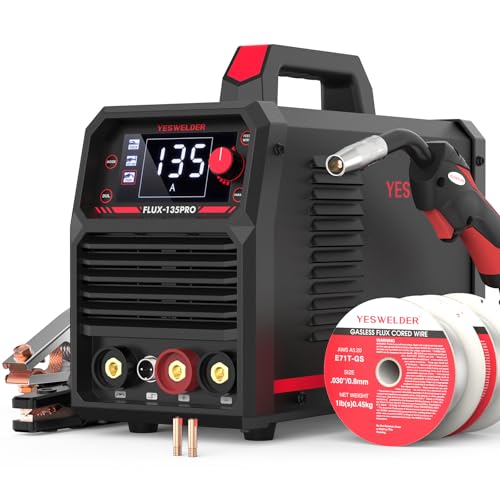
The 135A model delivers 110V flux-core MIG, gas MIG, and stick with optional Lift TIG capability via an additional torch. It uses synergic control to automatically match feed rate and voltage, simplifying setup for beginners while still offering manual adjustments for fine-tuning. It’s a cost-conscious option ideal for light automotive work, repairs, and small fabrication tasks. A potential limitation is its lower amperage, which may limit weld thickness and speed on heavier projects.
Best for: Beginners or budget-minded hobbyists focusing on light-duty metalwork and simple repairs.
YESWELDER 165A MIG Welder: 4 in 1 Gas/MIG/Stick/Lift TIG

This 165A model extends 4-in-1 capability with gas MIG, flux-core MIG, Stick, and Lift TIG. Its synergy-based MIG control helps beginners find the right balance between speed and penetration, while the TIG side provides additional welding flexibility for thicker or more intricate joints. The unit supports common wires such as .023, .030, and .035 inches. It suits small fabrication and automotive tasks, with a focus on stable performance and simple setup. A limitation is that Lift TIG tooling might require an extra torch for full TIG functionality.
Best for: Welders who need a higher amperage for thicker materials and a broad mix of processes in one machine.
ARCCAPTAIN 160A MIG Welder: 4 in 1 Portable

The ARCCAPTAIN MIG160 blends gas MIG, flux-core MIG, Lift TIG, and MMA with a lightweight 11.8-pound frame for portability. It features synergic control, allowing automatic matching of current and wire speed with chosen wire diameter. It supports both gas MIG and gasless MIG, making it versatile for indoor and outdoor use. The design is geared toward beginners and home workshops that need a compact, easy-to-move unit for small repairs, rusty metal, and farm equipment maintenance. A caveat is that the kit may require an additional Lift TIG torch for full TIG capability.
Best for: Home-shop welders who need a compact, portable 110V/220V machine with flexible MIG modes and occasional TIG capability.
Buying Guide: 110V MIG Welders With Gas
- Voltage compatibility: Dual-voltage (110V/220V) units offer flexibility for different outlets and job sizes. Consider a model with automatic voltage switching or simple manual selection.
- Process range: A true 4-in-1 or 3-in-1 unit broadens welding options for various metals and thicknesses. Check whether Lift TIG requires an extra torch.
- Synergic control: Synergic MIG control reduces setup time by automatically selecting voltage and wire feed speed based on material thickness. Manual override is a plus for seasoned welders.
- Display and usability: A large LED or digital display helps monitor amperage, voltage, and wire speed without guesswork, which is especially helpful for beginners.
- Portability and weight: If you need to move the welder, prioritize lighter models with a comfortable handle. Weight can influence usability in tight spaces.
- Spool compatibility: Verify wire sizes the machine supports, typically .023, .030, or .035 inches, and whether it accommodates 2 lb or 10 lb spools.
- Abrasive factors and work settings: For outdoor work or rusty metal, flux-core MIG can provide easier starts and less prep compared to solid wire with gas.
Frequently Asked Questions
- What is the main difference between gas MIG and flux-core MIG? Gas MIG uses shielding gas to protect the weld pool, delivering cleaner beads, while flux-core MIG relies on flux in the wire to shield the weld, often benefiting outdoor or windy conditions.
- Do I need a TIG torch to use Lift TIG on these machines? Lift TIG may require a separate torch or adapter depending on the model. Check the product’s manual for compatibility and additional torch requirements.
- Is dual voltage essential for beginners? Dual voltage is convenient for home shops with different outlets. It allows you to tackle small projects on 110V and tougher jobs on 220V without a separate dedicated welder.
- Which welding process is best for thin metal? For thin metal, MIG with a steady arc and controlled heat is typically best. Synergic MIG modes help manage this more easily for beginners.
- Can these welders handle auto body repair? Yes, many 110V/220V multi-process welders can manage auto body tasks when paired with appropriate wire and settings, though thicker frame materials may require higher amperage and more advanced TIG options.
- What maintenance is required? Regularly inspect connections, clean the contact tip, and ensure the cooling fan operates smoothly. Replace worn consumables according to usage to maintain welding quality.
Add a Comment