Find the right well pump irrigation system for your yard with options that fit small lawns to large, water-demanding landscapes. This guide highlights five reliable pumps and explains who each is best for, based on head, flow, and installation features. Ideal buyers range from homeowners seeking easy setup, to farmers needing higher flow for bigger plots, to those prioritizing durability or automatic operation.
| Product | Best For | Key Benefit |
|---|---|---|
| AQUASTRONG 1.5 HP Shallow Well Jet/Centrifugal Pump | Medium lawns, mixed-use irrigation | High flow up to 4250 GPH with dual voltage |
| Red Lion RL-SPRK150 1.5 HP | Reliable domestic irrigation | Cast iron housing with easy voltage switching |
| Aquastrong 1320 GPH with Pressure Tank | Small to mid-size gardens | Automatic pressure boosting with tank |
| Goulds GT15 IRRI-Gator | Self-priming, serviceable systems | Designed for easy maintenance |
| Aquastrong 1320 GPH (Pressure Tank) Model | Home irrigation with automatic control | NSF-certified components and automatic switch |
AQUASTRONG 1.5 HP Shallow Well Jet/Centrifugal Pump

Best for mid-sized lawns and garden beds that require a strong water push. This pump delivers a maximum head of 108 ft and up to 4250 GPH, suitable for several sprinkler zones or a large drip system. Dual voltage support (115/230 V) provides flexible power options and easier site wiring. The reinforced impeller and diffuser enhance efficiency for higher water volumes. Suitable where a robust jet/centrifugal design is advantageous, especially on wells with moderate drawdown.
Who it’s best for: homeowners needing a versatile, higher-capacity pump that can run with 115V or 230V supply. Choose this if you have a larger yard or multiple irrigation zones and want reliable performance with easy setup.
Caution: Not a self-priming unit; initial priming and correct piping are necessary for reliable operation. Ensure correct NPT sizing (2″ suction, 1-1/2″ discharge) to match existing plumbing.
Red Lion RL-SPRK150 115/230V, 1.5 HP

Best for long-term reliability with simple voltage management. This cast iron pump housing paired with a glass-filled thermoplastic impeller suits well water or lake water scenarios. It ships with a factory setting at 230V but can be switched to 115V, aiding compatibility with different power sources. One-time priming helps reduce initial setup time once installed.
Who it’s best for: buyers who want a rugged, dependable pump with straightforward voltage options and minimal priming requirements. Choose this if you expect a stable, long-lasting irrigation supply from a variety of water sources.
Caution: Verify voltage compatibility before installation to avoid electrical issues. Ensure priming is performed according to the manual for best results.
Aquastrong 1320 GPH Shallow Well Garden Pump (Pressure Tank)

Best for automatic home irrigation with gentle booster capability. This model offers up to 1320 GPH at 5 ft head and a head height of up to 164 ft, making it suitable for small to mid-sized gardens. The stainless steel casing and corrosion-resistant components support durability. It includes a pressure switch for automatic start/stop, a compact 5-gallon tank, and a pressure gauge for monitoring.
Who it’s best for: homeowners seeking automatic operation and a compact tank-based system for steady watering schedules without constant manual intervention.
Caution: This unit is not self-priming and requires initial filling prior to use. Confirm compatibility with your water supply and tank placement for optimal performance.
Aquastrong 115V Shallow Well Garden Pump with Pressure Tank

Best for domestic water supply and garden irrigation with automatic pressure control. This model features a 1.6 HP motor and a max head of 164 ft with a 1340 GPH flow. It includes a pressure switch that starts at 20 psi and stops at 40 psi, a 5-gallon tank, a pressure gauge, and a waterproof switch. The stainless steel housing adds corrosion resistance for longevity, while the included tank helps maintain steady pressure.
Who it’s best for: buyers prioritizing automatic pressure management in a compact, quiet package for home irrigation and water supply needs. Choose this if you want a self-contained system with a built-in pressure tank.
Caution: Not a self-priming pump; proper priming and set-up are required for reliable operation. Check hose sizes and connections to match 1-1/4″ or 1-1/2″ fittings as needed.
VEVOR 2 HP Shallow Well Jet Pump
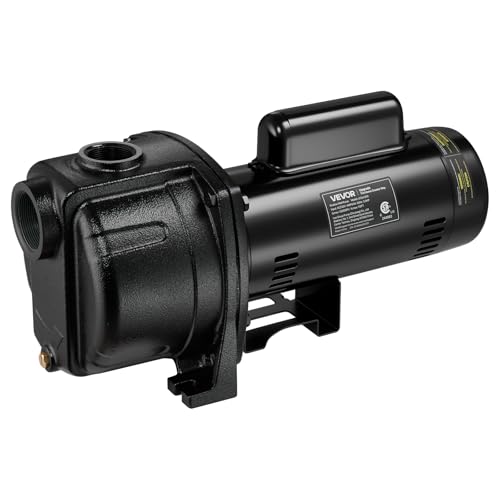
Best for larger irrigation demands and commercial-ish setups. With a 2 HP motor and up to 5200 GPH, this pump can manage sizable lawn zones and multiple sprinkler lines. It features a 25 ft suction lift and a 2″ inlet, designed for 230V operation. A check valve and thermal protection contribute to safe, consistent operation, with automatic on/off for convenient daily use.
Who it’s best for: buyers who need high flow for extensive irrigation or mixed-use water systems. Choose this if you require robust output and easy integration into larger layouts.
Caution: Higher power means more energy use and potential noise. Ensure electrical wiring and mounting are appropriate for a 230V setup in your space.
Buying Guide
What size pump do I need for my irrigation system?
Consider the required GPH (gallons per hour) and the maximum head (feet). Larger lawns or multiple zones need higher GPH and greater head. If you have a pressure tank, factor in its volume to maintain steady pressure between cycles.
Should I choose a self-priming or non-self-priming pump?
Self-priming models simplify installation and startup after priming. Non-self-priming units require pre-filling and careful priming to prevent air lock, making initial setup more involved.
What about voltage and plumbing connections?
Match pump voltage to your power supply (115V vs 230V). Check inlet/outlet sizes (commonly 2″ suction or 1-1/2″ discharge) and ensure your piping or hoses fit seamlessly to prevent leaks and cavitation.
Durability and material considerations
Cast iron housings offer durability for rugged use, while stainless steel components resist corrosion in chlorinated or mineral-rich water. Thermoplastic impellers are common but may wear faster with abrasive water; verify compatibility with your water source.
Automatic operation vs. manual control
Systems with pressure switches and pressure tanks support automatic cycling, reducing manual intervention. If you want constant water on demand, look for built-in switch features and tank capacity.
Installation and maintenance considerations
Look for pumps that are easy to prime and service. Serviceable impellers and accessible seals reduce maintenance time. For larger installations, plan for a check valve, properly sized fittings, and secure mounting to minimize vibration.
Summary of top picks by scenario
- Best for mid-size lawns: AQUASTRONG 1.5 HP Shallow Well Jet/Centrifugal Pump — high flow, flexible voltage.
- Best for reliability with simple voltage options: Red Lion RL-SPRK150 — rugged housing and straightforward priming.
- Best for automatic operation in small gardens: Aquastrong 1320 GPH with Pressure Tank — built-in pressure control.
- Best for easy maintenance and serviceability: Goulds GT15 IRRI-Gator — self-priming and serviceable design.
- Best for high-flow large-area irrigation: VEVOR 2 HP Shallow Well Jet Pump — highest GPH in this list.
FAQ
- What is a good GPH for a typical residential irrigation system? A: For small to medium yards, 1000–2000 GPH is common; larger lawns may require 3000–5000 GPH or more depending on zones and sprinkler output.
- Do I need a pressure tank with a well pump? A: A pressure tank helps maintain steady pressure and reduces pump cycling, extending pump life in automatic systems.
- Is it necessary to prime a jet pump before first use? A: Yes, most jet pumps require priming to remove air and start pumping efficiently.
- Can I run a well pump on a standard household circuit? A: It depends on the motor size and circuit amperage. Check electrical requirements and local codes before installation.
- How do I determine the right head height for my pump? A: Head height equals the vertical distance to the furthest sprinkler or emitter. Add friction losses for tubing and fittings to estimate total head.
Add a Comment