Protecting welders’ lungs and ensuring a cleaner work environment requires effective air filtration tailored to welding fumes, dust, and smoke. The following selection highlights five reliable filtration solutions designed to reduce particles, odors, and fumes typically generated in welding, soldering, and metalworking. Each product is evaluated for airflow capacity, filtration stages, and ease of use to help you compare options for small shops to larger workspaces.
The table below offers a quick snapshot of the chosen products, including brand, model, and a highlight feature to guide your initial comparison.
| Product | Brand | Key Benefit |
|---|---|---|
| YESWELDER LYG-Q800D | YESWELDER | Powered Air Purifying Respirator with auto-darkening lens and high air exchange |
| FumeClear FC100A | FUMECLEAR | Three-layer filtration with high iodine carbon for fumes and particles |
| WEN AF1270 | WEN | High airflow options with three speeds and replaceable filters |
| ALORAIR 780IG | ALORAIR | 270° intake with built-in ionizer and strong vortex fan |
| ABESTORM 1350IG | Abestorm | 360° intake with ionization and multiple filtration layers |
YESWELDER Powered Air Purifying Respirator Auto Darkening Welding Helmet LYG-Q800D

The YESWELDER LYG-Q800D combines a powered air purifying respirator (PAPR) with a solar auto-darkening welding helmet, delivering a refreshed breathing zone while filtering fumes. It claims to capture up to 99.97% of weld fume and particles as small as 0.3 microns. A large viewing area (3.94 x 3.23 inches) provides broad visibility, while four sensors help ensure consistent protection as you work from different angles. The PAPR design supplies a continuous flow of filtered air, enhancing comfort during longer weld sessions and minimizing inhalation of airborne contaminants.
Key considerations: This solution emphasizes respiratory and eye protection with integrated airflow. It is well-suited for welders who want an all-in-one helmet with active filtration. However, the system’s complexity and maintenance requirements (battery, filter cartridges) may be a consideration for hobbyist setups or shops prioritizing simple filter changes over powered air systems.
FumeClear Solder Fume Extractor FC100A
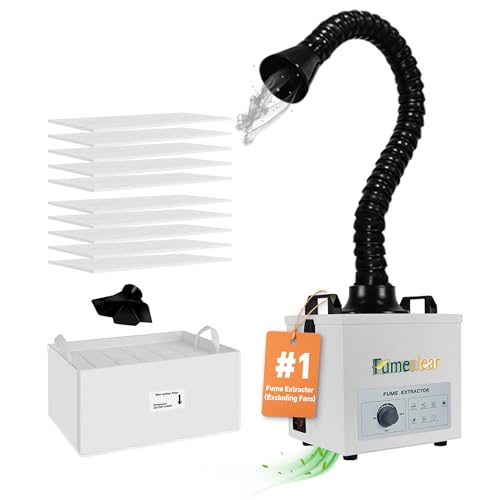
The FumeClear FC100A fume extractor is designed for small bench soldering and similar tasks. It features a maximum no-load power of 100W and claims a 99.97% purification rate for particles below 0.3 microns, providing strong filtration for fumes and smoke generated during soldering or light welding. Its three-layer filtration and pre-filter design aim to capture both large and fine particles while offering longer filter life when paired with the included pre-filters. Note that for larger laser engraving or heavy-duty welding, higher-capacity models may be required.
Considerations: Pros include compact size, high filtration efficiency, and multi-layer filtration. Cons may include suitability limitations for high-volume, heavy-duty welding environments. Users should ensure the unit’s airflow matches their workspace size and expected contaminant load.
WEN AF1270 4.2-Amp 3-Speed Air Filtration System
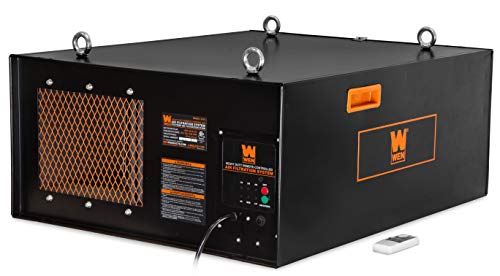
The WEN AF1270 offers remote-controlled operation with three speed settings (750, 950, 1270 CFM) to adapt to room size and filtration needs. It’s designed for larger shop spaces, claiming coverage for rooms up to 1000 square feet and an airflow rate that supports frequent welding or grinding tasks. The model ships with a 1-micron filter and a 5-micron pre-filter that are replaceable, allowing ongoing maintenance at a reasonable cost. The system’s noise level is moderate, so it fits typical workshop environments without excessive disruption.
Considerations: Suitable for mid-to-large spaces and for users who need adjustable airflow. The higher noise at peak settings and ongoing filter replacement costs are practical factors to weigh when planning shop layout and budget.
WEN 3417 3-Speed Air Filtration System
The WEN 3417 filtration system provides three airflow speeds and replaceable 1-micron and 5-micron filters, making it a practical option for hobbyist to small-shop environments. Its dimensions and electrical requirements are standard for many workshop setups, and the unit supports coverage for areas around a thousand square feet. The programmable timer feature adds a layer of energy efficiency by automatically shutting the unit off after a chosen duration, helping to balance filtration needs with operating costs.
Considerations: Efficient for mixed workshop environments with multiple tasks. Noise levels and filter replacement frequency should be evaluated relative to shop noise tolerance and ongoing maintenance plans.
ALORAIR 2 Stage 270° Intake 780IG Air Filtration System

The ALORAIR 780IG filtration system features a 270° intake design and a built-in ionizer to help reduce odors and improve air quality in woodworking and metalworking areas. It uses a strong vortex fan to sustain airflow even as filters become loaded, providing robust filtration during long sessions. With two-stage speed control and a focus on large-area coverage (up to roughly 800 sq ft), this unit is suitable for mid-sized shops seeking effective particle capture and odor reduction.
Considerations: Ionizer can help with odor and fine particles, but some users prefer systems without ionization due to sensitivity or ozone concerns in certain environments. The model’s noise level and installation footprint should be considered in shop planning.
ABESTORM DecDust 1350IG Air Filtration System

The ABESTORM DecDust 1350IG offers 360-degree intake with a built-in ionizer and a strong vortex fan for high-volume air movement. It includes four replaceable MERV-11 filters and remote control for convenience, making it well-suited for woodshop and metalworking environments where dust and fine particles are generated. The combination of remote operation and a large intake design supports efficient filtration in larger spaces or workshop corners that tend to accumulate dust and fumes.
Considerations: The multiple filtration layers and ionizer are advantageous for comprehensive air cleaning, but initial setup and ongoing filter replacements should be planned in the shop budget. The unit’s size and placement require adequate floor space or mounting options.
Buying Guide
Several factors determine the right welding air filtration system for your shop. Consider these perspectives to balance performance, cost, and practicality:
- Room size and airflow needs: Larger spaces require higher CFM (cubic feet per minute) ratings and more robust filtration stages. Match the unit’s coverage to your workshop square footage.
- Filtration stages: Three- to five-layer filtration systems typically provide better capture of welding fumes, odors, and fine particulates. Look for HEPA-like filters with activated carbon for gas absorption when fumes are a concern.
- Noise and comfort: Filtration units can produce noticeable noise, especially at higher speeds. Consider a model whose noise level fits your tolerance and work style.
- Maintenance and cost of filters: Replacing filters is an ongoing cost. Check the availability, replacement frequency, and price of filters in your region before purchase.
- Special features: Ionizers, remote control, timers, and built-in lamps or viewing aids can add convenience. Be mindful of ozone-sensitive environments if ionizers are included.
- Integration with welding gear: For welders using PAPR helmets, integrated respirators can complement filtration systems, but ensure compatibility and proper usage to avoid redundancy.
- Portability and installation: If you need to move the unit between workstations, prioritize wheeled models or compact designs with easy setup.
When evaluating options, compare the combination of filtration efficiency (percent capture of sub-micron particles), airflow capacity, filter replacement intervals, and power requirements. For metalworking environments, prioritizing higher CFM and multi-stage filtration helps maintain healthier air over longer shifts.
Add a Comment