Choosing a reliable variable speed peristaltic pump is essential for accurate liquid handling in labs, medical devices, and industrial applications. This guide highlights five top options with adjustable flow rates and RPM ranges, helping you compare performance, control interfaces, and tube compatibility. Each product below includes key features, a clickable Amazon link, and a quick visual reference to aid your decision.
Summary of selected models:
| Product | Flow Range | Speed Range | Tube Size (ID x OD) | Notable Feature |
|---|---|---|---|---|
| INTLLAB BT100 | 0.06–360 mL/min | 0.1–100 rpm | 17# tubing | User-friendly interface |
| Kamoer DIP1500 | ≤1500 mL/min | 0.1–400 rpm | S18# 7.9 mm ID × 11.1 mm OD | 3 rotors, LED display |
| TTeralmon Variable Speed | 0.07–380 mL/min | 0.1–100 rpm | #17 Tube (13.1 ft) | LED speed/status display |
| Kamoer DIPump-KK300 | ≤300 mL/min | 0.1–400 rpm | 4 rotors; S16# tubing | Fast tube change |
| Golander BT100S | 0.006–570 mL/min per channel | Variable per channel | Multi-channel capable | Stainless steel housing |
INTLLAB BT100 Variable Speed Peristaltic Pump
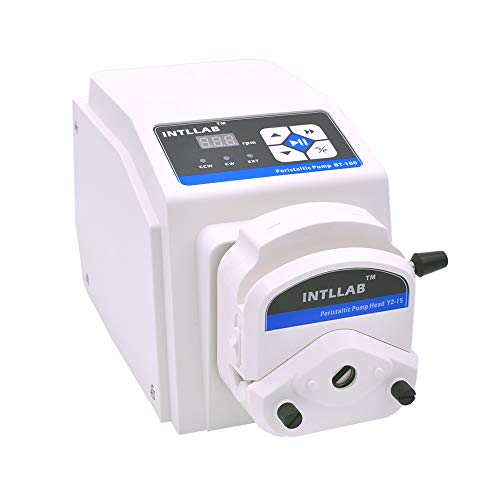
INTLLAB’s BT100 offers precise speed control with a range from 0.1 to 100 rpm and a high flow rate up to 360 mL/min. The device emphasizes a user-friendly interface designed for straightforward operation and reliable liquid transfer, supported by a compact form factor suitable for benchtop setups. The included 2 meter 17# tubing helps ensure ready-to-use performance out of the box. Applications include dosing, sampling, and general liquid handling across research and industrial settings.
Kamoer DIP1500 Peristaltic Pump

The DIP1500 from Kamoer is a high-flow, intelligent variable-speed pump, capable of up to 1500 mL/min with a 0.1–400 rpm range. It employs a long-life stepper motor and a digital LED display to show speed and flow in real time. The unit supports 3 rotors and easy tube changes with standard S18# silicone tubing (7.9 mm ID × 11.1 mm OD). With 24 V DC power and a compact, portable design, it suits lab dosing, chemical transfers, and biological applications where precision and throughput matter.
TTeralmon Variable Speed Peristaltic Pump

This model combines a driver, pump head, and hose into a compact unit delivering 0.07–380 mL/min flow and 0.1–100 rpm. The LED display makes it easy to monitor speed and status, while the ergonomic control panel and clamps simplify setup and adjustments. A recommended choice for quick-fill/empty workflows, TTeralmon emphasizes convenient operation and reliable performance for routine metering tasks across laboratory and industrial environments.
Kamoer DIPump-KK300 4 Rotors

The DIPump-KK300 features four rotors and a speed range of 0.1–400 rpm with flow up to 300 mL/min. It uses a 24 V motor with a compact footprint and a digital display for instant speed and flow rate. The pump supports quick tube changes and is designed for precise dosing in laboratory and production settings. It is compatible with Norprene tubing and includes practical controls for start/stop and direction changes, supporting robust metering and dosing tasks.
Golander BT100S Basic Variable Speed Pump

Golander’s BT100S provides multi-channel capability with a fast, adjustable flow range from 0.006 to 570 mL/min per channel. It operates on 85–285V AC power with reversible direction and built-in parameter storage for repeatable dispensing. Stainless steel housing adds durability and resistance to solvents, making it a practical choice for multi-channel pumping tasks, batch processing, and routine metering in challenging environments.
Kamoer KCP PRO2 40–210 mL/min

The KCP PRO2 is a compact 12 V peristaltic pump offering 40–210 mL/min with an adjustable speed range. It uses a Norprene tubing option and features a knob for adjusting run direction and flow, making it user-friendly for quick dosing experiments and routine liquid transfers. The device emphasizes straightforward operation, precise control, and dependable performance in lab settings where space is limited.
Buying Guide: Key Purchase Considerations
When evaluating variable speed peristaltic pumps, consider these factors to choose the right model for your needs:
- Flow rate and speed range: Align the pump’s maximum flow and rpm with your target dosing or transfer requirements. Higher max flow is useful for bulk transfers, while precise, low flow matters for microdosing.
- Tube compatibility: Verify the recommended tube size (ID × OD) and material. Common options include silicone and Norprene, each with different durability and chemical resistance.
- Control interface: LED displays, digital readouts, and user-friendly controls improve repeatability. Some units offer external control inputs for automated workflows.
- Number of channels: Multi-channel pumps enable simultaneous dosing parallel streams or multi-sample processing, increasing throughput.
- Power and noise: Check voltage requirements, current, power consumption, and noise level, especially for quiet lab environments or around sensitive equipment.
- Durability and build: Stainless steel or rugged housings increase solvent resistance and longevity in challenging environments.
- Maintenance and tube replacement: Consider how easy it is to replace tubes and perform routine maintenance, as this affects uptime and total cost of ownership.
- Software and calibration: Some models provide calibration routines, flow verification, and reverse flow or back-suction features for precise dosing.
Overall, selecting the right variable speed peristaltic pump involves balancing flow needs, control precision, tubing compatibility, and practical considerations like space and maintenance. The five models highlighted here provide a range of capabilities—from compact, entry-level units to higher-flow, multi-rotor configurations—across common lab and industrial scenarios. Use the comparison points above to identify which pump best fits your metering and transfer workflows.
Add a Comment