Answering your search for reliable vacuum investing casting machines, this guide highlights five top options that balance performance, durability, and value. These machines are suited for jewelers, metalsmiths, and hobbyists working with rings, pendants, and small molds. Each pick targets a common buyer profile—beginners seeking clarity, professionals needing consistent results, and small studios aiming for a compact, all-in-one setup. Below is a quick comparison table of the featured models to help you decide fast.
| Product | Best For | Key Strength | Notable Limitation |
|---|---|---|---|
| VEVOR Vacuum Investing Casting Machine (290W) | Beginners and hobbyists | Top oil port access and precise gauge | Smaller power compared with larger units |
| lakimi Vacuum Investing Casting Machine CM01 | Detail-focused jewelers | Sturdy 2L chamber and clear gauge | Standard 2L capacity; for smaller molds |
| VEVOR Vacuum Investing Casting Machine with Melting Furnace | Small studios needing all-in-one | Melting, vacuuming, molding in one | Melting furnace integrated; separate components still required for full setup |
| HAADID Vacuum Investing Casting Machine CM01 | Professional ring and pendant makers | Ergonomic design and real-time pressure readout | Limited to 2L chamber |
| GEMKIT Vacuum Casting Machine 2L HH-CM01 | Versatile workshop users | 11x11in workbench with durable chamber | Bell jar size may limit very large castings |
VEVOR Vacuum Investing Casting Machine (290W)

The VEVOR 290W model is designed for straightforward casting tasks with a focus on efficiency. It features a large thickened vacuum hood and a 3 CFM pump to rapidly extract air, reducing bubbles and surface burrs for smoother dies. An upgraded oil filling port located on top simplifies maintenance without removing the back panel. A precision pressure gauge provides clear vacuum readings, enabling accurate adjustments for bubble-free results. This unit is best for beginners and small studios that need a compact, reliable machine for standard jewelry molds.
Best for: Jewelers starting out or hobbyists who want a simple, observable vacuum process and easy oil maintenance. Better for small rings, pendants, and small resin molds.
Caution: Oil not included; plan for compatible vacuum oil and routine oil level checks to maintain performance.
lakimi Vacuum Investing Casting Machine CM01

The lakimi CM01 emphasizes durability and precision with a heavy-duty molded plastic vacuum hood that minimizes trapped air and defects. It packs a 110V, 375W motor and a 2L pump inside an 11 x 11 inch work surface, offering ample room for rings, pendants, and small wax molds. A built-in, easy-to-read pressure gauge allows real-time monitoring for bubble-free results, making it suitable for silver, gold, brass, and resin molds. This model suits jewelers who cast several small pieces per session.
Best for: Detail-oriented jewelers and artists who need reliable bubble control on moderate-sized molds. Choose this if you prioritize a sturdy chamber with clear pressure feedback.
Limitation: 2L chamber capacity may constrain larger molds or multi-piece casts in a single cycle.
VEVOR Vacuum Investing Casting Machine With Melting Furnace

This all-in-one VEVOR unit combines melting capabilities with vacuum casting and molding. It features a 3 CFM vacuum system that aggressively removes air, improving surface quality on dies and casts. The top-mounted oil port simplifies oil changes, avoiding panel removal. The integrated design aims to streamline workflows for makers who want to consolidate melting and casting in one station, which can save space in small studios.
Best for: Small studios seeking an integrated workflow for melting and casting without swapping machines. Choose this if you want to minimize equipment clutter while maintaining quality control.
Caution: Oil not included; ensure you source compatible vacuum oil and follow safe operating temperatures during melting.
HAADID Vacuum Investing Casting Machine CM01

The HAADID CM01 focuses on ergonomic design and real-time pressure control. Its aerospace-grade renewable components reduce burrs and air bubbles, while the metal air switch minimizes hand fatigue during long sessions. The unit includes a 2L air pump and an 11 x 11 inch workbench, suitable for rings, pendants, and small molds. Real-time gauge visibility supports precise adjustments for bubble-free finishes on precious metals like silver and gold.
Best for: Professionals who cast detailed jewelry pieces and require smooth, mirror-like finishes. Choose this if precise, real-time vacuum control is a top priority.
Limitation: 2L chamber capacity may restrict larger batch casts or bigger molds within one cycle.
GEMKIT Vacuum Casting Machine 2L HH-CM01
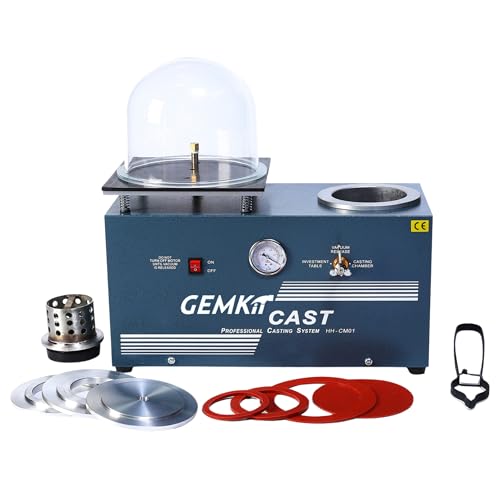
The GEMKIT 2L HH-CM01 provides a compact, professional option with an 11×11 inch workbench and a durable 3 CFM pump. The 11 x 7.8 inch bell jar design is paired with a spacious work area to accommodate various mold sizes, making it versatile for lost-wax casting and small metal projects. The durable chamber and strong suction ensure bubble-free results for delicate molds and fine details.
Best for: Jewelers and artists who need a versatile, mid-capacity unit capable of handling multiple small pieces per cycle. Choose this if you require a larger bell jar than typical 2L units but still want a compact footprint.
Limitation: Bell jar dimensions may limit very large casts; plan mold sizes accordingly.
Buying Guide
What to look for when choosing a vacuum investing casting machine:
- Chamber capacity: 2L vs 4L affects the size and number of molds per cycle. Larger chambers suit bigger pieces, smaller chambers suit delicate, intricate inserts.
- Vacuum power and gauge: A higher CFM pump and a clear pressure gauge help achieve bubble-free surfaces and repeatable results.
- Oil port design: Top-mounted oil ports simplify maintenance; ensure oil is readily available and compatible with your unit.
- Integrated melting: All-in-one machines save space but may limit upgrade paths. Consider whether you prefer separate melting and casting equipment for flexibility.
- Ergonomics and build quality: Durable hoods, ergonomic switches, and clear displays reduce fatigue and improve control during long sessions.
- Compatibility with metals: For precious metals like gold and silver, ensure the unit reaches appropriate casting temperatures and provides stable vacuum control for smooth surfaces.
- Maintenance needs: Oil changes, panel access, and parts availability affect long-term reliability and cost.
- Studio workflow: If you cast frequently, prioritize models with faster cycle times and easier oil changes to minimize downtime.
Frequently Asked Questions
- What is a vacuum investing casting machine used for?
Answer: It removes air from the mold to minimize bubbles and surface defects, producing smoother castings for jewelry and small metal parts. - Is a separate melting furnace necessary?
Answer: Not always. Some models combine melting and casting in one unit, offering space savings but potentially limiting flexibility compared to separate equipment. - What does a 2L vs 4L chamber mean for my projects?
Answer: A 2L chamber handles smaller pieces and molds; a 4L chamber accommodates larger molds and multiple pieces per cycle. - Do I need special oil for these machines?
Answer: Yes. Most models use vacuum oil that matches the pump design. Oils are not included in some listings and must be supplied separately. - Can these machines cast precious metals?
Answer: Many models are designed for precious metals like silver and gold, provided you operate within recommended temperatures and vacuum levels. - What are common maintenance tasks?
Answer: Regular oil top-ups, inspecting hoses, cleaning the bell jar, and checking the vacuum gauge for accurate readings.
Add a Comment