Answering the demand for reliable pipe inspection tools, this guide highlights top ultrasonic and related nondestructive testing (NDT) devices ideal for plumbers, industrial maintenance teams, and quality control professionals. The selected products cover flaw detection, thickness measurement, leak locating, and access to hard-to-reach areas. Each entry explains who benefits most, why it’s a strong pick, and a practical caveat to consider.
| Product | Best For | Key Benefit |
|---|---|---|
| GOYOJO GUF750 | Industrial inspectors and metal fabricators | High-bandwidth UT with detailed flaw mapping |
| Fafeicy Digital Pipe Thickness Meter | Maintenance techs needing metal/plastic coatings thickness | Accurate 1–320 mm range with fine resolution |
| PQWT L2000 Outdoor Pipe Water Leak Detector | Field crews locating outdoor leaks | 5 m depth capability with spectrum display |
| SKYBASIC Industrial Endoscope | Inspections in blocked or hard-to-reach pipes | 4.3″ display with 8 LED lighting |
| oOWYCjQX Ultrasonic Flaw Detector Oblique Probe | Welds and structural piping | Oblique 2.5P13x13 probe for transverse flaw detection |
GOYOJO GUF750 Ultrasonic Flaw Detector
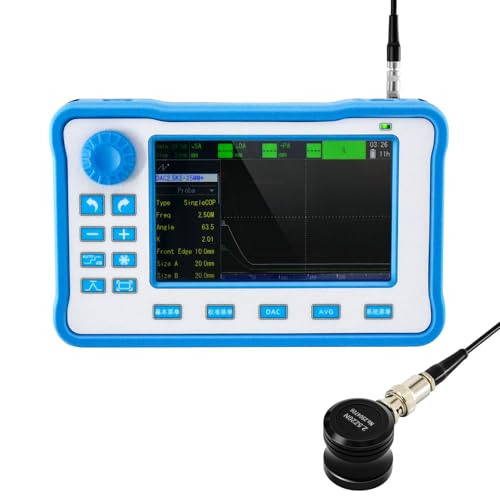
The GOYOJO GUF750 is designed for precision UT performance in metal defect detection. It supports a wide 0.1–20 MHz bandwidth and 100 MSPS hardware sampling, delivering fine-grain defect resolution up to sub-millimeter scales. This makes it a strong choice for in-process inspections and quality control. It is best for metal fabrication shops and field inspectors needing robust waveform analysis and high sampling rates.
Who it’s best for: mid-to-large size facilities and qualified technicians who require high-resolution flaw characterization and cross-sectional imaging. Why selected: the combination of dual-gate alarms, RF/full-wave demodulation, and standards compliance (AWS D1.1, NB/T 47013, GB/T 11345) supports rigorous inspection workflows. Caution: data handling requires familiarity with B-scan maps and image exports, which may have a learning curve for new users.
allsun Ultrasonic Leak Detector Stethoscope Kit
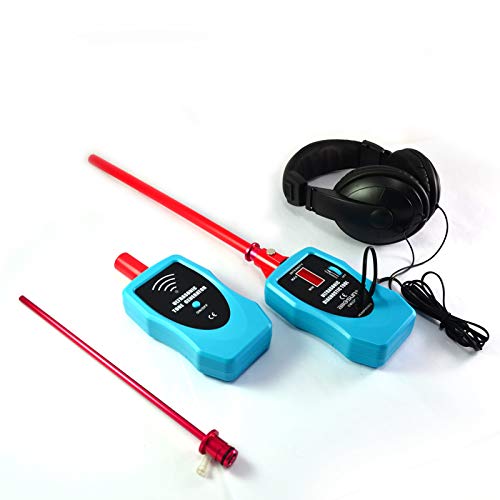
The allsun kit focuses on leak detection using ultrasonic feedback. It combines directional probes with a stethoscope-style listening approach to identify leaks or mechanical faults, such as bearing wear or valve leaks. It’s a practical choice for commissioning and maintenance teams that routinely verify piping integrity in facilities where leaks are a priority concern.
Who it’s best for: field technicians performing quick leak surveys and those needing dual-probe options for both air/pressure-related and internal machine diagnostics. Why selected: the dual-probe setup supports multiple inspection scenarios, and the instrument’s audio-visual cues aid rapid localization. Caution: this device is not a dedicated thickness or flaw detector for material defects; use it alongside other UT tools for a complete assessment.
PQWT L2000 Outdoor Pipe Water Leak Detector

The PQWT L2000 is designed for outdoor pipeline leak detection with a focus on environmental resilience. It operates at a depth capability of up to 5 meters and uses a single, versatile sensor to capture acoustic signals. The device outputs a spectrum and signal bars on screen while providing audible feedback through headphones, enabling operators to pinpoint leaks visually and aurally.
Who it’s best for: field crews working on buried or exposed pipelines in outdoor settings. Why selected: the depth capability and spectrum visualization support efficient, non-invasive leak localization across varied terrains. Caution: outdoor conditions can introduce background noise; proper setup and signal differentiation are essential to avoid misinterpretation.
Fafeicy Digital Pipe Thickness Meter

The Fafeicy thickness meter covers 1–320 mm with ±0.01 mm resolution, suitable for measuring metal and plastic coatings on steel, aluminum pipes, and plastics in industrial environments. Its user-friendly display and simple calibration support quick setup, making it a practical choice for technicians who need reliable wall-thickness data and coating measurements in one handheld device.
Who it’s best for: maintenance teams performing periodic wall-thickness checks and coating assessments. Why selected: the broad measurement range and precision help prevent over- or under-thickness interpretations. Caution: the device’s performance depends on proper probe contact; users should ensure proper calibration and surface preparation for accurate readings.
Ultrasonic Flaw Detector Oblique Probe 2.5P13*13

The oblique probe version of the ultrasonic flaw detector targets transverse wave inspections for steel pipe welds and steel structures. The oblique geometry helps access weld roots and complex joint geometries where conventional probes struggle. It is best for weld inspection and structural integrity checks in piping systems and steel frames.
Who it’s best for: experienced NDT technicians working on welded joints and pipe welds in challenging layouts. Why selected: the oblique 2.5P13x13 configuration enables better orientation for transverse flaw detection. Caution: the probe accessory is a specialized option; ensure compatibility with your existing UT instrument and workflow before ordering.
Ultrasonic Flaw Detector Oblique Probe 5P 13×13 K1
This oblique probe variant similarly targets UT transverse wave inspections for welds and structures with a 5P 13×13 configuration. It offers a similar application niche—optimal for weld and crack detection in steel piping and structural steel—serving professionals who need to adapt to complex geometries.
Who it’s best for: specialists who require alternative oblique probe configurations for specific joint designs. Why selected: the oblique approach often yields clearer flaw visualization in tight joints. Caution: similar to other probes, verify compatibility with your UT system and any accessory requirements before purchasing.
Buying Guide
- What type of inspection do you perform most? If metal flaw detection and thickness mapping are primary, prioritize UT flaw detectors like GOYOJO GUF750 or oblique-probe options for welding joints.
- What environment will you work in? Outdoor leak detection (PQWT L2000) benefits from rugged design and clear spectrum readouts; internal facility surveys may favor more compact units like the Fafeicy thickness meter.
- Need real-time visualization or audio cues? Leverage devices with dual feedback modes (visual graphs plus audible signals) for faster localization when noise is present.
- What materials will you test? For metals with coatings, ensure the device supports high-resolution thickness readings and compatible coating interpretation.
- Learning curve and data handling: some high-bandwidth UT instruments export complex data (A/B scans, thickness maps). Consider training time and data management needs when selecting.
Frequently Asked Questions
- What is ultrasonic flaw detection primarily used for in pipes? Answer: It detects internal and surface flaws such as cracks and inclusions, and measures wall thickness to assess structural integrity.
- Is a thickness meter sufficient for pipe inspections? Answer: It’s essential for verifying wall thickness and coatings, but for a full assessment you may need a dedicated UT flaw detector and, in some cases, a leak detector.
- When should I use an oblique probe? Answer: Use an oblique probe to access weld roots and complex geometries where standard probes don’t provide clear flaw indications.
- How important is environmental ruggedness? Answer: Outdoor inspections benefit from rugged devices with clear spectrum displays and weather-resistant housings to tolerate field conditions.
- Do I need multiple devices? Answer: Depending on your workflow, combining a thickness meter with a UT flaw detector and a leak detector provides a well-rounded inspection suite for pipe systems.
Add a Comment