Answering your need to locate tiny leaks quickly, ultrasonic leak detectors powered by vacuum or pressure testing provide precise listening tools for automotive, HVAC, and industrial systems. This guide highlights five reliable options and explains who should choose each model based on sensitivity, versatility, and ease of use. If you’re troubleshooting vacuum leaks, refrigerant lines, or pressurized tanks, these detectors help pinpoint issues fast and reduce downtime.
Overview at a glance: the following table summarizes the five selected models, their typical use cases, and the environment where they perform best.
| Product | Best For | Key Strength | Limitations |
|---|---|---|---|
| Vanlison Ultrasonic Leak Detector | HVAC techs, automotive diagnostics | 38-42 kHz range, lightweight, noise-isolation headset | Compact design may limit heavy-duty use in large plants |
| allsun Pro Ultrasonic Leaking Detector Transmitter Auto | Professional automotive and industrial techs | 36-44 kHz range, transmitter access, LED indicators | Requires listening probe for deep engine sounds |
| INFICON Whisper Ultrasonic Leak Detector | General industrial diagnosis with headphones | Headphone-based listening, reliable in noisy environments | May be less feature-rich than premium kits |
| allsun EM282-R Ultrasonic Vacuum Leakage Detector | On-site automotive and small- to mid-size shop checks | Active/Passive modes, dual LED + ticking tone | Not ideal for very low-pressure systems |
| KAISAL Ultrasonic Leak Detector 40KHz | Home and professional use with portable setup | High sensitivity, adjustable, dual alarm (sound & light) | Wide environment variability can affect accuracy without proper setup |
Each product below is presented with a concise summary of who it is best for, why it was chosen, and a practical caveat to consider during selection. All links open in a new tab to the respective Amazon listing.
Vanlison Ultrasonic Leak Detector

The Vanlison model uses 38-42 kHz ultrasonic waves to pinpoint leaks in air, gas, and water systems. It is compact and light, designed for reliable performance in harsh environments. The included noise-isolation headset helps users hear faint leaks in noisy settings. Best for technicians who need a portable, field-ready detector for automotive diagnostics, HVAC maintenance, and industrial inspection. Choose this if you prioritize a balance of portability and detection range. A potential limitation is that very large facilities may require more extensive sensing coverage.
allsun Pro Ultrasonic Leaking Detector Transmitter
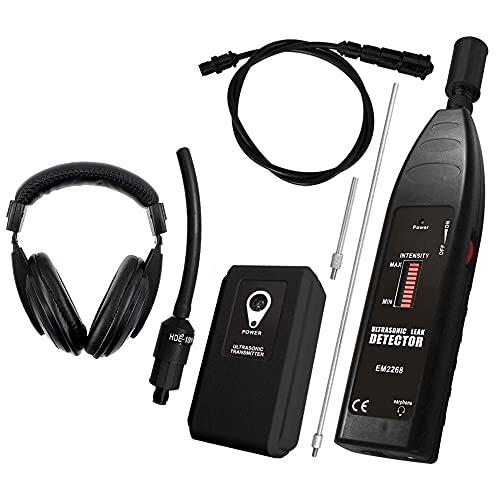
This professional-grade unit targets automotive and industrial applications, using a 36-44 kHz range to locate leaks in engines, compressors, and pressurized systems. It includes a transmitter and an adjustable sound system with LED indicators to visualize leak intensity. Best for users who need a robust solution with clear audible and visual cues. It is especially suitable when you need rapid pinpointing of leaks in complex systems. limitation: may require careful handling to avoid background noise interference in busy shops.
INFICON Whisper Ultrasonic Leak Detector

The INFICON Whisper emphasizes quiet operation with headphones for leak listening. It detects pressure and vacuum leaks for all gases and performs well in noisy environments due to its dedicated listening setup. Suitable for general industrial diagnostics where clear audibility is important. Best for technicians who rely on headphone-based listening in variable environments. Limitation: this model may lack some transmitter-based features found in higher-end kits.
allsun EM282-R Ultrasonic Vacuum Leakage Detector

Designed for automotive and small- to mid-size shop use, the EM282-R offers Active and Passive modes. It detects ultrasonic emissions at around 40 kHz and uses dual LED indicators with a ticking tone to guide the user toward the leak. Best for on-site checks where you need flexible modes and straightforward operation. Caution: it does not work well for low-pressure systems, so ensure your test conditions align with its capabilities before relying on it for delicate equipment.
INFICON Whisper with Accessory Kit

This kit extends the Whisper line with premium headphones, a metal contact probe, a Whisper transmitter, a rubber extension probe, and a rugged carrying case. It remains a reliable choice for detecting both pressure and vacuum leaks across gases, with audible and listening features that suit fieldwork. Best for professionals who want a complete portable package for varied leak scenarios. Limitation: higher initial cost relative to simpler detectors.
Superior AccuTrak VPE PRO Ultrasonic Leak Detector Kit
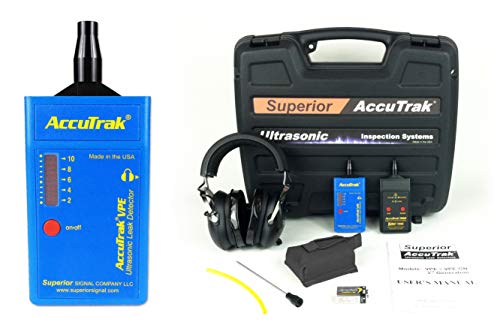
The VPE PRO kit emphasizes audiovisual cues with a 0 Hz to 4 kHz natural sound conversion and a 10-element visual bar graph. It is designed for professionals who need both audible and immediate visual feedback to confirm leaks. Best for users who require quick, multi-sensory confirmation during complex inspections. Caution: larger dimensions mean it’s less portable for tight inspection spots.
KAISAL 40KHz Ultrasonic Leak Detector

This model offers a focused 40 kHz frequency response with adjustable sensitivity and a sound-and-light dual alarm. It is well-suited for home and professional use where portability and quick setup are important. Best for users who want a compact detector with reliable audio-visual feedback. Limitation: highly variable environments may require careful sensitivity dialing for stable results.
Buying Guide: Key Purchase Considerations
What frequency range do you need? Most common leaks respond in the 36–44 kHz range. A broader range supports more leak types but may come with higher cost. Do you need headphones? Models with built-in headphones or the option to attach them provide clearer audible feedback in noisy settings. Is portability important? Tiny, handheld detectors are ideal for fieldwork; larger kits suit workshop environments. Do you require a transmitter or multiple probes? Transmitter-enabled units can test non-pressurized containers, while multi-probe setups help locate leaks in hard-to-reach areas. Consider the environment: HVAC, automotive, and industrial settings have different sound profiles and background noise that affect detection. Finally, assess whether you need a visual indicator (LEDs or bar graphs) in addition to audible signals for quick cross-checks on busy job sites.
Frequently Asked Questions
- What is an ultrasonic leak detector used for? It detects high-frequency sounds created by escaping gas, air, or vacuum leaks, helping identify leak points in automotive, HVAC, and industrial systems.
- Why would I choose a detector with a headset? Headsets improve audible clarity in noisy environments and allow you to focus on faint leak sounds without external distractions.
- Can these devices detect leaks in vacuum systems? Yes, many models detect both pressure and vacuum leaks, depending on operating mode and sensor sensitivity.
- Do all detectors require an external transmitter? No; some models are standalone, while others include transmitters to test non-pressurized containers or sealed areas.
- What should I consider for portable field use? Look for compact size, lightweight design, long battery life, and simple controls with clear indicators.
- Are there limitations in detecting leaks under low pressure? Some detectors are not optimized for very low-pressure environments; verify the product’s documented range before use.
Add a Comment