If you need a hoist that works in restricted spaces, an ultra low headroom hoist is the right choice. These units maximize hook travel and minimize space taken on the beam, making them ideal for cramped workshops, maintenance bays, and compact mezzanines. This guide highlights five top options, explains who each is best for, and outlines key buying considerations. Whether you’re outfitting a small fabrication shop or upgrading a crane rail in a service bay, you’ll find practical, space-saving choices here.
| Product | Best For | Headroom Note |
|---|---|---|
| Harrington SHB Series Ultra-Low Headroom Manual Hoist (1 Ton) | Small spaces with light to moderate loads | Very low headroom for maximum travel |
| Vestil LOW-1G Steel Low Headroom Chain Hoist | Constrained vertical spaces, short lifts | Low headroom design, 10 ft lift |
| Vestil LOW-1P Steel Low Headroom Chain Hoist Push Trolley | Compact rails with push trolley operation | Low headroom, 10 ft lift |
| Vestil LOW-6P Steel Low Headroom Chain Hoist Push Trolley | Higher capacity needs in tight spaces | Low headroom, 10 ft lift |
| Harrington SHB Series Ultra-Low Headroom Manual Hoist (2 Ton) | Moderate to heavy loads in tight spaces | Extremely low headroom, 20 ft lift |
Harrington SHB Series Ultra-Low Headroom 1 Ton Hoist
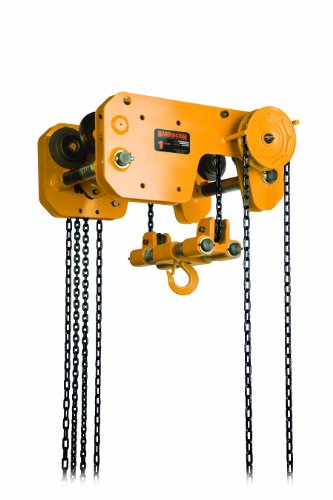
Best for small shops and light- to medium-duty tasks where floor-to-hook travel must be maximized. This 1 ton capacity hoist uses an ultra-low headroom design to provide more hook travel within the same beam footprint. The all-steel construction suggests durability for daily lifting cycles in controlled environments.
Who this is for: mechanics, small fabrication shops, and maintenance crews that frequently operate in constrained bays. Why selected: it delivers the most effective use of vertical space among 1-ton compact hoists.
Caution: Headroom performance is optimized for standard beams; verify beam type and rail dimensions before installation.
Vestil LOW-1G Steel Low Headroom Hoist

Best for installations where space is at a premium and a 1,000 lb capacity is sufficient. Its compact steel design supports dependable operation in tight spots, with a vertical lift around ten feet. The low headroom profile helps maximize hook travel in narrow aisles or overhead bays.
Who this is for: small maintenance departments and light manufacturing lines. Why selected: balance of compactness and reliability, with straightforward operation.
Caution: Rated capacity is 1,000 lbs; avoid exceeding the limit during lifts with bulky loads or leverage requirements.
Vestil LOW-1P Low Headroom Hoist Push Trolley

Best for installations needing a push trolley with minimal overhead footprint. The low headroom design fits into tighter rails while delivering a 1,000 lb lifting capacity. It complements environments where manual control is preferred and beam space is limited.
Who this is for: service bays and repair shops that rely on regular, straightforward lifting without power assistance. Why selected: combines compact headroom with reliable trolley movement.
Caution: Push trolley operation may require additional space for safe manual control in crowded areas.
Vestil LOW-6P Low Headroom Push Trolley Hoist

Best for higher-capacity needs in constrained spaces. This 6,000 lb capacity hoist offers the same space-saving headroom benefits while handling heavier loads. Its compact form still emphasizes snag-free operation on narrow beams and in confined shops.
Who this is for: larger maintenance departments and light manufacturing lines that require more lifting power without sacrificing headroom. Why selected: supports heavier tasks while preserving space efficiency.
Caution: Larger loads demand precise rigging and beam support; confirm rail specs and safety clearances before use.
Harrington SHB Ultra-Low Headroom 2 Ton Hoist

Best for moderate to heavy loads in tight spaces where crane rail dimensions limit traditional hoists. This model features an ultralow headroom and an efficient drive train to reduce operating effort. Trolley wheels accommodate both tapered and flat flanged beams for flexible installation.
Who this is for: facilities that frequently lift heavier items in restricted bays or on compact beam configurations. Why selected: expands ultra-low headroom benefits to a higher capacity tier.
Caution: Ensure the beam width and flange type match trolley compatibility to avoid misfit on installation.
Buying Guide: Ultra-Low Headroom Hoists
What is ultra-low headroom and why does it matter?
Ultra-low headroom refers to hoists designed to minimize the clearance above the hook, maximizing vertical travel within a given beam footprint. This is crucial in spaces with limited overhead clearance, such as low ceilings, mezzanines, or dense workshop layouts.
Key factors to consider
- Capacity: Choose a model that matches the heaviest anticipated load with a safe margin.
- Headroom and lift height: Ensure the headroom specification supports your required hook travel and starting height.
- Rail and trolley compatibility: Check beam type (tapered vs flat flange) and confirm trolley wheel compatibility.
- Manual vs powered: Determine whether you need hand operation or a powered option for repetitive lifts.
- Construction and durability: All-steel construction typically offers robust long-term use in industrial settings.
- Maintenance: Consider available service support, parts, and ease of inspection for safety.
Selecting by use case
- Small shops with frequent light lifts: prioritize ultra-low headroom and ease of operation (1–2 tons).
- Maintenance bays with restricted height: favor compact designs and 10 ft lift ranges for routine tasks.
- Higher capacity needs in tight spaces: look at 6,000 lb options with low headroom to balance power and space.
Installation and safety tips
- Verify that the beam, rail, and trolley are rated for the hoist’s capacity and dimensions.
- Ensure proper alignment and secure anchoring to prevent misalignment or drift during lifting.
- Follow local safety standards for hoist use, including load securing and operator training.
FAQ
- What is the advantage of ultra-low headroom hoists? They maximize hook travel in restricted spaces, enabling more efficient lifting in tight environments.
- Can I mix different headroom hoists on the same beam? It depends on beam compatibility and trolley design; ensure consistent rail dimensions and safe operating clearances.
- Are manual hoists safer than powered ones? Safety depends on use case; manual hoists require proper operation and training, while powered units reduce operator effort but need electrical safety checks.
- What load capacity should I choose for future needs? Choose a capacity that covers current loads with a reasonable margin for anticipated growth and peak tasks.
- Do these hoists require special maintenance? Regular inspection of chains, hooks, and rails is recommended; follow manufacturer maintenance guidelines.
- Can ultra-low headroom hoists work with different beam types? Yes, but verify wheel design and flange compatibility with tapered or flat beams.
Add a Comment