Find the right surface roughness testing machine for precise, on-site measurements. This guide highlights five top options, suited for professionals in manufacturing, quality control, and field inspections. Each model supports key roughness parameters, clear displays, and portable design to fit production environments. Choose this overview if you need reliable data for machined parts, cylinders, or complex surfaces on the shop floor or in the field.
Summary of selected products
- SUNNYSONG KR310 — Best for production floors needing a handheld, multi-parameter roughness tester with detachable drive.
- GOYOJO GSR720 — Best for portable, high-accuracy roughness measurements with rapid readings and broad applicability.
- AMTAST AMT220 — Best for versatile, color-mapped results and ISO/DIN/JIS compatibility in a compact profilometer.
- AMTAST AMT221 — Best for color-mapped data, flexible measurement directions, and real-time processing on the go.
- SUNNYSONG kR220 — Best for field work with 22 parameters and real-time graphics for large workpieces.
Sunnysong Kr310 Surface Roughness Tester

Best for production environments requiring a handheld instrument that measures a wide range of machined parts with clear parameter display and contour graphics. This model supports external and plane surfaces, bores, grooves, and tapered forms, with international-standard parameters as a core capability. It excels in fast measurements with stable accuracy and easy portability.
Who it’s best for: quality engineers and technicians who need a durable, all-in-one roughness tester on the shop floor. Why selected: it provides comprehensive measurement data and compatible sensors for special surfaces, enhancing workflow efficiency on busy lines.
Caution: some specialized surface geometries may require additional sensors; verify compatibility for your part shapes before purchase.
GOYOJO Surface Roughness Gauge Portable Digital Ra, Rz, Rq, Rt

Best for users who require a versatile handheld gauge with a broad measuring range and high-precision readouts. It covers Ra, Rz, Rq, and Rt with a tight display accuracy of 0.01 μm and a repeatability figure that supports reliable trending over time. The compact design makes it ideal for fieldwork and quick checks on diverse finishes.
Who it’s best for: technicians needing a compact, easy-to-read device for quick checks on various finishes. Why selected: strong balance of range, precision, and portability.
Caution: accuracy claims depend on proper calibration and consistent surface interaction; ensure calibration blocks are used regularly for critical audits.
AMTAST AMT220 Surface Roughness Meter Digital Profile Meter

Best for users who need a modern profilometer with 22 parameters and a color-mapped display for intuitive analysis. The design emphasizes portability with a lightweight shell and a DSP-driven data workflow, aligning with ISO, DIN, ANSI, and JIS standards. It also supports optional accessories like sensors and mini printers for extended applications.
Who it’s best for: professionals who value quick, visual interpretation of roughness data and flexible accessory options. Why selected: the color mapping and portable profile meter enhance decision speed in production and inspection tasks.
Caution: ensure the included sensors or optional accessories align with your measurement tasks to avoid gaps in capability.
AMTAST AMT211 Surface Roughness Meter Digital Profile Meter

Best for a compact measurement solution that combines a lightweight profile-meter design with flexible measurement directions. It supports adjustable measurement directions via a removable drive unit, enabling vertical and lateral positioning for diverse surfaces. DSP-based processing delivers fast results with low power consumption.
Who it’s best for: on-site technicians needing a portable instrument with adaptable measurement orientation. Why selected: its removable drive and flexible positioning suit curved or uneven features on the go.
Caution: the device relies on proper drive alignment for accurate directional measurements; verify setup before data collection.
GOYOJO GSR720 Surface Roughness Tester
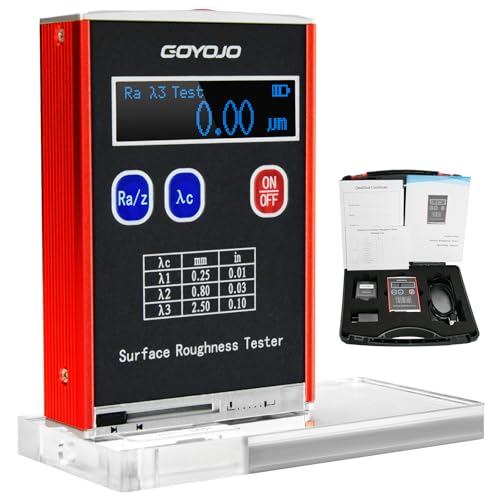
Best for professionals who need a portable roughness tester with high accuracy and comprehensive parameter support, including Ra, Rq, Rz, and Rt. It is designed to function well on a variety of surfaces, including larger or irregular shapes, with a practical calibration and bracket setup for stable measurements.
Who it’s best for: field inspectors and shopfloor technicians who require dependable data on a range of surfaces. Why selected: robust parameter coverage and compatibility with common calibration practices make it a versatile option.
Caution: performance on unusually large or complex geometry may require a bracket or fixture to ensure stable contact during measurement.
Buying Guide
What to consider when choosing a surface roughness testing machine
- Measurement parameters: Ensure the device supports the key roughness parameters you need (Ra, Rz, Rq, Rt, and others). More parameters offer richer analysis but may increase cost and complexity.
- Portability and use environment: For fieldwork or shop-floor use, prioritize handheld units with lightweight design and durable housing. For bench use, a larger unit with a stable base may be preferable.
- Display and data visualization: Color mapping, graphical contour displays, and easy export options help with quick interpretation and reporting. Consider whether you need PC or printer connectivity.
- Calibration and standards: Look for devices that align with ISO, DIN, ANSI, and JIS standards. Regular calibration blocks and accessories should be available.
- Measurement range and accuracy: Check the ranges for each parameter and the stated accuracy. A broader range is useful for diverse finishes but ensure it matches your typical parts.
- Flexibility and accessories: Removable drives, interchangeable sensors, and adapters can expand applicability to curved, flat, or large workpieces. Confirm compatibility with your typical geometries.
- Ease of use and data processing: A DSP-based processor or equivalent should provide fast, reliable results with low power consumption. A clear display helps operators avoid interpretation errors.
FAQ
Q: What is the most versatile roughness parameter set for general manufacturing?
A: Look for devices offering Ra, Rz, Rq, and Rt, plus options for additional parameters to capture texture variations on different surfaces.
Q: Are handheld roughness testers suitable for field inspections?
A: Yes. Handheld models with portable form factors and robust construction are designed for field use, enabling quick checks on large or in-process parts.
Q: How important is calibration when using a roughness tester?
A: Calibration is essential for accuracy and traceability. Regular calibration with standard blocks ensures measurement consistency across sessions.
Q: Can these devices connect to PCs or printers?
A: Many options offer USB or Bluetooth connectivity and printer support, which helps generate readable reports and log data over time.
Q: What should I avoid when selecting a roughness tester?
A: Avoid devices that have limited parameter sets for your typical parts or lack compatible accessories for your surface geometries. Consider future-proofing with expandable options.
Add a Comment