Direct answer: If you need a pallet jack that fits tight aisles and still handles heavy pallets, a low profile design is ideal. This guide highlights top low profile and narrow fork pallet jacks suited for compact spaces, warehouses, and workshops. The selections prioritize fork height, maneuverability, and load capacity. Best fits: compact warehouses and maintenance shops needing easy pallet entry and stable lifting with durable construction.
Buyer quick-reference table
| Product | Fork Size | Capacity | Notable Feature |
|---|---|---|---|
| Tory Carrier Low Profile Pallet Jack | 48″ L × 27″ W | 3300 lbs | 2″ lower fork height, ergonomic handle |
| APOLLO Low Profile Manual Pallet Jack | 48″ L × 27″ W | 2200 lbs | 3-position hand control, over-load valve |
| Tory Carrier Pallet Jack Truck | 48″ L × 21″ W | 5500 lbs | Leak-proof hydraulic pump, narrow aisle capability |
| Global Industrial Low Profile Narrow Fork | 21″ W × 48″ L | 4500 lbs | Low-profile, narrow fork design |
| NORTHSKY Standard Manual Pallet Jack | 48″ L × 27″ W | 5500 lbs | Narrow design with integrated hydraulic system |
Tory Carrier Low Profile Pallet Jack, 2″ Lower Fork Height

Best for compact spaces and frequent entry/exit through tight aisles. The 2″ lower fork height improves pallet entry when space is limited, while the reinforced steel frame supports heavier loads. The ergonomically designed handle minimizes operator fatigue. This unit is well-suited for maintenance shops, supermarkets, and compact warehouses where maneuverability matters most. Limitation: since capacity is 3300 lbs, extremely heavy loads may require a larger model.
APOLLO Low Profile Manual Pallet Jack

Best for smaller operations needing straightforward lifting with reliable control. The 1.4″ minimum height and 3-position hand control support precise raising, lowering, and neutral positioning. An entry/exit roller and overload valve contribute to smoother travel and long service life. Choose this if you prioritize simple operation and lower fork clearance, but be aware of the moderate 2200 lb capacity for heavier pallets.
Tory Carrier Pallet Jack Truck 5500 lbs

Best for heavy loads and wide applications in warehouses or workshops that require higher capacity. With a 5500 lb load capacity and 7.3″ max lifting height, this unit handles bulky pallets. Features include tapered fork ends with integrated lead rollers for easier pallet entry and a controllable lowering speed. Leaks-proof hydraulic pump and steel construction enhance durability. Limitation: wider forks may reduce manueverability in very tight aisles for some layouts.
Global Industrial Low Profile Narrow Fork Pallet Jack

Best for narrow aisles and precision handling. This model features a low-profile design with 21″ wide forks, allowing safe entry under tighter pallets. The durable finish and a 3-stage fingertip control with a safety loop handle support controlled lifting, neutral, and lowering. An articulated axle helps the load glide over uneven floors. Limitation: narrow forks may limit compatibility with wider pallet configurations.
Global Industrial Industrial Duty Pallet Jack
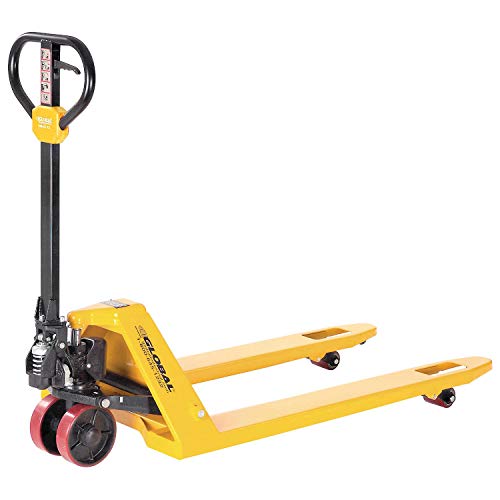
Best for demanding environments requiring higher weight handling and robust construction. This 5500 lb capacity pallet jack uses a reinforced steel frame and a German-engineered pump, enabling reliable lifting and lowering of heavy pallets with ease. It is well-suited for factories, warehouses, and large retail loads. Limitation: the heavier-duty design may be less maneuverable in very tight spaces compared with lighter models.
Buying Guide
Key considerations when selecting a low profile pallet jack:
- Load capacity vs. pallet size: Match capacity to the typical pallet weight and dimensions you handle.
- Fork height and entry: Lower fork height improves entry under pallets in confined spaces.
- Fork dimensions: Narrow forks fit tight aisles; wider forks offer stability for larger pallets.
- Handle and control: An ergonomic or multi-position handle reduces operator fatigue and enhances precision.
- Drive wheels and maneuverability: 3″ to 7″ wheel options influence turning radius and floor compatibility.
- Durability: Consider reinforced frames and leak-proof or robust hydraulic systems for long-term use.
- Maintenance needs: Simpler hydraulic systems can reduce downtime and maintenance costs.
Practical tips for choosing
- When space is the primary constraint, prioritize low-profile and narrow fork models with good entry angles.
- For heavy loads, choose high-capacity models with sturdy frames and reliable hydraulics.
- Consider the environment: steel vs. painted finishes affect durability and corrosion resistance in wet or dusty settings.
FAQ
- What is the advantage of a low-profile pallet jack?
They provide easier pallet entry in tight spaces and can reduce the effort needed to lift loaded pallets. - What fork width is best for narrow aisles?
Forks around 21″ wide are common for narrow-aisle models, while 27″ forks fit standard pallets in wider aisles. - Can a low-profile jack handle heavy loads?
Yes, but check the rated capacity to ensure it meets pallet weight; high-capacity models exist within the low-profile category. - Are hydraulic systems maintenance-heavy?
Most are designed to be low-maintenance, but regular checks on seals and oil levels extend life. - Which model is best for frequent tight-turning tasks?
Narrow fork and articulated-axle designs generally offer better maneuverability in tight spaces. - Is a lighter jack better for daily handling?
Lighter jacks improve ease of use but may have lower capacity; balance weight with required load.
Add a Comment