Choosing a stepper motor driven peristaltic pump means prioritizing precision, repeatability, and chemical compatibility. This guide highlights five strong options that balance accurate flow control, robust construction, and ease of integration for lab, analysis, and small-scale industrial tasks. The top picks appeal to researchers, technicians, and factory operators who need dependable, programmable flow with minimal maintenance. Below, you’ll find a concise buyer’s table, detailed product sections, and a practical buying guide to compare capabilities side by side.
| Product | Best For | Key Benefit |
|---|---|---|
| KPHM400-ST | High-flow dosing | 400 ml/min capacity with fixed tube design |
| KPHM100-STB10 | Reliable mid-range dosing | Stable 0–180 ml/min with 3 rotors |
| KCS 0.01–135 ml/min | High-precision small-volume dosing | Very fine control and low noise |
| M1-STP | Programmable lab workflows | LCD display and multiple operation modes |
| KKTS-24S18 | High-flow industrial tasks | Detachable head and food-grade tube |
Kamoer KPHM400-ST High-Flow Stepper Motor Peristaltic Pump

The KPHM400-ST is designed for large-volume dosing where speed matters. It uses a stepper motor for precise control, delivering up to 400 ml/min. The design fixes the pump tube securely to prevent movement during operation, reducing flow variance. Best for laboratories or process settings that require higher throughput without sacrificing repeatability. The pump head is made from nylon, with PharMed BPT tubing offering general chemical resistance, including acids and alkalis. A practical note: performance depends on temperature and humidity ranges of 0–40°C and below 80% humidity.
Who it’s best for: labs or industrial setups needing higher flow with reliable stepper-based control. Why selected: it provides a clear balance of high flow and predictable dosing while maintaining tube stability during operation. Caution: keep the working environment within specified temperature and humidity to avoid drift in flow or wear.
Kamoer KPHM100-STB10 High-Precision Low-Flow Pump

This model specializes in precise, low-flow dosing. With a 0–180 ml/min range and three rotors, it emphasizes stability and repeatability at smaller volumes. The pump head uses a plastic construction and PharMed-like tubing for chemical resistance. It’s suitable for water-quality analyzers, hypochlorite generators, and large-scale lab or commercial applications needing dependable, controlled transfer. The trade-off is that very high throughput is not its focus; choose this for precise, repeatable low-volume tasks.
Who it’s best for: users needing consistent low-volume dosing with robust stability. Why selected: it offers a compact, steady option that fits tighter spaces while maintaining accuracy. Caution: plastic pump head may limit chemical compatibility with highly aggressive substances; verify your fluid before use.
Kamoer KCS 0.01–135 ml/min Small Peristaltic Pump
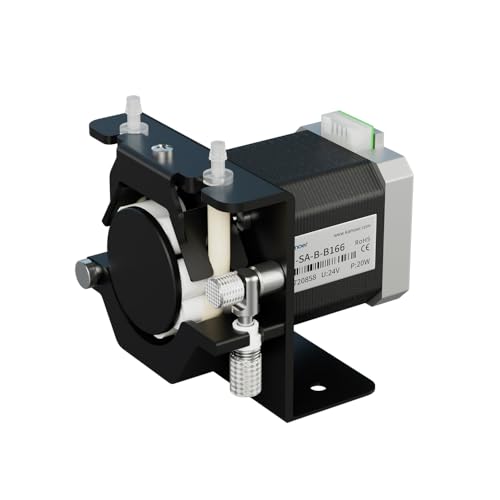
The KCS model emphasizes precision and long life with a 24V stepper motor and a 0.01–135 ml/min adjustable flow. It features six rotors and a quiet operation profile with noise under typical lab conditions. The tubing is BPT, and the tube size is 3.2 mm ID by 6.4 mm OD, making it compatible with a range of chemistries. This pump is ideal for automated dosing in experiments where micro to small-volume transfers are critical.
Who it’s best for: researchers and technicians needing fine, controllable dosing. Why selected: its high-precision flow control and long operation life support sensitive experiments. Caution: the 24V drive and six-rotor configuration may require careful integration into existing control systems; ensure compatibility with your controller.
Kamoer M1-STP Intelligent Peristaltic Pump

The M1-STP adds programmability to peristaltic pumping with a 24V stepper motor and 0–88 ml/min flow. It features an 1.9A drive and a user-friendly 1.8-inch color LCD screen. Modes include time, volume, continuous, and cycle dosing. It supports start/stop, speed regulation, and calibration, making it suitable for labs requiring repeatable sequences and automation. The power draw is modest (<48W), and the unit weighs about 510 g, aiding installation in compact racks.
Who it’s best for: laboratories implementing programmed dosing sequences and automated experiments. Why selected: the improved display, quieter operation, and multiple modes support versatile workflows. Caution: ensure your control system can manage the LCD-based interface and manual calibration steps when deploying new scripts.
Kamoer KMPP6 Low-Flow Mini Peristaltic Pump

The KMPP6 is a compact micro-pump with a 4 ml/min flow and a 3.7V DC motor. Its small size (37.5×21.6×21.6 mm) and light weight (14 g) make it ideal for portable, space-limited setups. It uses a small silicone tube (2 mm ID x 3 mm OD) and operates at around 110 rpm with low-noise performance (under 55 dB). It’s best used for very small, precise dosing in handheld devices or compact analytical rigs.
Who it’s best for: ultra-compact, low-volume dosing tasks. Why selected: portable form factor and low power; suitable for microfluidic experiments or field-ready prototypes. Caution: very limited flow and durability under continuous use; not ideal for long-running processes.
Kamoer KKTS-24S18 High-Flow Peristaltic Pump

The KKTS-24S18 delivers up to 1600 ml/min with a 24V stepper motor and 7.9 mm ID by 11.1 mm OD silicone tubing. It features a 1:20 reduction ratio and a detachable pump head for easier tubing replacement. This pump is well-suited for viscous or non-viscous liquids in industrial or manufacturing settings. It emphasizes reliable multi-stage gear movement, robust construction, and a wide operating temperature range down to -60°C and up to 200°C, broadening its fluid compatibility.
Who it’s best for: facilities requiring high throughput and modular tubing replacement. Why selected: best-in-class flow range with flexible maintenance options. Caution: higher flow and more complex mechanics may require advanced control integration and maintenance planning.
Buying Guide
What to consider when choosing a stepper motor peristaltic pump
- Flow range and resolution: Match the required minimal and maximal flow to the pump’s stated range and rotor count.»
- Tube material and chemical compatibility: PharMed/BPT, silicone tubes, and head materials influence chemical resistance and longevity.
- Drive voltage and current: Ensure your controller can provide the specified 24V (or other) supply and current draw.
- Temperature and humidity operating window: Adhere to recommended environmental conditions to maintain accuracy.
- Programmability and control modes: Note whether time, volume, continuous, or cycle dosing features align with your workflow.
- Maintenance and tubing replacement: Detachable heads and user-replaceable tubes can reduce downtime.
- Noise and footprint: Consider lab or workspace noise constraints and space availability for installation.
Comparison tips
- For high-volume dosing, prioritize pumps like KPHM400-ST or KKTS-24S18 with robust tubing and high flow.
- For precise, micro-volume dosing in experiments, prefer KCS models or M1-STP with fine control and programmable modes.
- For compact, portable setups, KMPP6 offers a very small footprint with adequate micro-flow performance.
FAQ
- What is a stepper motor peristaltic pump best used for?
– It provides precise, repeatable liquid dosing ideal for labs, chemical analyses, and controlled transfers. - Why choose a detachable pump head?
– It simplifies tubing replacement and maintenance, reducing downtime. - What should I verify before purchasing?
– Flow range, tube material compatibility, drive voltage, and available control modes. - Is noise a concern with these pumps?
– Some models are designed for low-noise operation; check dB ratings if noise tolerance is important. - Can these pumps handle viscous liquids?
– Many models support both viscous and non-viscous liquids, but check the product’s flow and tubing specs for viscosity limits.
Add a Comment