Steel braided hydraulic hoses offer higher burst resistance, improved flexibility, and longer service life in demanding hydraulic systems. This article compares top options to help buyers choose the right hose based on pressure, length, Fittings, and intended use. The listed picks are suited for industrial, agricultural, automotive, and heavy machinery settings. The top picks emphasize stainless steel braiding, PTFE or synthetic cores, and robust fittings for leak-free connections.
| Product | Length | Core / Braiding | Best For |
|---|---|---|---|
| Hope Braided Stainless Hydraulic Hose Kit | 1600 mm | Teflon inner core with braided stainless steel | Riders and light-off-road hydraulic systems needing corrosion resistance |
| Racewill 33FT Hydraulic Hose Kit | 33 ft | 2-wire braided with carbon steel fittings | High-pressure applications up to 7687 PSI, versatile fittings |
| Frienda Hydraulic Hose Kit | 50 ft | Steel wire braided, synthetic rubber core | Industrial and agricultural pipelines requiring flexibility |
| VEVOR Hydraulic Hose 1/4 in | 100 ft | Dual steel wire braid, synthetic rubber core | Long runs with high-pressure up to 5800 PSI |
| Luckstar 10 ft Hydraulic Hose Kit | 10 ft | Dual steel braid reinforcement, 3/8 in fittings | Compact, heavy-duty projects with standard JIC/NPT connections |
The following sections detail five selected options. Each product includes practical guidance on who should consider it, why it was chosen, and potential limitations to help buyers compare quickly.
Hope Braided Stainless Hydraulic Hose Kit

The kit uses braided stainless steel with a clear protective coating for corrosion resistance and longevity. It features a Teflon inner core for smooth hydraulic performance, offering consistent brake feel under strenuous riding conditions. Reusable stainless steel fittings with copper sealing washers provide reliable, leak-free connections. Best for: riders or mechanics needing a compact stainless setup with easy maintenance. Limitation: inner materials may require careful inspection after heavy use to prevent wear over time.
Racewill 33FT Hydraulic Hose Kit

This kit comprises a 33-foot, 3/8″ hydraulic hose with 16 fittings (JIC and NPTF) and a 2-wire braided construction. It is designed for high-pressure environments, with a working pressure up to 7687 PSI and a wide operating temperature range. Best for: projects requiring a broad assortment of compatible fittings and a high-pressure capability. Choose this if you need flexibility in connection types. Caution: ensure fittings are compatible with your system before installation to avoid threading issues.
Frienda Hydraulic Hose 3/8″ x 50 ft Kit

The Frienda kit features 50 feet of 3/8″ hose with 10 fittings, built with a 2-layer steel wire braided reinforcement. It offers a 4800 PSI working pressure and an explosion-proof function. Best for: industrial construction and agricultural setups requiring good oil resistance and weather resistance. Choose this if you need a cost-effective long hose with multiple fittings. Limitation: outer protective qualities may vary under harsh outdoor exposure; inspect for wear over time.
VEVOR Hydraulic Hose 1/4 Inch x 100 Ft

This 100-foot coiled hose runs 1/4″ in inner diameter with a 5800 PSI working pressure and dual steel wire braid reinforcement. It is designed for long runs in industrial settings where flexibility and resilience are essential. Best for: long, continuous lines in workshops or yards. Limitation: longer lengths can be more challenging to manage in tight spaces; ensure routing accommodates the full length.
Luckstar 10 Ft Hydraulic Hose Kit
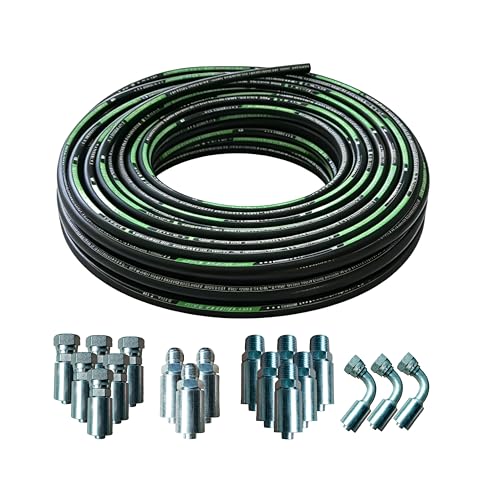
The Luckstar kit offers a 10-foot length with 3/8″ hose and dual steel braided reinforcement, compliant with SAE 100R2AT standards. It includes various fittings to accommodate most standard hydraulic setups. Best for: compact projects and mobile installations where a shorter, sturdy hose is advantageous. Limitation: shorter length limits reach compared to bulkier kits; verify available routing space before purchase.
Buying Guide
Key considerations when selecting a steel braided hydraulic hose:
- Working pressure: Match the hose’s PSI rating to your system’s maximum pressure to prevent bursts.
- Core material: PTFE cores offer low friction and chemical resistance; synthetic rubber cores provide flexibility and cost savings.
- Braiding and exterior: Stainless steel braiding strengthens durability and corrosion resistance; check for a protective coating to reduce environmental wear.
- Fittings and compatibility: Ensure the fittings (JIC, NPTF, etc.) align with your equipment’s ports and standards.
- Length and routing: Longer hoses enable flexible layout but can complicate management and routing.
- Temperature range: Systems exposed to extreme temperatures require hoses that maintain flexibility and integrity across the range.
- Installation and maintenance: Reusable fittings and accessible seals simplify maintenance and leak prevention.
FAQ
- What is a steel braided hydraulic hose best used for?
They are typically used in high-pressure hydraulic systems where durability, resistance to abrasion, and leak prevention are critical, such as industrial machinery, farming equipment, and off-road vehicles.
- How do I choose the right hose length?
Consider the distance between components and potential movement. Longer hoses offer flexibility but can add complexity in routing and cost.
- Are stainless steel braids always necessary?
No. Stainless braided hoses provide superior abrasion and corrosion resistance; other options may be sufficient for lower-stress, shorter runs.
- What fittings should I look for?
Check compatibility with JIC, NPTF, and other common standards. Ensure seals and washers match the system requirements for leak prevention.
- Can these hoses handle hot environments?
Many are designed to operate in wide temperature ranges, but verify the hose’s rated temperature and the system’s exposure to heat to avoid degradation.
- Do these hoses require special maintenance?
Regular inspection for wear, leaks, and kinking is advised. Replace fittings that show signs of wear and verify seals after installation.
Add a Comment