Answering the question for serious shop users: the best stationary electric air compressors deliver high CFM at elevated PSI, offer durable build quality, and provide reliable continuous duty for tools like sanders, impact wrenches, and spray systems. This guide highlights five top models that balance power, reliability, and space efficiency for professionals, DIY enthusiasts, and small shops. Each option is well-suited for long-running pneumatic tasks, with subtle differences that matter for size, noise, and maintenance.
Summary of chosen products:
| Product | ||||
|---|---|---|---|---|
| DEWALT 60 Gallon Vertical Air Compressor (3.7 HP) | Oil-lubed, vertical | 155 | 60 gal | |
| DEWALT 60 Gallon Vertical Air Compressor (5 HP) | Oil-lubed, vertical | 230 | 60 gal | |
| VEVOR 80 Gallon Oil-Free Stationary | Oil-free, vertical | 145 | 80 gal | |
| Campbell Hausfeld 80 Gallon Vertical | Oil-lubed, vertical | 140 | 80 gal | |
| Ingersoll Rand 7.5 HP Two-Stage 80-Gallon | Two-stage, cast iron | 175 | 80 gal |
DEWALT 60 Gallon Vertical, 3.7 HP

This oil-lubed, 3.7 HP electric compressor delivers up to 155 psi to support common shop tools. Best for professionals and DIY enthusiasts who need consistent air supply in medium-duty projects. The vertical design saves floor space in tighter garages and workshops. Choose this for reliable performance in home workshops or light industrial settings where space is at a premium.
Best for: small to mid-size shops, DIYers who need steady pressure for sanding, stapling, and air-die tools. Caution: The 60-gallon tank may feel heavy to relocate; ensure a fixed installation location.
DEWALT 60 Gallon Vertical, 5 HP, 230V
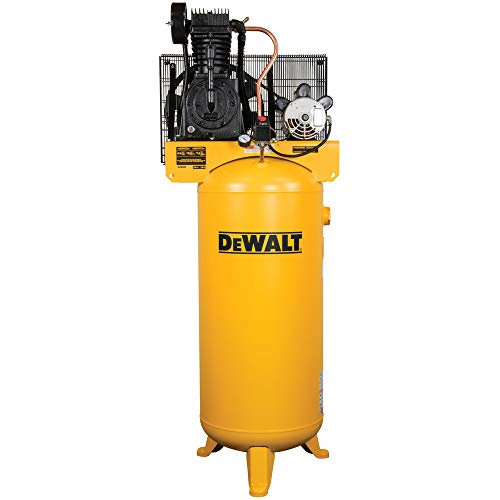
This 5 HP model delivers robust performance with about 13.5 SCFM at 175 PSI and 15.3 SCFM at 100 PSI. It operates quietly at around 65 dB for a larger shop, making it well-suited for environments where noise matters. Best for tradespeople and home garages that run higher-demand tools regularly, or spaces where quieter operation is advantageous. Caution: Higher power draw requires appropriate electrical supply and circuit protection.
VEVOR 80 Gallon Oil-Free Stationary

Powered by a 6.5 HP motor, this oil-free unit delivers up to 15.5 CFM at 90 PSI and reduces maintenance with oil-free operation. The large 80-gallon tank supports extended tooling use with less downtime. Best for manufacturers, automotive shops, and large garages needing rapid air delivery with lower ongoing maintenance. Limitation: Oil-free systems can be noisier and require clean air intake to prevent moisture buildup over time.
Campbell Hausfeld 80 Gallon Vertical
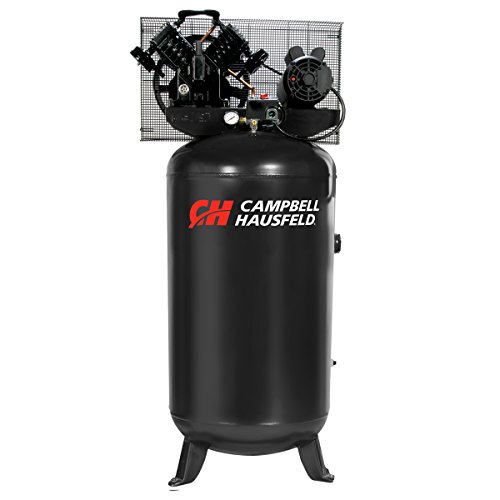
This 80-gallon vertical tank uses a 5 HP single-stage motor to deliver up to 140 PSI with 16.0 CFM at 90 PSI. It is well-suited for continuous operation with spraying, sanding, and cutting tools in a professional shop or large garage. Best for: users who need strong air output and a compact vertical footprint. Caution: Single-stage design may require more frequent service in demanding daily use compared to two-stage models.
Ingersoll Rand 7.5 HP Two-Stage 80-Gallon

A two-stage, cast-iron machine designed for continuous duty with up to 175 psig and an 80-gallon receiver. Best for heavy-duty, industrial-style workflows that require consistent high-pressure bursts and long tool runtimes. This model is more demanding in electrical requirements but offers robust longevity and power. Caution: Two-stage units can be larger and heavier to install; plan for a permanent, well-ventilated space.
Buying Guide: Stationary Electric Air Compressors
What size tank do I need?
Tank size affects runtime between recoveries. Larger tanks (60–80 gallons) provide longer tool operation before the compressor cycles on, which reduces heat buildup and cycling. For continuous tools such as spray guns or impact wliers, larger tanks are advantageous.
Oil-lubed vs oil-free: which is better?
Oil-lubed compressors generally offer longer life and higher durability in demanding use. Oil-free models reduce maintenance and are cleaner for indoor air, but can be noisier and may require more frequent checks for moisture buildup in the tank and lines.
Single-stage vs two-stage
Single-stage compressors are common for most home garages and light industrial tasks. Two-stage units deliver higher pressure more efficiently, with better performance for continuous high-demand tasks but are larger and typically more expensive.
Noise levels and placement considerations
Quiet operation (around 65 dB or lower) is beneficial for shared spaces or residential settings. Consider location, room ventilation, and vibration isolation in the setup to reduce sound transfer and wear.
Electrical requirements
180–230V 1-phase circuits are typical. Higher horsepower units may require dedicated circuits and proper wiring. Check local electrical codes and consult an electrician if needed before installation.
Maintenance and serviceability
Oil-lubed units usually require occasional oil checks and pump maintenance, while oil-free units emphasize seal integrity and moisture management. Cast-iron pumps tend to last longer in heavy use but may require more rigorous maintenance planning.
What to compare beyond price
- CFM at given PSI to match tool needs
- Duty cycle and runtime expectations
- Tank size versus space in the shop
- Noise, vibration, and warranty considerations
FAQ
- What is the best stationary air compressor for a small shop?
Answer: A 60–80 gallon unit with a balance of CFM at operating PSI and compact footprint, such as the DEWALT 60 Gallon Vertical (3.7 HP) or the Campbell Hausfeld 80 Gallon, is well-suited for mixed tools in small to medium workshops. - Is an oil-free compressor better for indoor use?
Answer: Oil-free models require less routine maintenance but may be noisier and can accumulate moisture; consider air filtration and a compressor with moisture management features for indoor use. - Do I need a two-stage compressor for spray painting?
Answer: For high-demand spraying and continuous operation, two-stage units like the Ingersoll Rand 7.5 HP 80-Gallon provide better high-pressure delivery and longevity. - How important is tank size for tools like impact wrenches and sanders?
Answer: Larger tanks reduce cycling, allowing sustained performance and less heat buildup during extended sessions. - What electrical setup is typical for these units?
Answer: Most require 230V single-phase power, with higher horsepower units sometimes needing dedicated circuits. Always verify electrical supply before installation. - How should I place a stationary compressor in a shop?
Answer: Place on stable flooring, with adequate clearance for airflow, and consider vibration isolation pads to minimize noise and movement.
Add a Comment