Stainless steel check valves are a critical component in many fluid systems, preventing reverse flow and protecting pumps, compressors, and tanks. Suitable for water, oil, gas, and chemical applications, these valves combine corrosion resistance with durable construction to withstand demanding environments. Below is a curated look at five top-rated stainless steel check valves, highlighting features, applications, and key considerations to help you choose the best fit for your system.
Summary of Selected Products
| Product | Key Features | Material | |
|---|---|---|---|
| 1-1/4″ NPT Stainless Steel Spring Check Valve | SYWUWV | Vertical inline, one-way flow, explosion-proof, wear-resistant, smooth inner wall | Stainless Steel |
| Boltigen 1 Inch Spring Check Valve | Boltigen | One-way flow, vertical/horizontal use, good sealing, wide temperature range | 304 Stainless Steel |
| 1/2″ NPT Stainless Steel Spring Check Valve | SYWUWV | One-way flow, durable body, smooth interior, corrosion resistant | Stainless Steel |
| Megairon 2″ NPT Check Valve | Megairon | Cracking pressure 4.5 psi, high max pressure, SS316 CF8M | Stainless Steel |
| DAIRAZAN In-line Ball Check Valve | dairazan | SS316, inline one-way, 1/4″ NPT | Stainless Steel SS316 |
1-1/4″ NPT Stainless Steel Spring Check Valve

This vertical inline check valve is designed to prevent backflow in mediums such as oil, water, gas, and air. Its one-way flow capability relies on medium pressure to seal and stop reverse flow, ensuring uninterrupted operation of pumps and piping systems. The valve body emphasizes explosion resistance and wear resistance, enabling long service life under high-temperature and demanding conditions. Its interior wall is finely polished to minimize scaling and clogging, contributing to reliable performance over time.
Boltigen 1 Inch Spring Check Valve

This 1″ NPT check valve is crafted from durable stainless steel with a robust spring, enabling both vertical and horizontal installations. It is engineered to prevent backflow while maintaining a strong seal under a working pressure up to 14 bar (200 psi). The valve withstands temperatures from -10°C to 120°C, making it suitable for various industrial settings. Its corrosion resistance and precise threading help ensure reliable operation in challenging environments.
1/2″ NPT Stainless Steel Spring Check Valve

This 1/2″ NPT stainless steel inline check valve offers one-way flow control and a robust, wear-resistant design. Built to resist corrosion and withstand high-temperature conditions, it provides a durable solution for preventing backflow in oil, water, gas, and air lines. Its polished interior aids in reducing fouling and prolonging service life in continuous operation environments.
Megairon 2″ NPT Check Valve
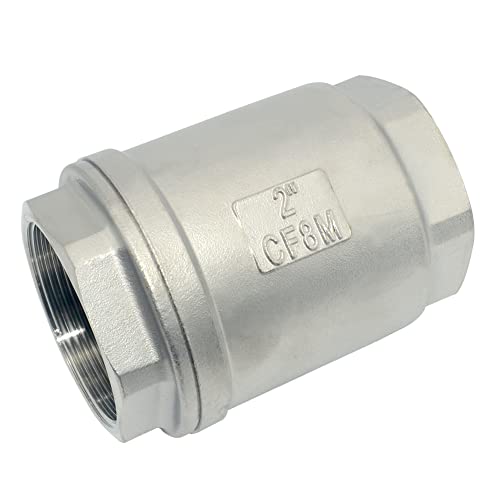
This 2″ inline check valve uses stainless steel SS316 CF8M materials for enhanced corrosion resistance and durability. It features a cracking pressure of 4.5 psi and a maximum working pressure up to 1000 psi for water, oil, and gas. The valve’s port type is Female NPT x Female NPT, and it operates across a wide temperature range from -60°F to 450°F (-51°C to 232°C). Suitable for high-pressure applications where reliable backflow prevention is critical.
DAIRAZAN In-line Ball Check Valve

The DAIRAZAN inline ball check valve is crafted from stainless steel 316 and designed for straightforward one-way flow with a compact 1/4″ NPT thread. It is suitable for water, oil, and gas applications, offering dependable backflow prevention in tight spaces. The SS316 material enhances corrosion resistance, making it appropriate for aggressive media and environments where longevity matters.
Buying Guide: How To Choose The Right Stainless Steel Check Valve
When selecting a stainless steel check valve, consider the following factors to ensure compatibility with your system and long-term reliability.
- Material and compatibility: Look for 304 or 316 stainless steel for strength and corrosion resistance. For highly aggressive media or chloride-rich environments, 316 stainless steel is typically preferred.
- Pressure rating and cracking pressure: Confirm the maximum working pressure and the cracking pressure (the pressure at which the valve opens). Choose a valve with a cracking pressure suitable for your system’s flow characteristics.
- Connection size and type: Ensure the NPT or other thread type matches your piping. Check for male/female conventions and whether the valve supports vertical or horizontal installation.
- Sealing mechanism and seat design: A well-sealed valve reduces backflow risk and minimizes leakage. Look for valves with robust springs and polished interiors to prevent clogging and improve flow.
- Temperature tolerance: Verify the operating temperature range. Some valves tolerate extreme temperatures, which can be critical for oil, gas, or steam applications.
- Installation orientation: Some valves are specified as vertical-only, while others support both vertical and horizontal orientations. Plan installation accordingly for optimum performance.
- Maintenance and service life: Consider valves with smoother interior surfaces and durable actuation components to extend service intervals and reduce downtime.
- Price-to-performance balance: Higher-grade materials and larger sizes offer durability but may come at a premium. Match choices to your system’s risk profile and maintenance budget.
In practice, selecting a set of check valves with similar materials and pressure ratings can simplify maintenance and inventory. For systems handling clean water or non-corrosive fuels, 304 stainless steel is often sufficient. For aggressive media or saline environments, 316 stainless steel is a safer long-term choice. Always follow manufacturer specifications for maximum temperature, pressure, and installation guidelines to ensure safe and reliable operation.
Add a Comment