If you’re looking for an accurate, affordable way to fill spray bottles, these compact liquid filling machines are designed for low-viscosity liquids like water, essential oils, perfumes, and cosmetic sprays. This guide targets buyers who want reliable, easy-to-operate machines for small-batch production, hobbyist projects, or starter setups. Below are five top options, with clear uses and limitations to help you choose.
Summary Table
| Product | Best For | Key Benefit | Limitations |
|---|---|---|---|
| Small bottle batches, essential oil or perfume applications | Weight-based fill control, accurate to 0.1 ml | Low-viscosity liquids only; upright bottles required | |
| Budget-friendly, versatile for 5-100 ml | Simple operation with adjustable fill quantity | Manual operation; requires careful handling for consistency | |
| Digital control with three modes | Three modes (weight, time, price) for flexibility | Smaller volumes may require careful calibration | |
| Small-batch line, multiple bottle sizes | Independent nozzle control for different sizes | Desktop version; limited to cylindrical shapes | |
| Liquid pastes and fluids with good flow | Anti-drip feature and shelf for convenient filling | Limited to 100 ml and smoother fluids |
Hanchen Liquid Filling Machine 1-50ml
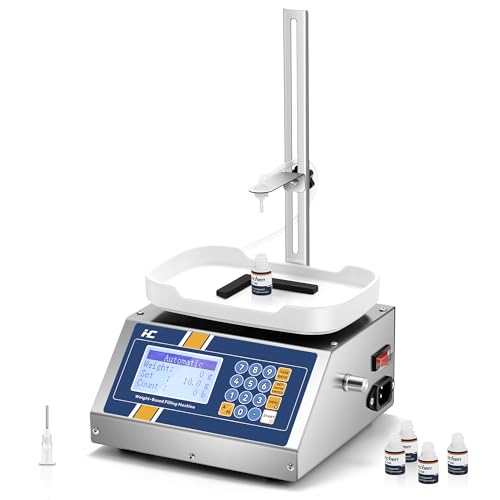
This model uses a high-precision peristaltic pump to fill 1-50 ml with weight-based control. Best for essential oils, perfumes, oral liquids, or spray bottles containing low-viscosity liquids. It automatically slows as it approaches the set volume, improving accuracy. A one-year warranty provides reassurance for buyers. Suitable for upright bottles with mouths large enough to accommodate the fill nozzle. Not appropriate for pastes, thick gels, or corrosive fuels.
Who it’s best for: Hobbyists or small-batch producers filling light liquids in compact bottles. Why selected: Combines accuracy and automatic flow limiting in one compact unit. Caution: Not suitable for thick or particulate-laden liquids; ensure correct bottle size and upright position.
VEVOR Manual Paste Liquid Filling Machine

This manual filler handles 5-100 ml with adjustable output, ideal for thinner pastes and light liquids. It features a reinforced handle for easy operation and a clear scale for precise quantification. Two nozzle options (0.16″ and 0.31″) help align fill volumes with different bottle necks. Suitable for short runs and environments where power access is limited. It is best for non-particulate liquids and moderate throughput.
Who it’s best for: Small operations needing a straightforward manual solution with repeatable accuracy. Why selected: Simplicity, adjustability, and durable construction. Caution: Manual operation can require consistent effort to maintain uniform fill across batches.
Moonshan [2026 New Version] Liquid Filling Machine

This fully automatic option offers 2-300 g weighing capacity with a digital control panel. It uses a hygienic peristaltic pump with a large 40 oz/min throughput and can fill 300 g bottles in about 15 seconds. It supports three modes: weight-based, time-based, and price-based. It slows down as it nears target to improve precision. Best for perfume, essential oils, and other light to medium liquids. Not ideal for very small volumes where speed is critical.
Who it’s best for: Small to mid-sized labs or studios needing versatile modes and fast fill. Why selected: Three operation modes and hygienic pumping reduce contamination risk. Caution: Larger bottles may require careful pan placement and tare setup.
Moonshan 4-Nozzle Desktop Liquid Filling Line

This desktop line integrates four-nozzle filling with belt conveyance and infrared sensing for automated filling. It supports independent nozzle control to tailor speed for different bottle sizes and ensures easy integration into small production setups. Best for small businesses handling multiple bottle sizes in a single workflow. The system is most effective with cylindrical bottles in the specified diameter range (20-90 mm) and height (40-400 mm). Shape compatibility is a factor to confirm before purchase.
Who it’s best for: Shops needing compact automation with multi-size capability. Why selected: Combines filling, transport, and sensing in one small package. Caution: Shape and size constraints may limit compatibility with non-standard bottles.
KIMTEM A03 Pro 100ml Manual

This manual filler handles 10-100 ml with an anti-drip function to reduce overflow, and includes a shelf for convenient bottle placement. It’s built for liquids and pastes with good fluidity and no particulates, such as shampoos and body washes. The hopper capacity and scale-based volume reference provide repeatable fills. It is best for compact, low-volume production with straightforward operation. Not ideal for highly viscous or particulate-laden products.
Who it’s best for: Small studios filling cosmetic liquids and gels. Why selected: Anti-drip feature and shelf improve usability. Caution: Limited to smoother fluids and smaller volumes.
Buying Guide: How to Pick The Right Spray Bottle Filler
- Liquid viscosity and contents: Choose a pump type and material compatible with your liquid. Peristaltic pumps are common for low-viscosity liquids; for thicker products, look for gear pumps or manual options with adequate flow.
- Volume per bottle: Match the fill range to your typical bottle size. Narrow ranges work well for essential oils; broader ranges suit cosmetics and sprays.
- Throughput needs: Manual fillers are fine for small runs; automatic or semi-automatic lines save time for moderate production. Consider whether you need independent nozzle control or multiple nozzles.
- Bottle compatibility: Check bottle diameter, mouth size, and height. Some machines require upright bottles with consistent necks and openings.
- Cleaning and sanitation: Food-grade or medical-grade materials and hygienic pump designs reduce contamination risk for cosmetic and essential oil products.
- Maintenance and support: Look for models with simple maintenance, available spare parts, and warranty options to minimize downtime.
FAQ
- What is the ideal liquid for these machines? Low-viscosity liquids such as water-like solutions, essential oils, perfumes, and light cosmetics.
- Can I fill thicker liquids? Some machines support thicker liquids with special pumps; check the max viscosity and recommended materials for each model.
- Do these fillers require special bottles? Most require upright bottles with sufficiently wide mouths and standard neck diameters; confirm bottle compatibility before purchase.
- Is automation worth it for small batches? Automation improves consistency and speed for moderate runs; smaller operations may prefer manual or semi-automatic options.
- What maintenance is typical? Regular cleaning of nozzles, replacing worn tubing, and inspecting seals help prevent drips and contamination.
- Can I use these for liquids with particulates? Particulates can clog pumps; choose models rated for smooth liquids and filters to protect the system.
Add a Comment