Finding the right small tube bending machine hinges on portability, ease of use, and the materials you’ll work with. This guide highlights five compact, capable options ideal for home workshops, automotive tweaks, HVAC projects, and light metalwork. Each option is chosen for its balance of performance and practicality, helping buyers match a machine to their typical tube sizes, power needs, and workspace constraints. The table below summarizes core specs to compare at a glance.
| Product | Best For | Key Drawbacks |
|---|---|---|
| VEVOR Electric Tube Bending Machine (750W) | Small-diameter pipes, adjustable dies | Oil not included in packaging |
| VEVOR Manual Bending Machine (14 Dies) | Budget-minded, versatile metal pipes | Manual effort required for bending |
| EQCOTWEA Electric Pipe Tube Bender Roller | Precise stainless/mild steel bending | Higher power draw, 110V |
| VEVOR 750W Electric Roll Bending Machine | Hub-friendly 3-roller design, horizontal/vertical | No plug included |
| INTSUPERMAI Electric Pipe Bender (2.2KW) | Heavy-duty bending with many dies | Industrial-grade power needs |
VEVOR Electric Tube Bending Machine, 750W

This electric bending machine uses a 750W motor to bend copper or steel pipes with up to 5mm wall thickness and 180° of bend. It accepts dies for 1″, 1-1/2″, and 1-3/4″ pipes, making it a strong choice for small-to-medium tubing projects. Best for: hobbyists and small shops that need a focused, portable electric bender with multiple dies.
What makes it stand out is the combination of power, die versatility, and mobility. A 6L hydraulic system supports smooth bending, while casters let you move the unit around a workshop to position optimally. Note: hydraulic oil isn’t included, so it must be supplied by the user.
Best use scenarios: creating automotive exhaust sections, fabricated brackets, and light structural work where precise, kink-free bends are essential. Choose this if you want electric operation with straightforward setup and mobile placement.
Caution: Because oil isn’t included, ensure you have the appropriate hydraulic fluid on hand before operation. Also confirm the pipe diameter compatibility before starting a bend.
VEVOR Manual Bending Machine with 14 Dies

The manual bending machine forgoes electricity, instead relying on leverage and a 14-die set to cover a wide range of sizes. It supports up to 2-inch wide flat steel, 0.65″ O.D. hollow pipes, and 1″ O.D. round tubes with a maximum 200° bend angle. Best for: users who want precise control and a large die library without power requirements.
Why it’s a good fit: the 14 dies cover common tube sizes used in HVAC, automotive brackets, and light frame work. It’s robust, offering durable carbon steel construction that promotes long service life in shop environments.
Limitation: manual operation requires physical effort and time for each bend, which may slow production on larger projects. It’s better suited for one-off parts or small runs rather than continuous production.
Best for choosing this if you value a wide die selection and don’t mind manual bending work. The variety of dies supports a broad range of shapes and sizes for versatile use.
EQCOTWEA Electric Pipe Tube Bender Roller
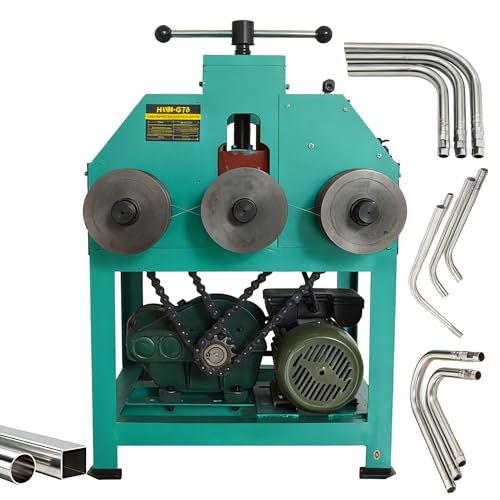
This 2HP electric roller bender handles square and round tubing with dies designed for a wide range of sizes, including stainless and mild steel. The machine ships with 9 round dies and 8 square dies, all made from hardened steel for durability. Best for: professional shops and serious hobbyists who need high-precision bends on various materials.
What makes it practical is the balance of high-power capability and precise die sets, enabling accurate, repeatable bends across multiple tube profiles. It’s a strong pick for projects that demand consistent radii and clean finishes.
Limitation: It runs on 110V, which may require a dedicated circuit in some garages or workshops. Also, larger dies mean less portability and more space occupied on the floor.
Choose this if you require precise, repeatable bends with a broad die library and stainless-steel compatibility, while planning for a stable power supply in your setup.
VEVOR 750W Electric Roll Bending Machine

This 750W roll bender uses a three-roller scheme to shape tubes with thickness up to 5mm. It supports horizontal and vertical operation and is compatible with 220V 60Hz 3-Phase configurations, though it does not include a plug. Best for: users who want a robust, versatile roll-bending setup that fits into larger 220V workshop circuits.
Why it’s selected: the 3-roller design adds stability for thicker-walled tubing and a smoother bending action, which helps minimize material deformation. It’s well-suited for fabricating curved sections in metal frames or brackets.
Limitation: no plug is included, so wiring is required before use. Ensure your electrical setup meets the machine’s 3-Phase needs if you choose this path.
INTSUPERMAI Electric Pipe Bender (15 Round Dies + 9 Square Dies)

The INTSUPERMAI unit features a powerful 2.2KW motor and a wide die assortment (15 round dies and 9 square dies). It is designed for cold bending stainless steel and mild steel with a 0-2 mm wall thickness range. Best for: shop environments requiring a broad array of tube sizes and reliable performance for continuous use.
Strengths include a built-in turbine reducer for stable operation, reduced noise, and efficient performance. The large dies enable flexible bending across common construction tubes and decorative metal components.
Limitation: higher power demands and potential space requirements mean this unit is better suited for dedicated bending stations rather than compact benches.
Buying Guide: Small Tube Bending Machine Essentials
- What tube sizes do you plan to bend? Choose dies and a machine that accommodate your most-used O.D. ranges and square profiles.
- Electric vs manual: Do you need frequent bends or occasional one-offs? Electric machines save effort for larger runs, while manual units excel in simple, small-scale tasks.
- Power requirements: Check voltage and phase (120V vs 220V, 60Hz vs 3-Phase) to ensure compatibility with your workshop electrical system.
- Mobility and workspace: If space is limited, look for units with casters or compact footprints. For fixed shops, consider stationary options with larger die libraries.
- Die quality and material: Dies made from hardened steel last longer and deliver crisper radii. Confirm die compatibility with your target materials (stainless, mild steel, aluminum, etc.).
- Oil and lubrication: Hydraulic or oil-based systems require oil. Verify whether oil is included or must be purchased separately.
- Safety and setup: Ensure you have adequate clearance for full 180° bends, and that clamps or fixtures secure components during bending.
Frequently Asked Questions
- What is the main difference between electric and manual tube benders? Electric benders reduce manual effort and enable more bends in less time, while manual ones are cheaper and portable for occasional use.
- Can these machines bend stainless steel? Some models support stainless steel within specified wall thicknesses; always verify the material compatibility and maximum bend angle for your chosen model.
- Do I need a damping or lubrication system for hydraulic benders? Hydraulics may require oil; check the product details for oil requirements and ensure you have the correct type and quantity.
- What safety precautions are essential? Maintain a clean work area, use protective gear, secure the workpiece, and follow the manufacturer’s operating instructions to avoid injury.
- Are dies interchangeable across brands? Dies are generally brand-specific, though many offer multiple dies within the same family. Always confirm compatibility before purchasing dies for a specific machine.
- Is a three-roller bending machine more stable than a two-roller model? Yes, three-roller designs typically offer smoother bending action and better material control, especially for thicker walls.
Add a Comment