Whether you’re upgrading a compact automated line or building a small-scale control system, a small programmable logic controller (PLC) can deliver reliable, compact control without the bulk of industrial-grade units. This guide highlights five suitable options, each best for specific user types—from hobbyists prototyping to small factories needing dependable I/O capability. The top picks balance ease of testing, sensor compatibility, and practical constraints like space and interface options. Use the quick-reference table below to compare core details at a glance.
| Product | Best For | Key Benefit |
|---|---|---|
| Marhynchus RX-03 PLC | Designers needing software simulation | Test programs without hardware upfront |
| Generic FX1S-based PLC with HMI | Compact HMI-enabled control | Integrated 2.8″ touch display for on-device control |
| Hilitand FX1N-20MR | Industrial control with reliable DC power | Wide power supply and compact size |
| Generic FX1S-9MT | Small-scale projects needing RS485 | RS485 connectivity and easy programming |
| Generic FX1S-20MT / 10-input variant | Encoder, servo, and stepper applications | High-speed pulse outputs for motion control |
Marhynchus RX-03 PLC With Software Simulation
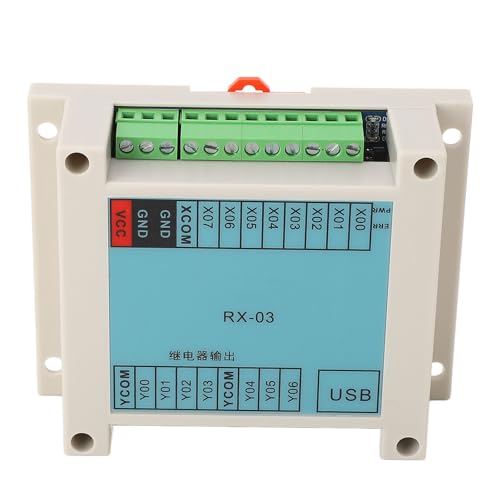
The RX-03 model centers on software-based testing, making it ideal for developers who want to validate logic before wiring hardware. It supports a broad set of sensors, including NPN proximity and position switches, while its outputs drive relays, solenoids, and motors. This PLC is well-suited for industrial sectors such as printing, chemicals, plastics, and packaging, where quick iteration reduces downtime. A clear limitation is that results depend on the software environment; real-world behavior may vary when hardware is connected.
Who this is best for: engineers or technicians who value a built-in simulation mode to speed development and debugging. Why selected: it directly addresses planning and testing workflows without requiring full hardware loopbacks until later stages.
Limitations to note: while the RX-03 supports many sensors and actuators, users should verify compatibility with their exact hardware lineup and confirm software version availability in their region.
Generic FX1S-Style PLC With 2.8″ HMI

This all-in-one unit combines a compact PLC with a 2.8-inch touch screen HMI and multiple I/O channels, including 7 input and 5 relay outputs plus 4 transistor outputs. It supports high-speed pulse generation for motion tasks and is compatible with GX Works 2 software. This setup is best for small automation tasks that benefit from direct on-device display and quick servo control. A caveat is the software language availability and potential language barriers in the provider’s documentation.
Who this is best for: small shops or integrators needing a compact PLC and a built-in HMI to simplify local monitoring. Why selected: the on-board display reduces the need for separate HMI hardware in limited spaces.
Limitation: need to ensure GX Works 2 tools and documentation align with your language and firmware version requirements.
Hilitand FX1N-20MR Industrial PLC

The FX1N-20MR variant emphasizes a robust DC 24V power interface and a compact footprint (86 x 73 x 20 mm), ideal for panel-based control in tight installations. It targets users who require a reliable, space-efficient PLC with established FX1S/FX1S-compatibility and RS485 communication. This option is better for projects where a single, compact unit must manage multiple inputs and simple relay outputs. Real-world performance will depend on the broader system integration and cabling quality.
Who this is best for: technicians and integrators needing a dependable, small-form-factor PLC with standard RS485 connectivity. Why selected: its dimensions and power options fit tightly enclosed enclosures while maintaining compatibility with common FX1S tools.
Caution: confirm your sensor types and output load expectations align with the FX1N-20MR’s I/O ratings to avoid overloading.
FX1S-9MT Ladder Logic PLC

This mini PLC emphasizes RS485 connectivity and basic ladder logic programming. It is fully compatible with FX1S ecosystems and is a practical choice for small automation tasks that require serial communication with other devices. It’s well-suited for education, hobby projects, or small production lines that can be managed with a compact I/O layout. Limitation: the product description notes Chinese-language tooling, which may affect ease of use for non-Chinese speakers without supplemental resources.
Who this is best for: learners and small operators seeking an approachable FX1S-based controller with RS485 access. Why selected: the price and compact form factor pair well with incremental automation projects and simple remote logging demands.
Caution: verify the RS485 addressing and training materials to minimize setup time and misconfiguration risk.
FX1S-20MT With High-Speed Pulses

This compact controller offers 10 inputs and 10 transistor outputs with 2 high-speed 100 kHz pulse channels for servo or stepper control via RS485. It’s tailored for motion-centric applications such as encoder-based positioning and rapid motor control in small automation lines. Choose this if high-speed pulse handling and expanded I/O are your primary need. A potential limitation is the reliance on specific GX Works tools for programming, so ensure compatibility with your development workflow.
Who this is best for: projects requiring precise, high-speed pulse control and additional I/O for motion tasks. Why selected: it combines a larger I/O footprint with motion-grade outputs in a small package.
Limitation: confirm software tooling availability and language support for your team to prevent delays in programming.
Buying Guide: Small PLCs For Compact Automation
- What’s your I/O requirement? Count input, relay, transistor, and high-speed pulse outputs. If you need motion control, prioritize high-speed pulse channels and RS485 compatibility.
- Do you need an onboard HMI? If you want local monitoring, a PLC with a built-in touchscreen (like the HMI-enabled unit) reduces external interface needs.
- How important is software testing? For rapid prototyping, a unit with software simulation speeds up development by letting you validate logic without wiring hardware.
- What about programming tools? Check compatibility with GX Works 2/Developer or other ladder-diagram tools. Availability in your language and any required drivers should be confirmed before purchase.
- Is space a critical constraint? Smaller form factors are essential for tight panels. Measure your enclosure and compare it to the PLC’s dimensions to prevent fit issues.
- Power supply considerations? Verify the PLC’s supported voltage (commonly 10-28 VDC) and ensure your power source aligns with the device’s requirements.
FAQ
- What is a small PLC best suited for?
Small PLCs are ideal for compact automation tasks, simple packaging lines, educational projects, and prototyping where space and cost are important.
- Do these PLCs support motion control?
Some models offer high-speed pulse outputs suitable for servos and steppers; others are limited to basic relay and transistor outputs. Review the high-speed channel specifications carefully.
- Is software simulation a common feature?
Software simulation is present in select models to help test logic before hardware assembly, reducing development time.
- What should I verify about programming tools?
Confirm the compatible software (like GX Works 2), language availability, and driver requirements before purchase.
- Are these units suitable for RS485 networks?
Yes, several options include RS485 ports for reliable serial communication with other PLCs or devices.
- Can I mix HMI with a PLC in a small panel?
Yes, but if space is a constraint, a PLC with a built-in HMI can simplify the layout and wiring.
Add a Comment