Whether you’re upgrading a garage, attic, or small workshop, choosing the right small electric chain hoist can save time and reduce effort. This guide highlights five compact models suited for light to heavy tasks, focusing on reliability, ease of use, and safety features. The best pick depends on your lifting capacity needs, ceiling space, and how you plan to use the hoist. Below, find a quick comparison and detailed product sections to help you decide which hoist fits your space and tasks.
| Product | Load Capacity | Lifting Height | Power | Best For |
|---|---|---|---|---|
| Prowinch Electric Chain Hoist | 330 lb | 10 ft | 110V | Light to mid-weight lifting projects |
| VEVOR Electric Hoist (440 lbs) | 440 lb | 39.4 ft max | 110V | Long reach with secure operation |
| Amarite Mini Chain Lever Hoist | 1100 lb | 10 ft | 110V | Medium-duty garage and shop tasks |
| KOERZORE 1100 lb Electric Hoist | 1100 lb | 25 ft | 110V | Garage ceilings and workshops |
| VEVOR 2200 lb Electric Chain Hoist | 2200 lb | 10 ft | 120V | Heavier loads in compact spaces |
Prowinch Electric Chain Hoist — 330 lb Capacity

The Prowinch unit offers a compact 330 lb lifting capacity with a 10 ft G80 chain and a wired remote for simple, precise control. It includes a chain bag for organized operation and is designed for light to mid-weight tasks in home workshops or small garages. Best for hobbyists or DIY projects that require frequent but modest lifts, with a straightforward one-speed operation for predictable lifting speed.
Best for: small garages, personal workshops, and occasional screen or ceiling fixtures. This model emphasizes reliability and ease of use, ideal for users who want a simple, integrated light-duty hoist without extra complexity. Caution: suited for lighter loads; avoid attempting heavier lifts beyond 330 lb to maintain safe operation.
VEVOR Electric Hoist With Remote Control — 440 Lb

The VEVOR 440 lb model features 14 ft of wired remote control and dual lifting modes. One-line lift reaches up to 32 ft/min at 220 lb, while the double-line option offers 440 lb capacity at 16 ft/min with a maximum height of 19.7 ft. It includes safety features like emergency stop, limit switch, auto brake, and anti-spin rope, plus a high-power 480W motor and a cooling fan for extended use. Best for: workshops or attics where you need more reach or heavier lifts with robust safety features. Caution: heavier loads require maintaining proper alignment and using secure mounting to prevent misalignment during operation.
KOERZORE 1100 Lb Electric Hoist — 25 ft Lift
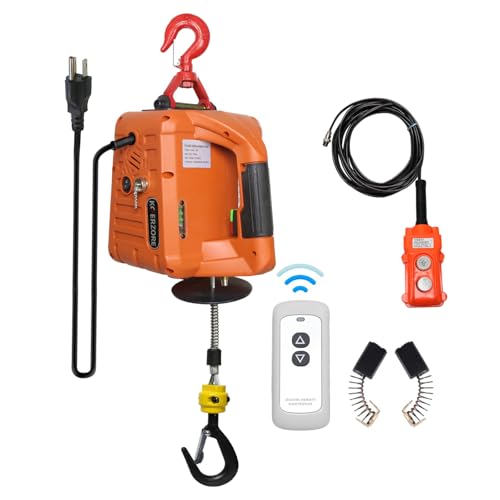
The KOERZORE hoist delivers 1100 lb capacity with a 25 ft lift height, designed for garages and workshops. It emphasizes plug-and-play convenience, a lightweight profile, and safety features including auto-stop overload protection and 360° rotating hooks with latches. The 110V operation and compact dimensions (about 24.25 lbs) make it suitable for installations where space and weight are considerations. Best for: portable overhead lifting in small shops. Caution: ensure ceiling mounting supports the load and that hooks are secured to prevent accidental disengagement.
VEVOR 2200 Lb Electric Chain Hoist — 10 Ft

The 2200 lb VEVOR hoist pairs a high-capacity chain with a 10 ft lift height and a 120V single-phase setup. It uses a copper motor with high-temperature insulation and a large radiator fan for cooling, plus an emergency stop and electromagnetic brake. This model is best for heavy-duty tasks in garages or small commercial spaces where higher lifting capacity is necessary but space is limited. Caution: ensure structural mounting can support repeated heavy loads and adequate clearance for safe operation at maximum travel distance.
Buying Guide
What lifting capacity do I need?
Match capacity to typical loads in your projects. Light tasks may only require 330–440 lb. For mid to heavy items, choose 1100 lb or 2200 lb models. Remember to include a safety margin of 20–30% to account for dynamic loads.
How much lift height is necessary?
Consider ceiling height and the maximum height you need for clears and storage access. If you work in tight spaces, a 10 ft lift height is often sufficient, but a 25 ft or more option offers flexibility for larger items or longer reaches.
What about control and safety features?
Wired remotes or switches simplify operation. Look for emergency stop, limit switches, auto brakes, and anti-slip or anti-spin rope features. Dual-line lifts provide higher stability for heavier loads, especially when lifting overhead in uneven spaces.
How easy is installation?
Most small electric chain hoists are ceiling-mounted. Check mounting compatibility with your joists or beams and ensure proper hardware is included. Consider models with straightforward mounting kits and clear instructional guidance.
What are possible limitations or caveats?
Higher capacity models may require more robust mounting and electrical framing. Heavier hoists can demand additional ceiling reinforcement and professional installation in some environments. Always follow manufacturer load charts and safety instructions to avoid overloading.
Maintenance considerations
Regular inspection of chains, hooks, and electrical connections is essential. Keep chains clean and lubricated as recommended by the manufacturer. Replace worn components promptly to maintain safe operation and consistent performance.
Frequently Asked Questions
- What is the difference between single-line and double-line lifting?
- Can these hoists be mounted in a garage?
- Do these hoists require professional installation?
- What maintenance is needed?
- What safety features should I prioritize?
Single-line lifting uses one chain and is suitable for lighter, simpler lifts. Double-line lifting uses two chains for improved stability and higher payloads, better for heavier loads.
Yes, most units are designed for ceiling mounting in garages or workshops, provided the mounting structure can support the load.
Installation can be DIY if you have proper mounting points and electrical setup. For heavier loads or uncertain ceiling structures, professional installation is recommended.
Inspect chains, hooks, and brakes regularly. Lubricate moving parts per the manual and replace worn components to prevent malfunction.
Emergency stop, limit switches, electromagnetic brakes, and secure hooks with latches are essential to prevent unexpected drops or chain slippage.
Add a Comment