Answer: This guide highlights five credible single-axis solar tracker products suitable for off-grid, residential, and DIY projects, focusing on those that improve daytime solar capture with straightforward setup. Best for homeowners seeking easier installation, or hobbyists building off-grid arrays. The top picks emphasize simple controls, weather resistance, and scalable mounting options to fit various panel sizes and configurations.
| Product | Best For | Why It Stands Out |
|---|---|---|
| BINGOX Dual-Axis Tracker Kit | All-around off-grid setups | LCD remote, wind sensor, and auto sun tracking for max power |
| ECO-WORTHY Single Axis System | Large panel arrays | 30% power boost potential with versatile panel configurations |
| GODIYMODULES Solar Tracking Module | Compact, affordable modules | Simple single-axis DM/relay-based tracking |
| LorFain Solar Tracker Controller | Residential or small commercial | Single-axis with automatic/manual, wind stabilization |
| LeTkingok Automatic Controller | Low-cost dual-axis needs | Real-time sun tracking, wind leveling, hemispheric compatibility |
BINGOX Dual-Axis Solar Tracker Controller Kit
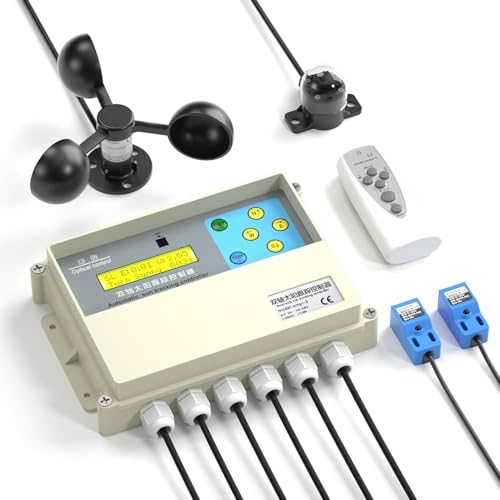
Best for off-grid and RV systems that demand robust automatic sun tracking with wind protection. Features include auto sun tracking across east–west and north–south axes, a built-in wind sensor that auto-adjusts or locks during high winds, and a user-friendly LCD menu with a complete setup kit (sunlight sensor, wind sensor, controller, remote). This package suits buyers who want hands-off daily optimization and a clear installation pathway. Caution: ensure compatibility with your panel dimensions and mounting frame before purchase.
iDili Solar Tracker Sun Tracking System

Best for enthusiasts who want a biaxial/uniaxial control capable of day-to-day tracking with a durable housing and long-lasting light sensor. The design emphasizes a pyramid four-quadrant light sensor and MCU-driven tracking, including night mode and manual options. Suitable for higher-visibility DIY projects where precise sun alignment matters. Limitation: detailed specifications and compatibility depend on the motor platform and mounting hardware in your setup.
ECO-WORTHY Solar Panel Single Axis Tracking System

Best for scalable installations with multi-panel layouts. It claims a power increase potential around 30% when tracking is used compared to fixed mounts and supports different panel sizes. The kit is suitable for yard, farm, or field deployments with adjustable mounting to fit up to multiple panels in sequence. Caution: verify the maximum number of panels and width allowances per your mounting surface to avoid overhangs or misalignment.
Aitoserlea Single Axis Sun Tracking Controller
Best for straightforward single-axis tracking needs with a dedicated controller and pyramid four-quadrant light sensor. The system aims to provide consistent tracking toward the sun and is suitable for compact or modest-size panel arrays. Limitation: detailed installation steps and supporting hardware should be confirmed to ensure proper motor drive compatibility with your panels.
GODIYMODULES Solar Tracking Module

Best for compact, low-cost single-axis projects. The module uses a simple solar-tracking principle with a small 5V-5.5V DC operation, making it appealing for hobbyists building mini-tracker projects or educational demos. Caution: mechanical stability and motor integration should be considered relative to your mounting structure and power requirements.
WQV Dual Axis Solar Tracker Controller

Best for dual-axis control with remote and weather-aware features. The kit includes high-precision sensors, wind leveling, and a 12V/24V DC motor for real-time sun tracking. It’s suitable for users who want flexible hemispheric applicability and an LCD interface for parameter tweaking. Limitation: ensure the four-direction limit switches and motor compatibility are in place for safe operation in windy environments.
LORFAIN Solar Tracker Controller

Best for universal compatibility with standard residential installations. The dual-axis capability and weatherproof housing make it a solid pick for homes and small farms seeking dependable sun tracking with simple manual override. Caution: check if your mounting system supports the controller’s dimensions and the required wiring connections.
LeTkingok Sun Automatic Tracking Controller

Best for users needing real-time dual-axis tracking with remote control and hemispheric adaptability. The controller supports wind leveling, cloud handling, and adjustable parameters via LCD, making it suitable for both northern and southern hemisphere deployments. Caution: verify that the included manual aligns with your hemisphere to avoid misalignment of east-west and north-south axes.
Buying Guide
What should you consider when choosing a solar tracker controller?
- Tracking axis: Single-axis trackers are simpler and often cheaper; dual-axis trackers maximize sun exposure but may require more complex installation.
- Control interface: LCD displays and remotes help adjust parameters; ensure the controller is user-friendly and compatible with your mounting hardware.
- Weather resistance: Look for weatherproof housings and wind protection features to protect components in exposed installations.
- Sensor quality: Pyramid four-quadrant light sensors or equivalent enable more accurate sun tracking; verify sensor durability and wiring.
- Power and motor compatibility: Confirm voltage (often 12V/24V) and motor type match your panels and mounting frame.
- Scalability: Check how many panels can be supported and whether the system can be expanded later.
- hemispheric suitability: Some controllers specify northern vs southern hemisphere operation; ensure correct setup for your location.
FAQ
- What is the main benefit of a solar tracker?
– It increases the sun exposure time of panels, potentially boosting energy capture compared to fixed mounts. - Do I need dual-axis tracking for residential use?
– Not always; single-axis trackers can provide significant gains with simpler setups, while dual-axis can maximize gains in variable sun conditions. - How important is a wind sensor?
– Important for protection; it helps automatically retract or lock the tracker during high winds to prevent damage. - Can I retrofit a tracker to an existing system?
– Retrofitting is possible but requires matching mounting hardware, wiring, and power supply to the new controller and motors. - What polar alignment considerations exist?
– Some controllers are hemisphere-specific; verify that the setup matches your location to ensure proper east-west and north-south tracking. - Are these trackers suitable for DIY projects?
– Yes, several units are designed for hobbyists and off-grid builds, but plan for mounting space, wiring, and weatherproofing.
Add a Comment