Short path distillation is a precision technique for separating compounds with close boiling points. This guide highlights five top-performing short path distillation units and related sets that are well-suited for laboratory work, hobbyist labs, and professional settings. Each entry includes distinct glassware components, joints, and configurations to support distillation, purification, and fraction collection. The selections emphasize durability, compatibility with 3.3 borosilicate glass, and secure joint connections, helping you compare options based on build quality and用途.
Product Summary
| Product | Brand | Key Features |
|---|---|---|
| Deschem 24/40 Short Path Distillation Head | Deschem | G3.3 borosilicate glass, 560°C annealing point, low thermal expansion |
| EISCO Short Path Distillation Set, 21 Piece | EISCO | Complete glassware set; ASTM Type I Class A; secure 24/40 joints |
| 2L Short Path Distillation Head (24/40) | haocheng | 4 Vigreux stages; vacuum-jacketed adapter; 24/40 joints |
| StonyLab Glass Short Path Distillation Head | stonylab | 24/40 joints; three hose connections for recirculation and vacuum |
| DONLAB DST-KIT01 Short Path Kit | DONLAB | All-in-one micro head, 24/40 joints, 10/18 thermometer joint, 3-way receiver |
Deschem 24/40 Short Path Distillation Head

The Deschem short path distillation head is designed for high-purity separations using G3.3 borosilicate glass. Its annealing point around 560°C indicates strong thermal stability, which helps withstand repeated heating cycles common in distillation work. The low linear coefficient of thermal expansion suggests reliable performance during temperature fluctuations. This head integrates with standard 24/40 joints, enabling compatibility with a range of glassware setups and accessories. The choice is suitable for researchers seeking a robust, glass-backed option for small to mid-scale distillation tasks.
EISCO 21-Piece Short Path Distillation Set

The EISCO 21-piece glassware set provides a complete collection suitable for short path distillation, extraction, and purification workflows. Made from borosilicate 3.3 glass, it offers strong chemical durability and thermal resistance. All joints use standard 24/40 ground connections, with Keck clips included to secure fittings. This kit is advantageous for labs requiring a comprehensive, ready-to-use glassware assortment with consistent joint sizing and secure assembly across multiple glass components.
2L Short Path Distillation Head (24/40) with Vigreux

This 2-liter distillation head features a heavy-duty borosilicate 3.3 glass build for durability. The vacuum-jacketed distillation adapter includes 4 Vigreux stages to aid separation efficiency. It employs 24/40 joints for a secure, precise fit and is suited for labs that perform moderate-capacity distillations, where stable temperature control and efficient column stages enhance product purity and yield.
StonyLab Glass Short Path Distillation Head
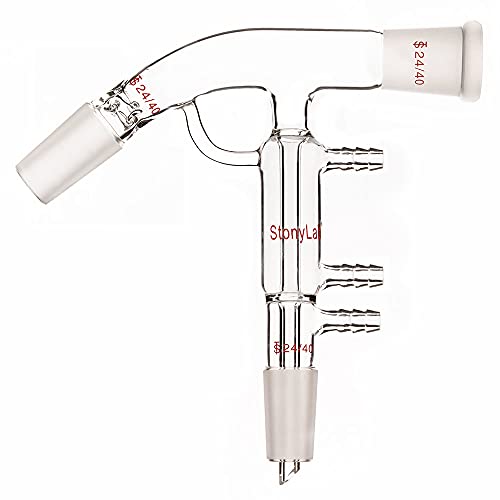
The StonyLab distillation head uses 24/40 standard taper joints with multiple hose connections, enabling recirculation fluids and vacuum handling. This configuration supports integrated lab setups requiring extra ports for cooling or vacuum lines. The design emphasizes straightforward assembly and compatibility with a range of lab glassware, making it a practical option for educational labs or research projects focusing on short path techniques in a compact footprint.
DONLAB DST-KIT01 Short Path Micro Distillation Head Kit

The DONLAB kit provides an all-in-one micro distillation head with a 24/40 joint along with a thermometer joint (10/18) and a 3-way distillation receiver. It also includes outer 135° joints, delivering a compact, modular solution for micro-scale distillation tasks. This set is suitable for researchers requiring a ready-to-assemble package that supports efficient fraction collection and flexible adapter configurations for small-scale experiments.
Buying Guide: Key Purchase Considerations
Choosing the right short path distillation unit depends on several factors. Here are practical considerations from multiple perspectives to help you decide which setup fits your needs:
- Glass quality and material: Look for 3.3 borosilicate glass for durability and thermal resistance. Higher annealing points indicate better tolerance to heat cycling, reducing the risk of breakage during distillation.
- Joint size and compatibility: Most short path configurations use standard 24/40 joints. Ensure you can connect with existing glassware and that clamps or Keck clips are included or readily available.
- System capacity: Distillation heads and kits range from 1–5 liters. Consider your typical batch size and whether a larger head with Vigreux stages or a compact micro-head better meets your workflow needs.
- Port availability: Additional hose connections or vacuum ports can simplify recirculation, cooling, and vacuum management. Evaluate how many ports you need for your setup.
- Assembly and security: Keck clips, ground joints, and secure fittings impact reliability. Kits with complete sets reduce the chance of compatibility gaps during assembly.
- Complete sets vs. individual components: A full glassware set provides convenience, especially for new labs, while individual heads offer customization for established setups.
- Temperature and vacuum ranges: Check the distillation temperature range and the vacuum alignment of adapters. This matters for more volatile compounds and higher-boiling substances.
- Brand and support: Reputable brands typically provide replacement parts and documentation. Consider the availability of spare joints and adapters in your region.
In summary, select a unit that aligns with your intended scale, assembly preferences, and maintenance capabilities. For beginners, a complete glassware set with standard joints offers a smooth start, while more advanced users may prefer a modular kit with adjustable columns and multiple ports for complex distillations.
Add a Comment