Answering the needs of homeowners seeking autonomous mowing, these self-driving lawn mowers are designed to reduce manual work and tackle real-world yards. The top picks below are ideal for families with uneven terrain, trees, or wide lawns, and they offer options for boundary-free setups, AI navigation, and app control. This guide highlights five robot mowers that balance advanced navigation with practical limits you should consider before buying.
Summary table of chosen products
- Sunseeker S4 LiDAR Robot Lawn Mower — Best for real yards with obstacles
- Sunseeker X5 AWD Robot Lawn Mower — Best for large, uneven yards
- MowRo Robot Lawn Mower — Best for quiet operation and easy programming
- LawnMaster OcuMow Perimeter Wire Free — Best for small to medium lawns with optical navigation
- LawnMaster OcuMow MAX VBRM601YCM — Best for mid-sized lawns requiring robust obstacle avoidance
Sunseeker S4 LiDAR: Vision AI With 360° LiDAR
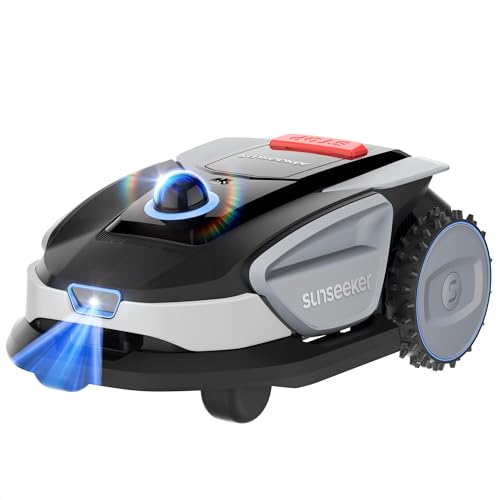
The Sunseeker S4 uses Vision AI combined with 360° 3D LiDAR to map your lawn and plan systematic mowing paths. It excels in navigating real-world obstacles and uneven spaces with minimal supervision. Best for: homeowners with real yards containing trees, slopes, or clutter where GPS may fail. It’s wire-free and quick to map, avoiding perimeter setup headaches. Limitation: LiDAR systems can be challenged by dense canopies or reflective surfaces in some layouts, which may affect obstacle detection in rare conditions.
Sunseeker X5 AWD: All-Wheel Drive for Real Terrain

The Sunseeker X5 AWD is built for bigger yards up to 0.5 acre. Its all-wheel-drive system and independent suspension help it handle uneven grass, slopes, and rough backyard terrain. It uses AI navigation and app control to set virtual boundaries, letting you adjust as your yard changes. Best for: larger properties with mixed terrain and no wired boundary requirements. Limitation: higher complexity may require more setup time and occasional app updates to maintain virtual boundary accuracy.
MowRo Robot Lawn Mower: Updated 2026 Programming
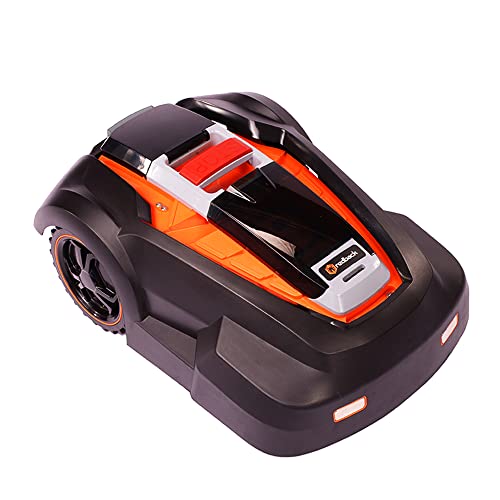
The MowRo mower follows a boundary wire and integrates updated 2026 programming for efficient, time-saving mowing. Ultra-quiet operation at about 65 dBA and a rain sensor to pause during wet conditions help protect the lawn and mower. Best for: users who already have a boundary wire and want dependable, low-noise mowing with a simple scheduling system. Limitation: Requires installing and maintaining the boundary wire for accurate navigation, which can be less convenient for some properties.
LawnMaster OcuMow Perimeter Wire Free: Optical Navigation

The OcuMow uses optical navigation and obstacle avoidance with no perimeter wire. It is designed for small lawns and features a wide-angle camera to identify grass and guide mowing, along with ultrasonic sensors for obstacle avoidance. Best for: small to medium yards where wiring a perimeter is undesirable. Limitation: Optical navigation can be affected by strong lighting or highly contrasting lawns, which may reduce guide accuracy in certain conditions.
LawnMaster OcuMow MAX VBRM601YCM: Enhanced Coverage

The OcuMow MAX expands coverage to 2000–3500 square feet with improved optical navigation and obstacle avoidance. It’s ideal for small to medium yards that need reliable, wire-free operation and consistent mowing results. Best for: households seeking scalable, boundary-free mowing with strong obstacle handling. Limitation: Maximum yard size is still limited compared with larger robot mowers, so very large properties may require multiple charging cycles or additional units.
Buying Guide: Key Purchase Considerations
- Yard size and terrain: Choose a mower verified for your acreage and slope. Some models handle slopes up to 30% while others excel on flat lawns.
- Navigation method: Boundary wires, wire-free virtual boundaries, or map-based navigation each have pros and cons depending on your yard layout and desired ease of setup.
- Obstacle handling: Models with LiDAR, AI obstacle detection, or ultrasonic sensors reduce collisions around trees, flower beds, and furniture.
- Noise and wind impact: Quieter mowers are better for neighborhood living; consider decibel levels and run times for daily use.
- App control and automation: App scheduling, rain sensors, auto-charging, and weather compatibility affect ease of use and reliability.
- Maintenance and parts: Consider blade replacement frequency, battery longevity, and availability of replacement parts in your region.
FAQ
- What is the main advantage of a LiDAR-equipped mower?
LiDAR supports detailed 3D mapping and obstacle detection in real-world conditions, helping it navigate complex yards efficiently. - Do wire-free mowers require perimeter boundaries?
No, many use app-based virtual boundaries or AI mapping, but some models still perform best with physical boundaries for accuracy in larger yards. - How important is slope handling for robotic mowers?
For properties with hills, choose a model rated for higher slope tolerance to prevent stalls and ensure even cutting. - Can these mowers operate in rain?
Some include rain sensors and weather resistance, but it’s best to follow manufacturer guidelines and avoid mowing during heavy rain. - Is boundary wire required for all robots?
No; several models offer wire-free setups, though some still perform best with a defined boundary wire.
Add a Comment