Answering the question “which scientific and chemical supplies are right for my needs?” this guide highlights five practical choices across glassware, bottles, and spatula sets. This selection is tailored for students, professional labs, makers, and teachers seeking reliable, durable tools for routine experiments, storage, and handling of chemicals. Each product section notes who it’s best for and why it stands out, plus a concise comparison to help you decide quickly.
| Product | Best For | Why It Stands Out |
|---|---|---|
| Karter Scientific Beaker Set | Small to mid-size volumes | Four sizes, Borosilicate glass, Griffin low form |
| United Scientific 1000ml Beaker | Precise measurements & autoclaving | Double-scale readings, heat-safe glass |
| stonylab Wash Bottles | Rinsing and dispensing | Two-pack, narrow mouth, LDPE flexibility |
| Scientific Labwares Spatula Set | Mixing and scraping | Double-ended, long-reach |
| United Scientific Bottles (500ml) | Storage and transport | Autoclavable, leak-proof |
Karter Scientific 214T2 Beaker Set

The Karter Scientific 214T2 Griffin Low Form Beaker Set includes four sizes: 10 ml, 50 ml, 100 ml, and 250 ml. Constructed from Type I Class A 3.3 borosilicate glass, these beakers are designed for routine lab tasks that require clear volume readings and reliable chemical resistance. This set is best for students, hobbyists, and entry-level labs needing versatile, budget-conscious glassware for basic preparation and transfer tasks. A limitation is that the set does not include larger sizes or graduations beyond the listed volumes, which may necessitate additional pieces for bigger batches.
Best for: Beginners or compact labs needing a small, dependable beaker assortment.
Why selected: Combines multiple common volumes with robust borosilicate glass and Griffin low-form stability for steady mixing and pouring.
United Scientific 1000ml Beaker
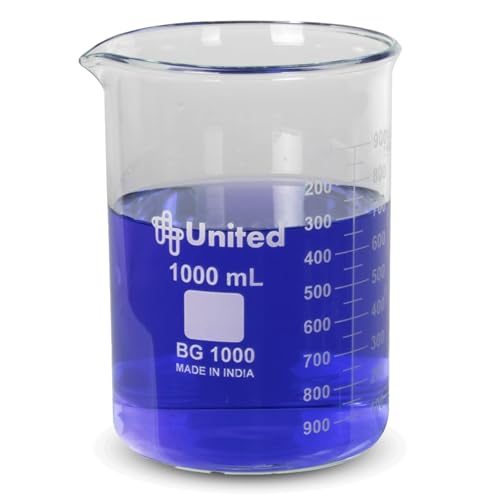
This 1000 ml borosilicate beaker features precise double-scale graduations from 100–900 ml in 50 ml increments, aligned with ASTM-E960 standards and a tolerance of ±5%. Made from heat-safe 3.3 borosilicate glass, it withstands thermal shock and autoclaving for sterile lab work. The low-form Griffin base adds stability during heating and mixing, helping reduce spill risk. A caveat is that the beaker’s large size may be heavier to handle during repetitive tasks.
Best for: Medium to large-volume prep and autoclave-ready lab work.
Why selected: Combines precise volume readings, durable glass, and a stable base for routine heating and mixing tasks.
stonylab Chemical Wash Bottle Duo

The stonylab 2-pack chemical wash bottles are LDPE plastic with narrow-mouth design, offering controlled dispensing for rinsing and transferring liquids. Each 250 ml bottle is lightweight and easy to handle, making them suitable for classrooms, teaching labs, or compact workspaces. The LDPE material provides flexibility and chemical resistance for typical aqueous solutions. A potential limitation is that LDPE is not the best choice for highly aggressive solvents or high-temperature applications beyond typical classroom use.
Best for: Rinsing, dispensing, and routine washing in educational or small lab settings.
Why selected: Reliable, easy-to-grip design with precise flow control in a cost-conscious two-pack.
Scientific Labwares Long-Spatula Set

The Laboratory Spoon Spatula Set from Scientific Labwares includes 12 pieces with dual-ended tools designed for mixing, scraping, and transferring materials. The long-handled design improves access to deep containers and bottles, making this set a solid pick for labs and makers working with powders, gels, or liquids. Best used for general-purpose work rather than precision weighing. A limitation is that stainless steel tools can react with certain acids if not cleaned properly between uses.
Best for: Comprehensive mixing and scraping needs in schools, hobby labs, or studio environments.
Why selected: Versatile, dual-ended tools provide multiple functions in one kit, improving workflow efficiency.
United Scientific 500ml Sample Bottles (12-Pack)

These 500 ml polypropylene sample bottles come with leak-proof caps designed for long-term storage and transport. The autoclavable construction covers a broad temperature range, and the material is BPA-free and RoHS compliant for lab safety. The screw-cap design with integrated seals reduces spill risk. A caution is to ensure cap integrity during repeated autoclaving, as wear may affect sealing over time.
Best for: Storing and transporting samples in labs and fieldwork settings.
Why selected: Durable, autoclavable, and compliant bottles with reliable closures for routine sample management.
United Scientific 500ml HDPE Bottles with Lids

The United Scientific HDPE Sample Bottles with Lids provide a wide-mouth design and 500 ml capacity for straightforward filling and retrieval. The HDPE container delivers strong chemical resistance and impact durability, suitable for classroom storage and lab use. The cap closure is designed for a leak-proof seal, though the wide mouth may be more prone to spillage during vigorous handling. Best for: general storage and classroom projects where lightweight bottles matter.
Best for: Reusable storage of reagents and samples in educational labs or home setups.
Why selected: Combines practical size with durable material and a secure closure system for everyday storage needs.
BKMAMLAB 250ml Round Storage Bottles
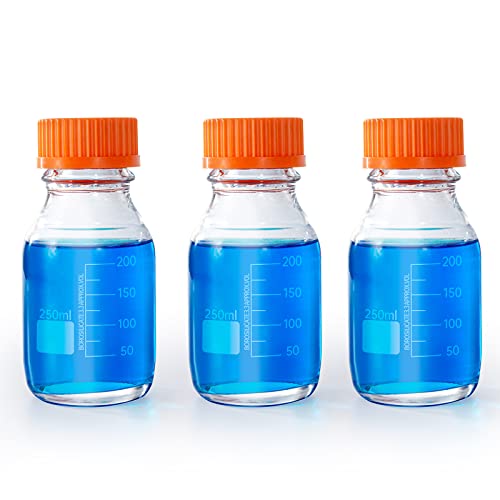
This set includes 250 ml borosilicate glass bottles with GL45 screw caps. The glass handles high temperatures (up to 121°C) and offers chemical resistance, while the screw cap made of polypropylene is suitable for steam sterilization up to 140°C. Note that the cap cannot be sealed under high pressure, as cooling vacuum may cause breakage. Best for: chemical storage and small-volume experiments requiring glass durability and autoclave compatibility.
Best for: Chemical storage and simple solution preparation in laboratories needing glassware with reliable heat resistance.
Why selected: Combines glass with high-heat-capable caps to support sterile handling and storage needs.
Buying Guide
Key considerations when selecting scientific and chemical supplies:
- Material: Borosilicate glass offers chemical resistance and thermal stability, while HDPE and LDPE plastics provide lightweight handling and affordability. Choose glass for high-temp or aggressive chemicals and plastic for budget-friendly storage.
- Volume range: Ensure the product sizes cover your typical workflows. A mix of small and large volumes reduces the need for frequent replacements.
- Autoclavability: If you rely on sterile conditions, prefer autoclavable materials and packaging designed for autoclaving.
- Sealing and closures: Leak-proof caps are essential for transport and storage. Check cap materials and compatibility with your liquids.
- Durability vs. convenience: Glassware offers stability and heat resistance but is heavier and more fragile; plastics are lighter and often more versatile for classroom or hobby use.
- Ease of cleaning: Tools with simple shapes and removable parts facilitate washing and sanitization between uses.
Frequently Asked Questions
- What is 3.3 borosilicate glass?
It refers to a type of borosilicate glass with a 3.3 coefficient of thermal expansion, offering good thermal shock resistance and chemical durability. - Are these bottles autoclavable?
Several listed items are autoclavable, notably those made from borosilicate glass and autoclavable plastics. Always confirm specific item compatibility before sterilization. - Which item is best for classroom use?
Wash bottles and the 12-pack bottle sets are typically well-suited for classroom settings due to their durability, cost, and ease of use. - What should I consider for safe storage?
Look for leak-proof closures, compatible materials with your reagents, and appropriate volume and closure designs for transport and storage in your workspace. - Is stainless steel required for all lab tools?
No. Stainless steel spatulas are common, but many laboratories successfully use borosilicate glassware and HDPE/LDPE bottles for a wide range of tasks. - How do I choose between glass and plastic beakers?
Choose glass for high-temperature or chemically aggressive contexts; choose plastic for lightness, lower cost, and educational or general-purpose use.
Add a Comment