Finding the right saw mill blades hinges on reliability, compatibility, and the ability to deliver clean, precise cuts with minimal downtime. This guide highlights five blades that align with common sawmill setups and portable mills. Each option is best for specific buyer needs—whether you operate Wood-Mizer gear, portable mills, or heavy-duty ripping tasks. The table below summarizes the key points to compare at a glance.
| Product | Best For | Blade Length | Width | Tooth Angle / Type | Material |
|---|---|---|---|---|---|
| 144″ Sawmill Bandsaw Blades (5-Pack) | Smaller, compatible mills | 144″ | 1-1/4″ | 10° rake | High-density alloy steel |
| 158″ Sawmill Bandsaw Blades (5-Pack) | Medium to large portable mills | 158″ | 1-1/4″ | 10° rake | High-density alloy steel |
| Sawmill Blades 158 Inch (5-Pack) | Versatile portable and fixed mills | 158″ | 1-1/4″ | 7° / 39° universal hook angle | Double-hard high alloy steel |
| Wood-Mizer 171″ Sawmill Blades (5-Pack) | Wood-Mizer LT-series and wider | 171″ | 1-1/4″ | 10° | DoubleHard high-alloy steel |
| Freud LM72M010 10″ Heavy-Duty Rip Blade | Ripping with hardwoods/softwoods | 10″ | 0.5″ arbor | 20° | TiCo carbide |
The selections below are organized to help you compare compatibility, durability, and performance. Each entry explains who benefits most, plus a practical caveat if needed.
144″ Sawmill Blades 5-Pack — All-Purpose 10°
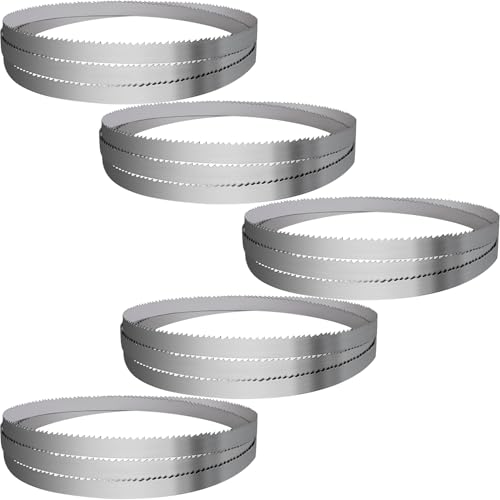
The 144″ blades are designed for compatibility with Wood-Mizer and similar brands such as Harbor Freight, Frontier, Timbery, and TMG Industrial Mills. The 1-1/4 inch width and 0.042 inch thickness create steady cutting performance for generic sawmills with the same specifications. The 10° rake and 7/8 inch pitch provide a reliable balance between aggressive cutting and smoother feed. Best for owners with smaller to mid-sized portable mills seeking a cost-effective, all-purpose blade. A note: the blades are designed for high-density alloy steel and heat-treated to improve hardness and wear resistance, reducing the likelihood of breakage under typical operation. Caution for very hard or exotic hardwoods might be necessary, as no blade is universally perfect for every species.
158″ Sawmill Blades 5-Pack — All-Purpose 10°
These 158″ blades extend compatibility to slightly larger mills and share the same width and thickness as the 144″ set (1-1/4″ wide, 0.042″ thick) with a 10° rake. The 7/8″ pitch supports a range of wood species while the high-density alloy steel construction enhances durability. Best for operators with mid-to-large portable mills who want a straightforward upgrade path from shorter blades. A potential limitation is that the 158″ length requires mills with corresponding arbor and track geometry.
Sawmill Blades 158 Inch — Universal Hook

This 158″ blade set emphasizes versatility with a universal hook angle option (7°/39°) to adapt to various wood types. The 1-1/4″ width and 0.042″ thickness support robust cutting, and the blades are built from double-hard high alloy steel. Best for buyers who need flexibility across a mixed species portfolio and multiple mill configurations. Caution: the universal hook geometry may require adjustment in feed rate and tension for certain mills; verify compatibility with your specific model before purchase.
Wood-Mizer 171″ Sawmill Blades 5-Pack

Designed for Wood-Mizer LT40WIDE and LT50WIDE portable mills, these 171″ blades use DoubleHard high-alloy steel to deliver twice the sharp life versus standard carbon steel. The 1-1/4″ width and 10° rake provide stable cutting for longer runs and larger logs. Best for dedicated Wood-Mizer owners who require long blades for extended cuts and higher blade life. Limitation: longer blades demand precise tensioning and alignment; ensure your mill’s setup can accommodate 171″ blades comfortably.
Freud LM72M010: 10″ Heavy-Duty Rip Blade

Freud’s LM72M010 is a 10″ heavy-duty ripping blade with a 5/8″ arbor and 20° hook angle. It uses TiCo carbide for high-density performance, delivering smooth, straight rips and a clean edge on hardwoods and softwoods. Best for bench or small shop setups where a dedicated ripping blade is needed. A caveat is that it is a different blade category than bandsaw blades; reuse or cross-application should be avoided unless the machine supports it.
HORUSDY 6-Pack 9-Inch Bi-Metal Reciprocating Blades

These 9-inch, 14TPI blades are designed for reciprocating saws cutting steel pipe, rebar, and sheet metal. The bi-metal construction improves heat resistance and durability during long cutting sessions. Best for projects that involve metal cutting, where a separate blade set would be wasteful due to occasional use. Choose this if you need a robust option for metal work in addition to wood cutting. Limitation: not a sawmill blade; intended for reciprocating saws and metal tasks.
Buying Guide
What should you consider when choosing sawmill blades?
Blade length must match your mill’s bar. Longer blades enable longer cuts but require proper tensioning and space. Width and thickness influence cut quality and heat dissipation; common sizes are 1-1/4″ wide and 0.042″ thick for many 144″ to 171″ blades.
What about hook angle and tooth design?
A 10° rake is common for balanced cutting in many hardwoods and softwoods. Universal hook variations (such as 7°/39°) can improve adaptability across species, but they may require different feed rates or tension settings.
Material quality matters
High-density alloy steel and double-hard high-alloy steel generally offer greater wear resistance and blade life than standard carbon steel. Heat treatment (quenching and annealing) enhances hardness and reduces premature dulling.
Compatibility and installation considerations
Always confirm blade length, width, and arbor compatibility with your specific sawmill model. Longer blades require compatible arbor spacing and track length. When in doubt, consult your mill’s manufacturer guidelines and verify the blade’s stated compatibility with your model.
Maintenance and safety
Keep blades sharp, clean, and properly tensioned. Inspect for cracks, warping, or missing teeth before each use. Use appropriate safety gear and follow all manufacturer safety recommendations for blade changes and operation.
Frequently Asked Questions
- What length blade do I need for a Wood-Mizer LT40WIDE? The LT40WIDE typically uses long blades such as 171″ or similar lengths designed for Wood-Mizer’s frame. Check the exact model specs for the preferred blade length.
- Are all 158″ blades universal across brands? Not always. Some blades use a universal hook design (7°/39°) intended to fit a range of mills, but confirm compatibility with your specific model and track geometry.
- Is a double-hard alloy blade better than standard carbon steel? Yes for durability and wear resistance in demanding cutting tasks, though price and availability may vary by brand.
- Can I use a heavy-duty ripping blade on a bandsaw mill? No. Ripping blades are designed for different machines (table saws or circular saws). Use blades intended for your machine type.
- What should I watch for with long 171″ blades? Ensure your mill can accommodate the blade length, alignment, and tensioning requirements. Longer blades demand precise setup for optimal performance.
- Do these blades come with warranties? This article does not specify warranties; review each product listing for terms offered by the seller.
Buying the right blade involves aligning blade length, width, and tooth geometry with your sawmill’s design and the wood species you process. This guide highlights options that balance compatibility, durability, and cutting efficiency for most American portable and small-to-mid sized mills. For best results, pair blades with proper machine setup, routine maintenance, and operator training.
Add a Comment