Safety pop off valves protect compressors, pumps, and pressure vessels from overpressure by releasing excess air or gas. This guide highlights five reliable options tailored to different system requires, from high-pressure industrial setups to small hobby air compressors. If you need a quick pick, choose by compatible thread size and target pressure to match your job. The table below compares the five top picks to help you decide faster.
| Product | Thread | Set Pressure | Best For | Limitations |
|---|---|---|---|---|
| Giant 22533A 3/8″ 5000 PSI | 3/8″ | 5000 PSI | High-pressure industrial setups | Brass construction; larger size may not fit compact systems |
| Milton S-1090-150 1/4″ MNPT ASME | 1/4″ MNPT | 150 PSI | Small to medium air tools and hobby compressors | Low-pressure, limited to 150 PSI |
| ST-4 Safety Pop Off Valve | 1/2″ NPT | 250 PSI | Heavy-duty air brake or large compressors | Specific cross-refs; larger footprint |
| Milton S-1090-125 1/4″ MNPT ASME | 1/4″ MNPT | 125 PSI | Budget-friendly, general use | Lower pressure range |
| Ei New 1/2″ NPT 200 PSI | 1/2″ NPT | 200 PSI | Mid-range performance for tanks | May require larger fittings |
Giant 22533A 3/8″ 5000 PSI Pressure Washer Pump Safety Pop Off Valve

This 3/8″ blue spring pop off valve is designed for high-pressure systems up to 5000 PSI, with a temperature tolerance up to 160 degrees Fahrenheit. Brass construction offers durability for rugged environments. It’s best for users with 3/8″ connections and high-pressure washing or industrial pumping needs. A potential limitation is its heavier build, which may not suit compact or low-profile setups.
Milton S-1090-150 1/4″ MNPT ASME Safety Valve – 150 PSI

The S-1090-150 provides bubble-tight performance at 150 PSI and 1/4″ MNPT. It suits small to mid-sized compressors and tools where precise pressure regulation is essential. Best for hobbyists or light shop air systems. A caveat: the lower setting means it’s not ideal for high-pressure applications.
ST-4 Safety Pop Off Valve – 250 PSI, 1/2″ NPT

This 1/2″ NPT valve delivers 250 PSI, designed as a direct replacement for various Bendix and Cummins models. It suits heavy-duty air compressors and heavy equipment. Choose this if you need a robust valve with standard 1/2″ threading; a possible limitation is its larger size that may not fit smaller lines.
Milton S-1090-125 1/4″ MNPT ASME Safety Valve

This model maintains a 1/4″ MNPT connection with a 125 PSI set point and bubble-tight performance within 10% of set pressure. It’s well-suited for light-duty to mid-range air tools and compressors. Best for budget-conscious buyers who still need reliable pressure relief. A limitation is the lower pressure rating, which may not suit higher-demand systems.
Milton S-1090-200 1/4″ MNPT ASME Safety Valve

With a 1/4″ MNPT and a 200 PSI set point, this valve is a practical choice for smaller industrial air systems that demand higher relief pressure than entry-level models. It offers bubble-tight sealing within 10% of the set pressure. Best for mid-range needs; avoid if your system requires very low or very high pressures beyond 200 PSI.
New 1/4″ NPT 100 PSI 40 SCFM Relief Valve

This 1/4″ NPT valve targets lower-pressure needs with a 100 PSI relief setting and 40 SCFM capacity. Brass construction and stainless steel spring provide corrosion resistance, making it suitable for smaller air systems and hobby shop use. It’s best for low-pressure applications; consider higher-pressure options if your tools require more relief capacity.
DALQUIS 1/4″ Brass Safety Valve, 200 PSI
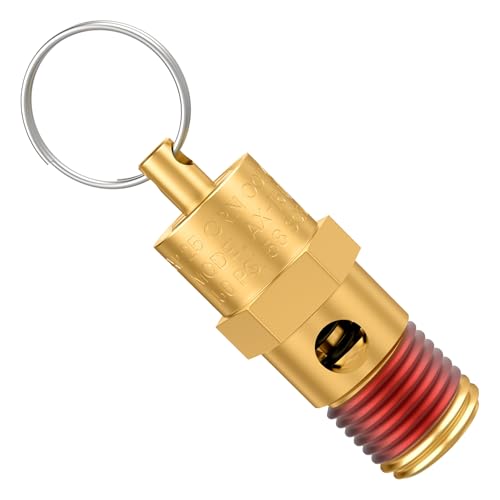
DALQUIS offers a 1/4″ NPT brass safety valve with a 200 PSI relief setting and flow of up to 70 SCFM. Brass construction supports durability and corrosion resistance in air, water, or oil discharge applications. It’s a solid choice for medium-pressure systems; avoid if your system routinely exceeds 200 PSI or requires higher flow capacity.
New 1/2″ NPT 200 PSI Air Compressor Safety Relief Valve

This 1/2″ NPT valve provides 200 PSI protection for larger or higher-capacity compressors and tanks. It is a practical mid-to-high range option, balancing relief capacity with general-purpose compatibility. Best for systems where 1/2″ connections are standard; consider smaller valves for compact units.
Buying Guide: Key Purchase Considerations
- Pressure setting vs. system needs: Match the relief pressure to the safe operating pressure of your equipment. Avoid over-sized valves that cause unnecessary leakage or under-sized valves that trigger too early.
- Thread size and connection type: Verify that the valve’s thread (MNPT vs NPT) and size fit your equipment’s mounting points and hoses.
- Material and durability: Brass bodies are common and durable; consider stainless steel for environments with moisture or corrosive elements.
- Flow capacity and size: Larger valves may be required for high-flow applications such as large air tanks or industrial pumps; smaller valves fit compact tools.
- Installation orientation and access: Ensure the valve can be installed in the available space and accessed for maintenance or inspection.
Frequently Asked Questions
- What is a safety pop off valve? A valve that relieves excess pressure to protect equipment and operators by venting air or gas when a preset threshold is reached.
- What mean bubble-tight in a valve? It refers to the valve’s ability to seal and prevent leakage at or near the set pressure, typically within a small percentage of the set point.
- Why check valve thread size before purchasing? Incorrect threads prevent installation and may require adapters or replacements that add cost and risk leaks.
- Can I use a valve with a higher pressure setting on a low-pressure system? It may not activate when needed, reducing safety margin; always choose a valve that matches or slightly exceeds your system’s maximum operating pressure.
- How do I know which valve is best for my compressor? Consider your pipe size, required relief pressure, and whether your system uses NPT or MNPT threads; for high-demand systems, a higher PSI and larger NPT might be necessary.
- Is a higher PSI valve always better? Not necessarily. The valve should match the maximum safe pressure of your equipment and provide reliable relief without causing nuisance venting.
Add a Comment