Looking for a reliable roll-to-sheet machine to form metal into precise shapes? This guide highlights five top options ideal for professionals and DIY enthusiasts. Each product is evaluated for material compatibility, ease of use, and practicality in typical workshop settings. Best for small-batch fabricators, hobbyists, and metalworkers who need consistent bends with minimal setup.
Buyer’s quick picks:
| Product | Best For | Why It Stands Out |
|---|---|---|
| VEVOR Slip Roller, 12.6″ Width | Compact benches and light to medium metals | Solid capacity, detachable rollers, multiple groove sizes |
| VEVOR Slip Roll Machine, 24″ Width | Medium to larger sheets and smoother operation | Upgraded surface and easy detachment for faster workflow |
| Metal Roller, Slip Roller, 23.5″ Width (Generic) | No electricity, desktop operation | Fully manual, versatile with several metals |
| KAKA INDUSTRIAL Slip Roll Machine, 49″ Width | Industrial-scale bending | Dual-speed drive, robust cast iron build |
| KAKA INDUSTRIAL Sheet Metal Brake (12″ 20-Gauge) | Combined shearing and rolling in small spaces | 3-in-1 machine reduces tool-changing |
VEVOR Slip Roller, 12.6 Inches

Best for: hobbyists and small shop settings needing a compact, sturdy slip roller for light to medium gauge work. This model handles up to 1.0 mm thick ST37 sheets and supports widths up to 320 mm, making it suitable for aluminum, copper, and low-carbon steel projects.
Why selected: It combines precision-ground steel rollers with a detachable upper axis, enabling easier retrieval of finished pieces. The two detachable rollers include grooves in 5/32 in, 15/64 in, and 5/16 in, providing flexibility in forming curves without frequent tool changes.
Limitation: The 12.6″ width constrains sheet size; larger jobs may require a broader machine to minimize repositioning.
VEVOR Slip Roll Machine, 24-Inch Forming Width
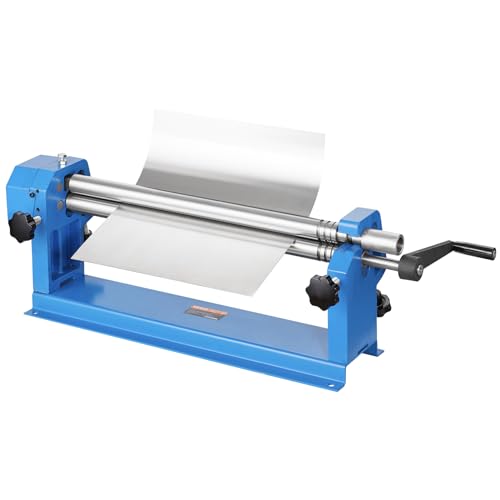
Best for: workshops needing a wider working width and smoother operation for aluminum, copper, and steel sheets. This model supports a 16 gauge capacity and offers detachable rollers for quick access.
Why selected: Upgraded roller surface grinding provides a smoother, more consistent finish with reduced friction. The detachable rollers and upper-shaft design streamline setup and part removal, boosting efficiency on repeated runs.
Limitation: Larger footprint requires more bench or floor space; ensure mounting stability for best results.
Metal Roller, Slip Roller, 23.5 Inch Width

Best for: users seeking a fully manual operation without electricity. It can handle a variety of metals with a width up to 23.5 inches and thickness under 1.5 mm, making it versatile for copper, aluminum, and low-carbon steels.
Why selected: The design emphasizes simplicity and portability, ideal for quick field fixes or desktop setups where power access is limited.
Limitation: Manual operation may reduce throughput for heavier gauge work; ideal for lighter gauges and craft-grade applications.
KAKA INDUSTRIAL Slip Roll Machine, 49″ Width

Best for: industrial-scale bending on wide sheets; suitable for thick metals where strength and consistency are paramount. It handles 16 gauge mild steel and 18 gauge stainless steel up to 49 inches wide with a dual-speed gearbox.
Why selected: High-duty cast-iron construction and a 60 mm ground roll with wire-forming grooves deliver robust performance under demanding workloads. Quick-release top roller simplifies workpiece removal and setup turnover.
Limitation: Higher weight and larger footprint; requires solid mounting and a stable workspace to maximize accuracy.
KAKA INDUSTRIAL Sheet Metal Brake, 12-Inch (20-Gauge)

Best for: small shops needing a compact 3-in-1 tool that can shear, bend, and roll in a 12-inch footprint. Supports 20-gauge mild steel and offers 90° bending with roll bending for cones and boxes.
Why selected: Zero-Flex HT200 cast iron frame resists deflection under heavy loads, while reinforced blades and steel rollers resist deformation. This unit reduces tool-switching and expands capabilities in tight spaces.
Limitation: 12″ work length may limit large panels; ensure the project scope fits the machine’s reach and capabilities.
Buying Guide
What should I consider when choosing a roll-to-sheet machine?
Material compatibility, maximum sheet width, and thickness capacity are key. If you work with aluminum or copper, ensure rollers are corrosion-resistant and smooth to minimize marking. For heavy-gauge steel, choose more robust cast-iron frames and higher gauge capacity.
What operation style fits my workflow?
Fully manual units are portable and low-cost, ideal for fieldwork or small crafts. Semi-automatic and gear-driven models suit higher-volume production with better control and repeatability. Consider whether you prefer detachable rollers for quick setup or fixed rollers for maximum rigidity.
How important is the build quality?
A sturdy frame (cast iron or welded steel) minimizes deflection under load, improving bend accuracy. Look for smooth roller surface finishes to reduce friction and wear. Quick-release features help with faster part changes and less downtime.
What about space and mounting?
Wider machines require more bench space or floor mounting. Ensure you have a stable workspace to avoid unwanted movement that could affect accuracy. If space is limited, prioritize compact models with decent width and capacity.
Maintenance considerations
Regularly inspect grooves and rollers for wear. Detachable rollers should be checked for alignment. Keep a simple lubrication routine to extend life and maintain smooth operation.
Practical tips for use
- Start with lighter gauges to dial in settings before moving to thicker sheets.
- Use appropriate protective equipment when bending metal to avoid injuries.
- Record settings for common jobs to speed up future work cycles.
Summary of key specifications (quick reference)
- Widths: 12.6″, 24″, 23.5″, 49″, 12″
- Typical gauges: 16-20 gauge (where specified)
- Detachable rollers: Yes (in several models)
- Materials: Aluminum, Copper, Low-Carbon Steel, Stainless (where supported)
Frequently Asked Questions
- What is a roll-to-sheet machine used for?
It forms sheet metal into curved shapes by bending along rollers. - Can I use these machines with stainless steel?
Some models support stainless steel up to specified gauges; check the exact capacity for each model. - Do I need electricity to operate a slip roller?
Some models are fully manual, while others use gears or motors; choose based on your preference. - What is the advantage of detachable rollers?
They speed up setup and reduce handling time between operations. - How should I maintain the rollers?
Regular cleaning, lubrication at recommended intervals, and inspection for grooves or wear help maintain performance.
Add a Comment