Finding the right rigid heat shield material depends on your heat source, installation surface, and the level of protection you need. This guide highlights five top options designed to handle extreme temperatures, with clear notes on who each product is best for and why. The selections favor high-heat resilience, flexible application, and installation practicality for automotive, DIY, and workshop projects.
The following quick-reference table helps compare chosen products at a glance. It focuses on suitability, temperature tolerance, and ideal use cases.
| Product | Best For | Max Temperature | Notes |
|---|---|---|---|
| Design Engineering 50519 Form-A-Shield | Under-hood heat management | Up to 1400°F | Aluminum with basalt barrier; formable for hot surfaces |
| FLASLD Aluminized Heat Shield Mat | High radiant heat areas | Up to 2000°F+ | Reflective, flexible, heavy-duty; multiple sizes |
| Peastorm Exhaust Wrap Heat Shield | Mufflers, chassis, engine compartments | Up to 1000°F continuous | Aluminum-embossed, easy to cut and shape |
| MAUTEMOWING Titanium Adhesive Backed Shield | Flame and ember protection | Up to 2500°F | Basalt-based, lightweight, reusable |
| FOURUB Automotive Shield | High-temp insulation with reflection | Up to 2300°F | Ceramic fiber with aluminum foil layer; reflective |
Design Engineering 50519 Form-A-Shield 12″ x 21″

Best for: Under-hood heat management where you need a rigid barrier that can be formed to curved or complex surfaces. This product uses a 10 mil dimpled aluminum layer bonded to a basalt thermal barrier to resist direct heat up to 1400°F. The Form-A-Shield is most suitable where durable, moldable protection is required around exhaust manifolds, turbo housings, or hot side engine components.
Why selected: It combines rigid protection with heat-resistant barrier material, offering a dependable option for installations that demand both shape retention and high-temperature tolerance.
Caution: Ensure surface is clean and dry before application to maximize bonding and longevity.
FLASLD Aluminized Heat Shield Mat 12” X 24”
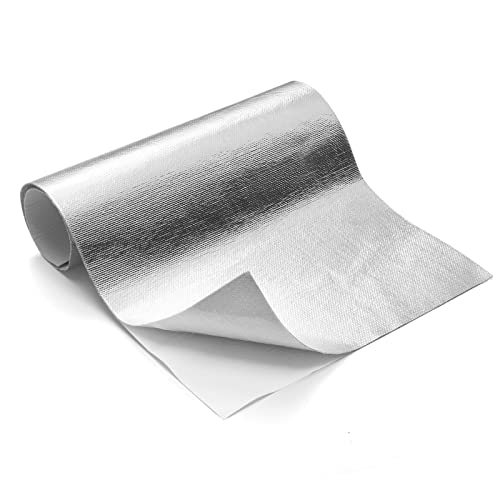
Best for: Projects where radiant heat control is critical, such as engine bays or rear of exhaust components needing strong reflective protection. It withstands extremely high temperatures (claimed above 2000°F) and reflects about 95% of radiant heat, reducing surface temperatures effectively. Available in several sizes for custom fits.
Why selected: Its aluminized surface and durability make it a dependable barrier for heavy-duty heat reflection and long life in demanding locations.
Caution: The material can be rigid after installation; trim carefully to avoid gaps that could let radiant heat penetrate.
Peastorm Exhaust Wrap Heat Shield 12” x 24”

Best for: Mufflers, chassis, and engine compartments needing flexible, easy-to-cut shielding. The 10 mil aluminum bonded to heat-resistant glass fiber enables a durable shield that can withstand continuous high temperatures, making it effective for wrapping pipes or shielding components in tight spaces.
Why selected: It offers a practical balance of rigidity and flexibility, enabling precise shaping around curved surfaces while delivering solid heat protection.
Caution: Fit around sharp edges may require careful trimming to prevent abrasion or tearing over time.
MAUTEMOWING Titanium Adhesive Backed Shield

Best for: High-temperature environments where maximum protection is required, such as areas prone to embers or intense heat exposure near fires or welds. The mat uses basalt-based layers to offer robust fire resistance with a lighter profile than solid stone.
Why selected: It provides the highest documented heat tolerance among the listed options (up to 2500°F) and easy adhesion for quick installations.
Caution: The product claims high temperature resistance; always ensure proper surface preparation to maintain adhesion under thermal cycling.
FOURUB 78mil Automotive Shield

Best for: High-temperature insulation with a strong reflective surface, suitable for automotive heat management around engines, exhaust systems, and hot components requiring a reflective, ceramic-fiber based barrier.
Why selected: It combines ceramic fiber insulation with an aluminum foil outer layer to reflect heat effectively, offering a balance of shielding performance and material flexibility.
Caution: Ceramics and reflective foils can be sensitive to punctures; handle with care during installation and avoid sharp, direct contact with abrasive surfaces.
Buying Guide
Key purchase considerations help determine which rigid heat shield material is right for you:
- Temperature tolerance: Match the shield’s maximum temperature rating to the expected heat source. Higher ratings are preferable for engine bays and exhaust systems.
- Installation surface: Refer to whether you need adhesive-backed sheets, pre-formed barriers, or cut-to-fit blankets. Adhesive-backed options simplify mounting on flat or mildly curved surfaces.
- Material composition: Aluminum-based shields are light and formable; basalt and ceramic fiber blends offer excellent high-temperature protection with rigid stability.
- Flexibility vs. rigidity: For tight spaces, flexible aluminized or embossed shields suit contours; for flat panels, rigid barriers provide lasting protection with fewer edges to seal.
- Ease of shaping: Consider whether the product can be trimmed, folded, or wrapped to fit custom layouts without compromising thermal performance.
- Durability and reuse: Reusable shields or those with easy-to-clean surfaces can reduce long-term replacement needs in workshop environments.
Frequently Asked Questions
- What is a heat shield material typically made of? — Materials vary but common options include aluminum-backed barriers, aluminized fabric, basalt composites, silicone-based binders, and ceramic fibers with reflective layers.
- Can I install heat shield on a curved surface? — Yes, many shields are designed to be formed or cut to fit curved surfaces, but some rigid barriers perform best on flatter panels.
- What temperature range should I target for automotive projects? — For most under-hood applications, aim for shields rated at least 1000°F, with higher protection for exhaust systems and near combustion zones.
- Are adhesive-backed shields reliable for outdoor or engine heat? — Adhesive-backed shields work well on clean, dry surfaces but may require additional mechanical fasteners for vibration-heavy areas.
- Is reflective shielding better than non-reflective for heat protection? — Reflective surfaces reduce radiant heat transfer, which is beneficial in direct line-of-sight heat exposure, while insulating barriers handle conductive and convective heat.
- How do I trim or cut heat shield material safely? — Use appropriate tools (snips, a sharp utility knife) and wear eye protection; follow the manufacturer’s guidance to avoid tearing or fraying the edges.
Add a Comment