Looking for reliable PTFE coated stainless steel stirring tools for laboratory mixing? This guide highlights five top options that deliver strong axial flow, corrosion resistance, and long-term durability. These tools are ideal for researchers, technicians, and students who need clean, reproducible mixing with minimal sample adhesion. Each option explains who it’s best for, plus practical considerations to help you choose.
Summary table — Selected products
| Product | Best For | Key Benefit | Diameter / Length |
|---|---|---|---|
| MEKIBOT 4-Blade Propeller Stirring Rod | Research labs needing fast, uniform mixing | Efficient axial flow with PTFE coated impeller | Not specified |
| MEKIBOT 4-Blade Straight Stirring Rod | Stable, clean mixing in overhead setups | 64mm impeller, PTFE coated | 64 mm |
| Hibatul PTFE Coated Rod 250mm | Medium-length overhead stirring for bench work | High temp and chemical resistance | 250 mm |
| HIBATUL INC 450mm PTFE Rod | Long-reach stirring for larger vessels | Wide compatibility, PTFE coating | 450 mm |
| HIBATUL INC 300mm PTFE Coated Shaft | Mid-length overhead mixing | Stability and low friction surface | 300 mm |
| MEKIBOT Flat Blade Shaft | Stable, controlled mixing | 67mm impeller with PTFE coating | 350 mm shaft |
MEKIBOT 4-Blade Propeller Stirring Rod

This 4-blade propeller design creates strong axial flow for fast, uniform mixing in laboratory liquids. The shaft is made from durable 304 stainless steel, and the impeller is PTFE coated to resist common lab solutions. Best for labs performing rapid homogenization of viscous or multi-component samples. A limitation is availability of precise shaft dimensions in the listing, so verify compatibility with your overhead stirrer model. Choose this for high-throughput mixing in research settings.
MEKIBOT 4-Blade Straight Stirring Rod

This straight 4-blade design uses a 64mm impeller for fast, uniform mixing in laboratory applications. It employs a PTFE-coated impeller to resist lab solvents and reduce adhesion, helping maintain clean samples across runs. Best for steady, even mixing in overhead setups. It’s a solid choice for routine lab tasks where predictable flow is important, though it may be less effective for highly viscous fluids without additional agitation.
Hibatul 250mm PTFE Coated Shaft

This PTFE stirring rod offers a mid-length reach with high chemical and temperature resistance, suitable for longer vessels or higher-temperature experiments. Best for biochemical and medical research labs that require stable operation over extended periods. A potential limitation is that the listing emphasizes chemical resistance; verify the specific solvent compatibility for your samples and overhead stirrer shaft fit.
HIBATUL INC 450mm PTFE Shaft
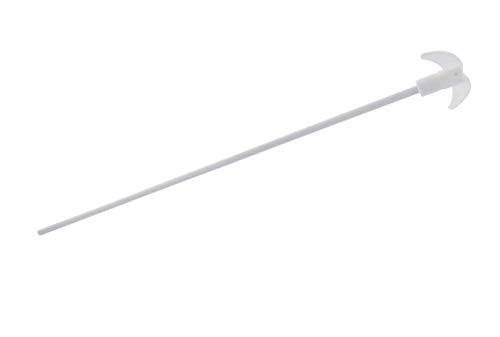
This long 450mm shaft supports stirring in larger vessels and wider reactors. The PTFE coating minimizes sticking and simplifies cleaning after experiments involving sticky or polymeric samples. Best for facilities that routinely prepare large-volume mixes. A caveat is the longer shaft length may require compatible overhead stirrers and mounting hardware; confirm compatibility before purchase.
HIBATUL INC 300mm PTFE Shaft

This 300mm PTFE-coated shaft provides a balanced option for mid-sized vessels. It combines a stable torque with low friction surface, aiding smoother mixing in routine lab tasks. Best for standard overhead stirring in medium-scale experiments. Limitation: not as long as the 450mm option, so suitability depends on vessel size and mounting height.
MEKIBOT Flat Blade Shaft

The flat blade design with a 67mm impeller provides stable, controlled mixing suitable for routine liquid processing. The 350mm shaft length with a 6mm diameter supports reliable torque transmission and compatibility with overhead stirrers. Best for steady, uniform mixing in standard lab workflows. A note: ensure your vessel diameter matches the blade span for optimum efficiency.
Buying Guide: PTFE Coated Stainless Steel Overhead Stirring Tools
- What vessel size and shape will you stir? Consider shaft length and blade diameter to avoid overhang or insufficient immersion.
- What fluids will you handle? PTFE coating offers chemical resistance but verify compatibility with strong solvents or reactive reagents in your lab.
- What temperature range is required? Look for PTFE coatings rated for your operating temperatures to prevent deformation or wear.
- Which design suits your workflow? Propeller vs. flat blade affects mixing pattern; choose based on viscosity and desired shear.
- Are you using a compatible overhead stirrer? Confirm shaft diameter, mounting type, and locking mechanisms to ensure a proper fit.
FAQ
- Q: What is PTFE coating used for in stirring tools? A: PTFE coating reduces friction, resists chemical attack, and minimizes sample adhesion for easier cleaning.
- Q: Are PTFE-coated shafts suitable for high-temperature labs? A: Yes, many are rated for elevated temperatures, but check the exact operating range for each model.
- Q: How do I choose between a 250mm, 300mm, and 450mm shaft? A: Match shaft length to vessel height and required immersion depth for effective mixing.
- Q: Can these tools be used with standard overhead stirrers? A: Most are designed for compatible overhead stirrer systems; confirm shaft diameter and mounting compatibility.
- Q: Is a PTFE-coated impeller better than a plain stainless steel one? A: PTFE coatings resist sticking and chemical attack, improving cleanliness in many lab scenarios.
- Q: What maintenance is required for PTFE-coated rods? A: Rinse after use, avoid abrasive cleaners, and inspect coating for signs of wear or delamination.
Add a Comment