When shopping for a precision 3 jaw chuck, you want reliable rigidity, accurate runout, and clear clamping ranges for both internal and external work. This guide highlights five top options, each suitable for different buyers—whether you’re building a small CNC setup, upgrading a manual lathe, or equipping a workshop for multi-purpose turning and milling. The selections prioritize concentricity, durable materials, and practical jaw designs to help you choose confidently.
Summary table of selected products:
| Product | Approx. Clamping Range | Best For | Notes |
|---|---|---|---|
| maXpeedingrods 8″ 3-Jaw Lathe Chuck K11-200A | Internal 4–85 mm; External 65–200 mm | Small parts to larger shafts and discs | High precision ≤0.05 mm, hardened steel |
| WFLNHB K11-80 3″ 3-Jaw | 3″ (approx. 80 mm) | Compact CNC milling and drilling | Includes two jaw sets |
| Yunnergo K11-80 Self Centering | 0.08–2.48″ (2–63 mm) | Multi-scenario processing | Quenched, easy setup |
| Shars 3″ 3 Jaw Self Centering | 3″ size | Precision projects with Morse taper | Specifics limited in listing |
| VEVOR 8″ 3-Jaw Lathe Chuck | 4–200 mm external; 0.16–8 in internal | Heavy-duty and versatile | HT300, self-centering |
maXpeedingrods 8″ 3-Jaw Lathe Chuck K11-200A
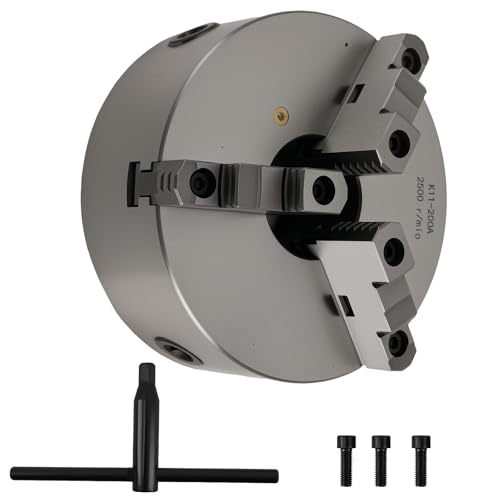
The K11-200A is an 8-inch self-centering chuck designed for both internal and external turning. It clamps a wide range: 4–85 mm for internal jaws and 65–200 mm for external jaws. The high-precision scroll mechanism delivers up to ≤0.05 mm accuracy, supporting stable operation at higher speeds. Best for hobby CNC lathes and manual machines that require precise, versatile holding of shafts, discs, or hex bars.
Who it’s for: machinists needing a single chuck to handle varied parts without changing jaws. Why chosen: strong combination of wide clamping range, hardened steel construction, and low runout. Caution: ensure your spindle and mounting bolts align with the K11-200A’s bolt circle and T-key mounting requirements.
WFLNHB K11-80 3 Inch 3 Jaw Self Centering Lathe Chuck

sized at three inches, this compact chuck is a practical option for CNC drilling and milling setups where space is limited. It includes two sets of jaws for versatility, enabling both internal and external workholding within a compact footprint. Its design emphasizes straightforward mounting and reliable centering for smaller projects.
Best for: users who need a compact, reliable chuck for lighter applications or small-diameter workpieces. Why chosen: the two jaw sets expand capability without requiring a full-size chuck. Caution: performance details such as runout are not highlighted in the listing, so verify tolerance needs for higher-precision tasks.
Yunnergo K11-80 Self Centering 3 Inch Lathe Chuck

Yunnergo’s K11-80 offers a 3-inch diameter with a clamping range from 0.08 to 2.48 inches (2–63 mm). It features a hardened steel body and rolling plate with a dedicated T-shaped wrench for straightforward installation. This chuck is positioned as a versatile option for multi-scenario processing, balancing ease of setup with dependable performance for small to mid-sized parts.
Best for: users seeking a straightforward, easy-to-set-up chuck for varied, moderate-precision tasks. Why chosen: the combination of a compact size and quenching-hardened construction supports stable operation. Caution: ensure compatibility with your spindle thread and mounting pattern before purchase.
Shars 3″ 3 Jaw Self Centering Precision Chuck

Shars offers a 3-inch 3-jaw self-centering chuck designed for precision applications with a Morse taper back and an arbor option. The listing notes drawbar thread size and maximum RPM (3/8×16 UNC and up to 4000 RPM), indicating it’s suited for precise, moderate-speed turning and milling tasks where quick setup and repeatable clamping are essential.
Best for: users who need a Morse-taper chuck for small lathes and mills with reliable self-centering performance. Why chosen: standard Morse taper compatibility simplifies integration with compatible machines. Caution: check if your spindle requires an alternative back-plate size or thread pattern beyond the listed options.
VEVOR 3-Jaw Lathe Chuck, 6 Inch

This 6-inch VEVOR chuck uses HT300 iron construction with 53 HRC jaw hardness and 45 HRC scroll plate hardness. It features a self-centering mechanism for stable clamping and a 1-1/2 in-8 threaded backing plate for quick, secure mounting. The clamping range spans from 0.12 to 5.71 inches (3–145 mm), making it adaptable for a broad set of parts and applications.
Best for: workshop operators needing a robust, mid-to-large size chuck with broad clamping capacity. Why chosen: strong materials and precise self-centering reduce runout across a range of job sizes. Caution: confirm compatibility with your machine’s backing plate thread and the involved jaw options for optimal fit.
Buying Guide: How to Choose the Right Precision 3 Jaw Chuck
- Clamping range: Match internal and external jaw ranges to your typical parts. A wider internal range helps with small shafts and bores, while broader external jaws handle larger discs and irregular shapes.
- Runout and accuracy: Look for a claimed runout or accuracy of around 0.05 mm (or better) for high-precision turning and milling tasks.
- Jaw material and hardening: Hardened jaws and heat-treated scroll plates improve wear resistance and longevity, especially in high-speed operations.
- Back plate and mounting: Confirm the back-plate thread size (e.g., 1-1/2 in-8, Morse taper) and whether the chuck supports T-keys, bolt circles, or direct mounting on your spindle.
- Jaw versatility: Some chucks include both internal and external jaws, and some offer reversible jaws. Decide if you need dual-use jaws or separate jaw sets for specialized parts.
- Material and build quality: HT300 iron and hardened steel bodies provide good rigidity and durability in demanding environments. Consider corrosion resistance for workshop conditions.
- Application fit: For small, precise parts, prioritize compact chucks with tight internal ranges. For larger components, select chucks with higher external clamping capacity and robust construction.
Frequently Asked Questions
- What is the difference between a 3-jaw and a 4-jaw chuck? A 3-jaw chuck is self-centering and quick for symmetric parts; a 4-jaw chuck offers independent adjustment for irregular shapes, but takes longer to center.
- Can I use a 3-jaw chuck on a milling machine? Yes, many 3-jaw chucks are compatible with milling machines and lathes, provided the backing plate and mounting pattern match your machine.
- What should I consider when choosing clamping range? Choose clamping ranges that cover your typical part sizes. A wider internal range plus a strong external range reduces jaw changes during work.
- Is higher hardness always better? Higher hardness improves wear resistance and longevity, but may require special maintenance and correct jaw material pairing.
- Do all chucks include mounting bolts or wrenches? Many listings include basic mounting hardware, but verify which accessories are included to avoid missing essential tools.
- How do I verify compatibility with my machine? Check the thread size, back plate type, and whether your spindle uses a Morse taper, bolt circle, or T-slot mounting.
Add a Comment