Answering your search for a reliable poultry feed making machine: these machines compress raw ingredients into durable pellets that poultry, livestock, and farm animals can readily eat. The best options balance power, durability, and ease of use for different scales of operation. This guide highlights five strong choices, explaining who each is best for and why.
Summary table of selected products:
| Product | Best For | Pellet Diameter | Key Strength |
|---|---|---|---|
| VEVOR 5 mm Pellet Mill | Small to mid-size farms needing consistent 5 mm pellets | 5 mm | Three rollers, safety features |
| TECHTONGDA 6 mm Pellet Mill | Livestock-focused, needs flexible disc options | 6 mm | Three-roller design, durable rollers |
| ChickTrek 4 mm Pellet Mill | DIY homestead or small farm | 4 mm | Three-roller anti-blockage design |
| VEVOR 8 mm Pellet Mill | Scale-up operations needing larger pellets | 8 mm | Robust motor, safety features |
| TECHTONGDA 4 mm Pellet Mill | Smaller facilities with 4 mm needs | 4 mm | Four-head rollers, durable construction |
VEVOR Feed Pellet Mill Machine, 5 mm

The VEVOR 5 mm model uses a 3KW single-phase copper motor, a 5 mm grinding disc, and 3 pressure rollers. This combination aims for steady production of high-quality 5 mm pellets for chickens, pigs, sheep, and ducks, and it works with some farm byproducts like hay and corn. The design emphasizes wear resistance and heat tolerance through heat-treated steel components. A larger protective cover adds motor protection and can improve overall production efficiency.
Best for: small to mid-size operations needing consistent 5 mm pellets with straightforward operation. Better for users who want a robust safety setup and real-time monitoring of voltage, current, and oil levels. Avoid this if you require discs significantly smaller than 5 mm or oversized pellets beyond 5 mm.
Caution: The machine relies on a three-roller system; ensure rollers are aligned to prevent uneven pressures that can affect pellet uniformity.
TECHTONGDA 6mm Feed Pellet Mill Machine

This pellet mill features a 6 mm grinding disk and a 3-Head roller system. It’s designed for sheep, pigs, and cattle feeds and supports different disc sizes to tailor pellet diameter. The rollers and grinding discs are quenched for hardness and durability, helping to maintain pellet molding regularity and uniformity. The three-roller setup promotes consistent compression and smoother operation, reducing downtime due to jams.
Best for: users who want flexibility in pellet size and a robust build for regular pellet production. Choose this if you need a reliable option for multiple livestock types and occasional disc swaps. Limitations include the need to manage disc changes and alignment when changing pellet sizes.
ChickTrek 4MM Pellet Mill
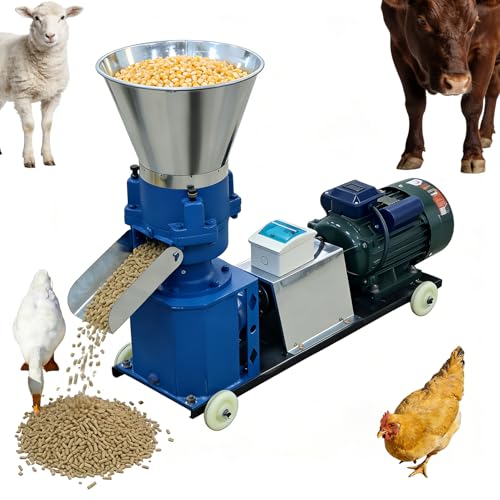
ChickTrek uses a unique three-roller anti-blockage design, reducing jamming and downtime. It targets DIY farmers and homesteads needing dependable 4 mm pellets for chickens, ducks, and other poultry. It emphasizes ease of use, with a straightforward operating process suitable for non-experts while delivering professional-style results. The machine processes common ingredients into dense, durable pellets with consistent size.
Best for: small farms or home setups seeking a simple yet efficient 4 mm pellet system. Choose this if you prioritize minimizing downtime due to blockages. Caution: its three-roller approach may limit output for very large batches compared to higher-capacity models.
VEVOR 8 mm Feed Pellet Mill
The 8 mm version from VEVOR upgrades to an 8 mm grinding disc with the same 3-roller design and 3KW motor. It’s designed for farms producing larger pellets needed by certain livestock or for specific feed mixes. The protective cover and safety features mirror the 5 mm model, with real-time monitoring of power, voltage, and oil levels, plus overload protection for safer operation.
Best for: larger flocks or operations that require bigger pellet sizes for particular animals or feed strategies. Better for users who want a higher-volume setup without sacrificing safety. Limitation: pellet output and heat must be managed to avoid motor wear during long runs.
TECHTONGDA 4mm 4-Head Roller Pellet Mill

This TECHTONGDA model adds a fourth roller and a 4 mm grinding disk, designed for poultry and other farm animals. The four-head roller system emphasizes stable pellet formation and uniform diameters. It suits users who want precise control over pellet consistency and need to accommodate a range of ingredients. The device supports 2–8 mm discs in general, enabling adaptable pellet sizes through configurations.
Best for: farms needing precise 4 mm pellets with higher roller count for smoother compression. Choose this if you want robust construction and smoother molding, but be mindful of potential higher maintenance needs with more moving parts.
Banfluxion 4mm Pellet Mill with Three Head Rollers
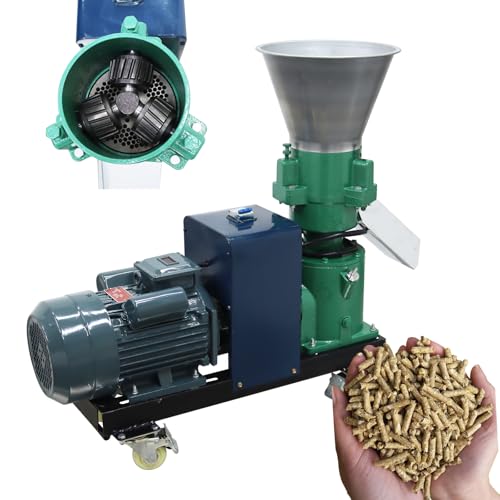
Banfluxion’s 4 mm model provides a large discharge port and voltage display for monitoring. It rides on strong nylon wheels with brakes, making movement around a farm or workshop practical. With a 4 mm grinding disc, this unit targets common poultry feeds and lighter industrial pellets. It emphasizes ease of use and transportability while maintaining efficient production.
Best for: users who need mobility and straightforward operation, especially on small farms or moved-between-sites setups. Avoid if you require very large-scale pellet output in a single run, as higher-volume models may offer more throughput.
Dewinston 110V 3-Head Pellet Mill

Dewinston’s 110V pellet mill offers 3 heads, multiple disc sizes (2.5–8 mm), and a 5.5 KW motor designed for 60 Hz operation. It supports a range of pellets suitable for various poultry and livestock feeds. The specification sheet notes high-efficiency motor features and multiple disc options to tailor pellet size to your needs.
Best for: mid-to-large operations seeking versatility in pellet size and a strong head-roller setup. Choose this if you regularly switch pellet diameters and want ceiling-level production; plan for compatible electrical requirements and space.
Buying Guide: Key Considerations for Poultry Feed Pellet Mills
- Pellet size: Choose a model whose available discs cover your target diameters (commonly 4–8 mm for poultry). Smaller diameters suit chicks; larger sizes suit mature birds or cattle feed.
- Roller system: Three- vs four-head rollers affect pressure stability and jam risk. More rollers often improve uniformity but may require more maintenance.
- Motor power and voltage: Look for a motor with sufficient wattage (3KW–5.5KW is common for home to small-farm use) and check electrical compatibility (110V vs 220V).
- Durability: High-temperature quenching on grinding discs and rollers boosts wear resistance. Steel components should be treated for heat tolerance to extend life.
- Safety features: Overload protection, emergency stops, visible oil windows, and voltage/current dashboards help monitor operation and protect workers.
- Ease of use: Intuitive controls and straightforward assembly make a big difference for DIY users and small farms.
- Maintenance: Consider availability of replacement discs and rollers, and how easy it is to clean and service the machine after use.
Frequently Asked Questions
- What pellet diameter should I choose for chickens? For growing chicks, 2–4 mm is common; for adult chickens, 4–5 mm often works well.
- Do I need a three-roller or four-roller machine? Three-roller designs are typically sufficient for small to mid-size operations; four-roller units can improve pellet uniformity and throughput for larger volumes.
- Is a copper motor better than other motors? Copper-wired motors can offer reliable electrical characteristics and efficiency, but overall performance depends on the design and build quality of the entire unit.
- Can I use this machine for non-poultry pellets? Yes, many models support hay, straw, corn, alfalfa, and similar ingredients, subject to disc size and roller compatibility.
- What safety features are essential? Look for emergency stop, overload protection, clear status indicators, and protective covers around moving parts.
- How do I maintain pellet quality? Regularly check disc alignment, roller wear, and ensure consistent input material moisture to avoid pellet breakage.
Add a Comment