When choosing a portable toxic gas detector, the goal is fast, reliable detection of common industrial gases with clear alarms and long battery life. This guide highlights five top options ideal for workers, homeowners, and DIY adventurers who need immediate alerts for H2S, CO, LEL, O2, and more. Each product section explains who it’s best for, why it was chosen, and any practical limitations to consider.
| Product | Best For | Key Strength |
|---|---|---|
| TopTes Guard-101 | Work sites needing 4-gas monitoring with long run time | Fast 0.5s response; triple alarms; 14h battery |
| Forsensal Gas Detector with Pump | Field work requiring pumped sampling and data visibility | Includes calibration kit; records and curves on large display |
| TOPTES Guard-863Pro | Heavy-duty environments requiring durable sensors and data export | 5-year O2 sensor; TFT screen; USB data export |
| HAOKESITE 4 Gas Monitor | Underground or confined spaces with loud environments | Real voice prompts; factory calibrated; LCD display |
| ADKS-4 Portable Gas Detector | Industrial safety with robust alarms and certifications | Three alarms; high-quality sensors; rugged ABS body |
TopTes Guard-101 Gas Detector
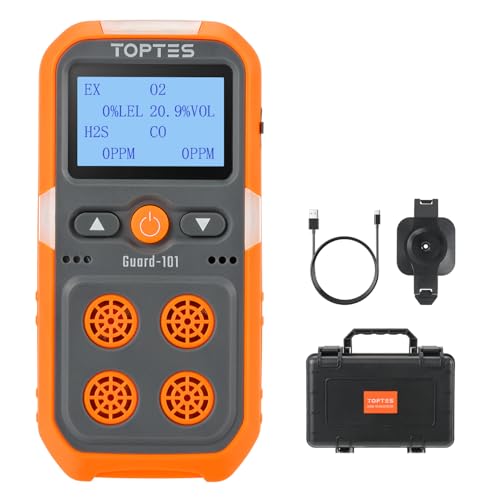
The TopTes Guard-101 is a 4-gas monitor for H2S, CO, LEL, and O2. It uses a rugged ABS housing that’s waterproof, dustproof, and explosion-proof, with a back-clip for easy carry on the job. It includes password protection to prevent accidental use, initially set to “69.” This detector features a triple alarm system—LED, vibration, and audible alerts—and responds within 0.5 seconds. A battery life of up to 14 hours supports extended monitoring. Alarm records can be stored for later review, helping teams track exposure events over time.
Best for: maintenance crews, construction sites, and industrial workers who need quick 4-gas alerts and long battery life. The device’s rugged build suits harsh environments, but the 14-hour runtime should be planned with shift lengths in mind. Consider this if you require fast response and persistent alarms in dusty or wet conditions.
Caution: For extended multi-day use, verify battery management and consider having spare batteries on-site to avoid interruptions during long shifts.
Forsensal Gas Detector With Pump

This 4-gas monitor includes a built-in pump, enabling efficient sampling of air from areas that are hard to reach. It detects CO, O2, H2S, and EX (combustibles) and arrives with a Calibration Certificate in the box. An initial password (“4321”) provides basic security, and readings are displayed on a large screen. A 3000mAh battery supports more than 8 hours of standby usage, and the package includes essential accessories such as calibration caps and USB-C charging. The device allows viewing gas-type records and curves, which is useful for pattern analysis over time.
Best for: field technicians and contractors who need pumped air sampling and straightforward data visualization. It’s a solid choice for jobs where accessing the gas source requires suction rather than diffusion. Note: Users should rely on the calibration kit for accuracy and follow the included setup instructions closely.
Caution: Availability of calibration materials may vary; ensure you have the appropriate calibration flow for your environment.
TOPTES Guard-863Pro 4 Gas Monitor

The Guard-863Pro is a professional 4-gas monitor for H₂S, CO, LEL, and O₂ featuring a TFT color display and an upgraded O₂ sensor with a claimed 5-year lifespan. It emphasizes fast 0.5-second detection and a continuous triple alarm that includes sound, light, and vibration. USB data export supports recording alarm histories and calibration data for analysis. Sensor performance remains robust in demanding environments, making it suitable for industrial settings where precise gas tracking over time matters.
Best for: workplaces needing detailed visibility into gas trends and reliable long-term sensor life. The upgraded O₂ sensor and data export capability make it a strong choice for compliance and safety programs. Limitation: higher-end features may require familiarity with the interface to maximize data export and interpretation.
Caution: Ensure regular calibration per manufacturer guidance to maintain accuracy and data integrity.
HAOKESITE 4 Gas Monitor

The HAOKESITE 4 Gas Monitor covers EX (LEL), H2S, O2, and CO with four alarm modes: voice, 120 dB siren, vibration, and visual indicators. An LCD display helps read concentrations, and a substantial 1800mAh battery supports longer use. The device is factory calibrated and ships with a calibration cap, enabling quick start after unboxing. It uses real voice prompts to aid understanding in noisy environments and offers reliability for underground or confined-space work.
Best for: workers in noisy, confined spaces who need audible, visual, and tactile alerts. It’s a good balance of usability and durability. Limitation: the presence of loud alarms may be disruptive in open, quiet environments; plan usage accordingly.
Caution: Like all gas detectors, regular calibration is essential to maintain accuracy, especially if stored for long periods between uses.
ADKS-4 Portable Gas Detector

The ADKS-4 is a portable 4-in-1 detector for CO, O2, H2S, and LEL. It features triple alarm modes—LED, sound, and vibration—so alerts are noticeable in various environments. Built from high-strength ABS plastic, the unit is designed to be water and dust resistant as well as explosion-proof, suitable for harsh environments. The device emphasizes speed and reliability with quick response times and a long sensor lifespan typical of industrial-grade devices. It also mentions test reports and certificates for reliability and accuracy across environments.
Best for: industrial settings where robust alarms and durability are essential, and where certification-backed reliability matters. Limitation: users should verify sensor response times and ensure calibration intervals align with site safety protocols.
Caution: Ensure compatibility with your local safety standards and maintain calibration as recommended by the manufacturer for consistent performance.
Buying Guide: Portable Gas Detector Essentials
What gases does your work or home environment require monitoring for? Match the detector’s gas sensing capabilities to your risk profile. Consider the following:
- Gas coverage: Most “4-gas” models monitor CO, H2S, O2, and LEL. If you rely on detecting other gases, search for detectors with additional sensors or modular options.
- Alarm types: Look for triple alarm systems (audible, visual, vibration) to ensure alerts in noisy or remote areas.
- Power and runtime: Longer battery life reduces downtime. Check whether you need internal rechargeable packs or replaceable batteries for extended field use.
- Durability: For construction or underground work, select models with explosion-proof ratings, water/dust resistance, and rugged housings.
- Data and calibration: Some devices offer data logging and USB data export. Regular calibration ensures accuracy in changing environments.
- Display readability: A bright LCD or TFT color display improves visibility in dim or bright conditions. Consider models with user-friendly interfaces or voice prompts for noisy sites.
Frequently Asked Questions
- What is a 4-gas detector good for?
– It monitors four common hazards (often CO, H2S, O2, LEL) to provide rapid alerts in diverse environments, helping prevent exposure and accidents. - Do I need a pumped detector?
– Pumped units are helpful when sampling air from hard-to-reach areas or when diffusion is slow. For open areas, diffusion-only models may suffice. - How often should I calibrate?
– Calibration frequency depends on usage and environment; many devices include an initial calibration certificate and require routine checks per manufacturer guidelines. - What is battery life typically like?
– Battery life ranges from several hours to a full work shift. Choose a model with enough runtime to cover your typical tasks and have backups if needed. - Are data logs important?
– Data logs help track exposure incidents, support safety audits, and enable trend analysis for ongoing safety programs. - Is durability important for home use?
– For home maintenance and occasional use, a rugged, explosion-proof design isn’t essential, but consider resistance to dust and water for longevity.
Add a Comment