When you need fast, reliable hardness readings on the go, a portable hardness testing machine is essential. This guide highlights five top options for American buyers, focusing on accuracy, versatility, and ease of use. The featured models suit different needs: from compact pen-type testers for fieldwork to multi‑scale kits for shops and job sites. Read on to find the best fit for your materials and testing scenarios, with practical pros, limitations, and who each device is best for.
| Product | Best For | Key Benefit | Note |
|---|---|---|---|
| LS252D Leeb Portable Hardness Tester | Professional metal shops and field technicians | Built‑in direction sensor for cross‑direction compensation | Reliable with dual coil design |
| Helivivfy Metal Hardness Tester | Multi‑material testing and data logging | 7 hardness scales and 20 materials supported | Rich data storage capabilities |
| GOYOJO Portable Leeb Tester | Versatile testing with easy interface | 7 impact devices; OLED display; intuitive menu | Good for quick switching between tests |
| Soonkoda 7‑in‑1 Portable Leeb Tester | Thick or varied metal parts | 7 scales; automatic device recognition | Preset hardness alarms |
| PHR‑1 Small Portable Rockwell Tester | Small parts and precise RC readings | ISO/ASTM compliant; desk‑grade accuracy in a mini form | Best for compact parts and standard Rockwell tests |
Buyer tip: choose a device whose supported scales match your common materials (e.g., HRC, HV, HB) and whose probe type suits your workpiece thickness and geometry. If you test many materials or need memory, prefer models with multiple scales and robust data logging.
LS252D Leeb Portable Hardness Tester Machine
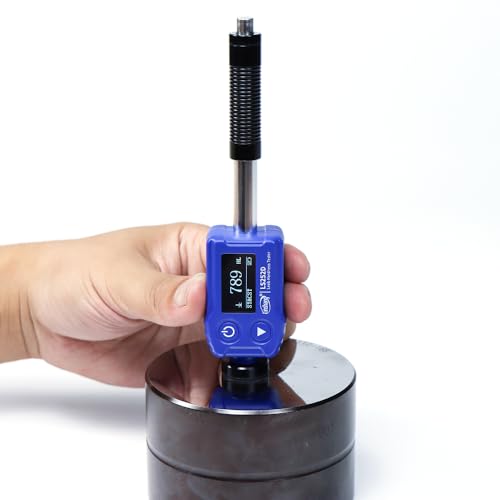
The LS252D uses a D‑type impact device for measuring hardness across a range of metallic materials. It features dual coil technology to improve measurement repeatability and accuracy and includes a built‑in direction sensor that automatically compensates for impact direction. Best for professional metal processing environments where quick, repeatable tests on steel and alloy workpieces are needed. Limitations may include the learning curve for operators new to Leeb testing and reliance on proper impact alignment for best results.
Helivivfy Metal Hardness Tester

This tester supports seven hardness systems (HL, HB, HRA, HRB, HRC, HV, HS) and up to 20 material types, making it versatile for mixed metal shops. It also stores data across dozens of test blocks, enabling traceability for batch testing. Best for users who need cross‑scale compatibility and strong data management. A potential limitation is that the device’s breadth can be more than what a single project requires, which may complicate operation for occasional users.
YUSHI Portable Leeb Tester (LM100, LM500) Collection

Designed for small parts, pipes, and surface‑hardened layers, this collection is well‑suited for small batch processing and on‑site spot checks. The emphasis is on portability and accessibility, with a focus on simple tests rather than a broad scale range. Best for field technicians handling compact components or thin sections where quick checks are needed. A limitation is that it may not cover as many scales or impact device options as larger multi‑scale kits.
GOYOJO Portable Leeb Hardness Tester

GOYOJO offers a versatile Leeb hardness tester with seven impact devices and an OLED display for clear readings. Its intuitive menu facilitates rapid switching between scales and materials, making it a strong choice for shops that handle a mix of metals, including stainless steel and copper alloys. Best for users who value a straightforward UI and flexible testing options. A caveat is that recalibration isn’t required when swapping devices, but users should verify device compatibility for specialized alloys.
Soonkoda 7‑in‑1 Portable Leeb Tester

This model emphasizes multi‑scale versatility with seven scales and automatic recognition of impact devices. It also includes preset hardness limits to support batch measurements and alarms when limits are exceeded. Best for manufacturers or job sites performing routine checks across different materials and batches. Limitations include dependence on automatic device recognition, which may require occasional verification for unusual alloys.
PHR‑64 Chain Clamp Portable Hardness Tester

Engineered for on‑site testing of large cylindrical workpieces like shafts and rollers, this unit is suitable for piecewise hardness assessment across long sections. Best for field teams working with large pipes or heavy machinery components. A potential drawback is that it is specialized for large pieces, making it less convenient for small parts or quick spot checks.
Buying Guide: Portable Hardness Testing Machines
What scale do you need?
Common scales include Rockwell (HRC, HRB, HRA), Vickers (HV), Brinell (HB), and Shore (HS). Match the scale to your typical material family to avoid conversion complexities and ensure measurement relevance.
What material range should the device handle?
Some testers excel with steel and cast iron, while others cover copper alloys, aluminum, and beyond. If you test a broad mix, prioritize models with multi‑scale capability and robust data logging so you can store and compare results later.
Do you require data storage and export?
If batch testing or proof of compliance matters, choose a model with ample storage (blocks of tests) and easy data export. Devices with on‑board memory simplify traceability and reporting.
Is field portability a priority?
Pen‑type and compact handheld units are ideal for tight spaces and road projects. Larger multi‑scale kits suit workshops and controlled job sites where battery life and ergonomic handling matter.
How important is automatic device recognition?
Automatic recognition helps when switching between test devices or scales. It reduces setup time and minimizes measurement errors from human error. Consider this feature if your workflow frequently uses multiple probes.
What are the common limitations to expect?
Limitations often include a learning curve for accurate impact alignment, the need for calibration checks for specialized alloys, and potential compatibility gaps between devices and exact material types. Plan for operator training and device validation where necessary.
Operational tips for better results
- Ensure proper impact direction alignment with the material surface.
- Use the correct impact device for the workpiece thickness and material type.
- Record environmental conditions if readings are sensitive to temperature or surface finish.
- Maintain calibration checks per your internal quality procedures.
FAQ
- What is a Leeb hardness tester? A Leeb tester measures hardness by analyzing the rebound velocity of a standard impact body on a material, using a numerical scale for various materials.
- When should I prefer a 7‑in‑1 tester over a single‑scale unit? Choose a 7‑in‑1 tester when you work with diverse metals and need quick access to multiple hardness scales in one device.
- Can these devices test non‑ferrous metals? Yes, many models support alloys beyond steel, including aluminum and copper alloys, depending on their scale support.
- Do testers require calibration for every material change? Calibrations are recommended for accurate results, especially when switching material families or testing very hard or very soft alloys.
- Are there safety considerations when testing large pipes or shafts? Follow standard shop safety practices and use proper clamps or fixtures to stabilize long workpieces during testing.
- Which tester is best for on‑site large components? Devices designed for large workpieces, such as chain clamp testers or specialized pipe testers, are typically best for on‑site large components.
Add a Comment