All-in-one portable gas flow meters help technicians quickly verify shielding gas, air, nitrogen, oxygen, and other gases in field or shop settings. This guide highlights five top options and clarifies who each is best for. Whether you’re welding, performing leak audits, or conducting lab checks, these meters offer compact design, clear readouts, and practical features to support precise gas flow measurements.
Summary at a glance: the following table compares the five selected models for quick decisions on best use cases, portability, and key capabilities.
| Product | Best For | Flow Range | Key Benefit |
|---|---|---|---|
| Sxstar Argon Co2 Professional Gas Flow Meter | Welding shops needing simple, direct gas testing | 0-25 L/min | Peashooter style tester for MIG/TIG torches |
| Rendrox 1/4″ NPT Portable Digital Mass Flow Meter (MF5706) | Field audits and leak checks | 0-20 L/min | Lab-grade accuracy with portable 180° LCD |
| Dowwnel MF5712 (0-250 L/min) | Industrial testing and multi-gas tracking | 0-250 L/min | MEMS tech, RS485 Modbus, versatile gas support |
| Profax PX 50020 | Shield gas optimization in welding | Up to 25 LPM | Direct torch gas flow measurement |
| JIAWANSHUN Oxygen Flow Meter 0.1-1.5 LPM | Oxygen flow control and detection | 0.1-1.5 L/min | Copper connector, simple single-gas readout |
Sxstar Argon Co2 Professional Gas Flow Meter

Best for: Welding shops that need a straightforward, attach-and-measure device for MIG/TIG torch gas flow testing. The peashooter-style meter reads 0-25 L/min with 1 L/min graduations, and is designed to sit over the gas nozzle to show flow from the ball’s top. Suitable for all gases, it provides a simple, quick check in production or repair environments. Limitation: lacks advanced networking or multiple gas-sensor options, so use when you primarily need a quick read.
Rendrox 1/4″ NPT Portable Digital Mass Flow Meter

Best for: Field audits and maintenance tasks requiring reliable accuracy with common 1/4″ NPT connections. It measures 0-20 L/min for air, nitrogen, oxygen, and other inert gases, and features a rotatable LCD for easy viewing. Dual power options (batteries or AC) support mobile work. Caution: battery life and availability of AA batteries should be considered for long field sessions.
Rendrox 1/2″ NPT Portable Digital Thermal Mass Flow Meter

Best for: Larger-scale or lab-like checks where higher flow is needed, up to 250 L/min. This unit expands on the smaller Rendrox models with a robust NPT port and a 180° rotatable LCD for versatile viewing. Useful for system audits and process monitoring in industrial settings. Limitation: bigger footprint than pocket models, so ensure workspace compatibility.
Profax Gas Flow Meter PX 50020
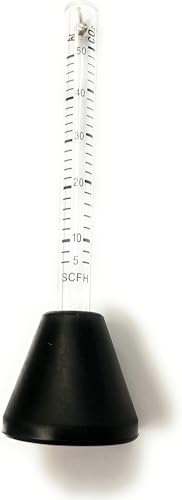
Best for: Shield gas observation in welding operations. This model emphasizes actual shield gas flow rates at the torch and is designed to help reduce gas usage and welding variations. Choosing this helps maintain gas efficiency in production lines. Caution: data is focused on shield gas flow; broader gas types may require another device for non-welding tasks.
JIAWANSHUN Oxygen Flow Meter

Best for: Specific oxygen flow control in medical or industrial contexts where precise 0.1-1.5 LPM readings are necessary. It features a copper connector and a simple single-gas flow readout. Limitation: limited to lower flow rates; not ideal for higher-volume applications.
Buying Guide: How To Choose The Right Portable Gas Flow Meter
What is your primary use? If you need quick checks at the torch, look for a compact unit with a straightforward readout and easy-to-attach nozzle. For field audits or lab-style monitoring, prioritize higher flow ranges, RS485 Modbus networking, and robust power options.
Key considerations:
- Flow range and gas compatibility: Match the device’s range with typical gas flows (0-25 L/min vs 0-250 L/min) and confirm compatibility with gases used in your operations.
- Port size and connections: Choose NPT or PE fittings that align with your existing gas lines (1/4″ NPT, 1/2″ NPT, etc.).
- Display and readability: Rotatable LCDs and clear units reduce misreading in tight spaces.
- Power options: Battery-only devices are portable, while models with AC adapters support longer on-site work.
- Networking and data: RS485 Modbus or other digital interfaces enable integration with control systems or data logging.
- Size and portability: Pocket-sized meters excel in fieldwork; larger meters suit lab or workshop environments.
- Calibration and accuracy: Look for MEMS-based sensors for stable measurements and low drift across gas types.
Practical decision tips:
- Choose this if you need fast, on-the-spot checks at the torch (Sxstar variant).
- Choose this if you perform extensive field audits and require durable LCD readouts (Rendrox MF5706 or MF5712 series).
- Avoid this if you require multi-gas networked data collection in a single compact device (consider Dowwnel MF5712 or similar).
Frequently Asked Questions
What is a gas flow meter used for in welding?
It measures the flow of shielding gas to the weld torch, helping maintain consistent gas coverage and reduce weld defects.
What flow range should I expect for shop testing?
Most shop tasks fall in the 0-20 to 0-250 L/min range, depending on whether you test at the torch or in a larger system.
Do I need RS485 or other digital outputs?
RS485 Modbus enables data logging and integration with control systems; choose it if you plan automated monitoring.
Is a portable meter suitable for oxygen or nitrogen lines?
Yes, many meters support multiple inert gases, including oxygen and nitrogen; check the device’s listed gas compatibility before use.
Add a Comment