The portable hardness testers below cover the most common hardness scales used in metalworking and QC: Brinell, Rockwell (A, B, C, and more), Vickers, Shore, and others. Each model combines portability with multi-scale capability, data storage, and user-friendly interfaces for field and shop use. This guide highlights five top options, summarizes their key features, and offers practical buying considerations for selecting a tester that fits your materials and workflow.
| Product | Brand | Key Scales | Storage | Power |
|---|---|---|---|---|
| Helivivfy Metal Hardness Tester | Helivivfy | Richter HL, Brinell HB, Rockwell A/B/C, Vickers HV, Shore HS | 48-350 groups | Battery |
| Metal Hardness Tester Kit (RYJNM) | RYJNM | HL, HB, HRA, HRB, HRC, HV, HS | 350 data capacity | Unknown |
| GOYOJO Portable Leeb Tester | GOYOJO | 7 scales incl. HL, HV, HB, HRC, HRB, HRA, HS | Noted memory | Rechargeable |
| Phase II Portable Hardness Tester | Phase II Plus | Rockwell, Brinell, Vickers, Shore etc. (7+) | Memory output | Unknown |
| SUNNYSONG Portable Hardness Tester | SUNNYSONG | 7 recognized scales; includes built-in printer | 600 groups | Lithium-Ion |
Helivivfy Portable Brinell And Multi-Scale Hardness Tester

The Helivivfy hardness tester supports seven hardness systems, including Brinell HB and Rockwell variants (A, B, C) plus Vickers HV and Shore HS, enabling quick cross-method comparisons for mixed material lots. It accommodates twenty material types—from steels and cast irons to aluminum alloys and copper alloys—helping inspectors select the right scale for each part. A data storage function records 48 to 350 groups of test results, enabling traceability for QC documentation in manufacturing or field audits.
Metal Hardness Tester Kit (RYJNM): 7-in-1 Portable Leeb Tester
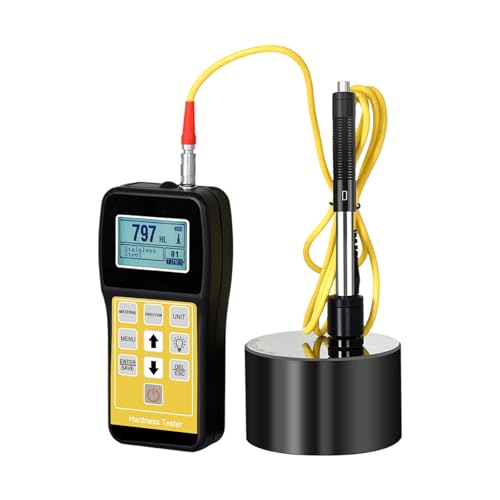
RYJNM’s tester provides seven hardness scales, including HL, HB, HRA, HRB, HRC, HV, and HS, delivering broad material versatility. The D-type impact device supports 360-degree testing, improving flexibility for complex geometries. An integrated advanced sensor and processing system supports precise, reliable measurements. The unit features a large-capacity LCD with backlight to view readings clearly, plus data storage for up to 350 measurement records, aiding in on-site documentation and batch comparisons.
GOYOJO Portable Leeb Hardness Tester Kit

GOYOJO emphasizes ease-of-use with a user-friendly menu interface and an OLED display for clear readings in varying lighting conditions. The tester supports seven impact devices, enabling quick switching to accommodate different materials without recalibration. This flexibility makes it suitable for on-site materials testing where different alloys and metals are encountered, from steel to copper alloys and aluminum.
Phase II Portable Hardness Tester (PHT-1800)

Phase II Plus’ PHT-1800 model is designed for large hard metal parts in the field or QC shop. It offers fast test speeds with memory and output options, and supports conversion among popular scales such as Rockwell, Brinell, Vickers, and Shore. The device emphasizes accuracy for demanding applications on bigger components and complex geometries, combining portability with professional-grade performance.
SUNNYSONG Portable Hardness Tester With Printer

SUNNYSONG’s tester features a built-in printer and a color display, with data memory supporting up to 600 test results. It provides seven recognized hardness scales and includes seven impact devices. The device runs on a lithium-ion battery, delivering long operation times and convenient recharging in remote work sites. It is well-suited for quick field checks and generating hard copy records for quality control documentation.
Buying Guide: Key Considerations And Comparisons
When choosing a portable hardness tester, consider material compatibility, the required hardness scales, and the testing environment. If you work with varied metals (steel, aluminum, copper alloys, cast iron), prioritize models offering multiple scales (Rockwell, Brinell, Vickers, Shore) and a straightforward conversion among them. A large data storage capacity supports long-term Q.C. logs, trend analysis, and compliance reporting.
Accuracy and repeatability are essential for quality control. Look for testers with precise load application, robust impact mechanisms, and dependable sensor technology. Some units offer 360-degree testing capabilities, which is valuable for curved or intricate parts. A readable display (backlit LCD or OLED) helps in dim shops or outdoor settings. The option for a built-in printer can simplify on-site reporting, though it adds weight and cost.
Portability and power management influence field usability. Most devices run on rechargeable batteries; verify runtime and charging options to minimize downtime. Memory features enable offline data capture, while optional data export (USB, Bluetooth) supports integration with your quality management software. Consider calibration needs and whether the device offers NIST traceability or ISO-compliant accuracy, especially for regulated industries.
Price, support, and warranty vary widely. In professional settings, a multi-year warranty and access to spare parts can reduce total cost of ownership. For large parts testing, models with higher impact energy ranges and larger measurement ranges help minimize re-tests, while smaller, lighter units excel in quick, on-site checks. Finally, assess compatibility with your existing inspection workflows and whether the device can be updated as standards evolve.
Add a Comment