Instantly find the right pneumatic solenoid valve manifold for compact automation or full-scale production lines. This guide highlights practical, commonly used multi-valve manifolds and explains who benefits most from each option. Ideal buyers include hobbyists building small rigs, maintenance engineers upgrading vintage machinery, and automation integrators seeking scalable, space-saving manifolds. Below is a quick summary of five top choices, followed by detailed product sections and a buying guide.
| Product | Stations | Voltage | Port Size | |
|---|---|---|---|---|
| Baomain 6 Station 24V DC | 6 | 24V | 1/4″ PT | Compact automation with multiple outputs |
| Baomain 3 Station 12V DC | 3 | 12V | 1/4″ PT | Smaller projects needing space efficiency |
| Baomain 10 Station 24V DC | 10 | 24V | 1/4″ PT | Medium to large automation tasks |
| Baomain 6 Station 12V DC | 6 | 12V | 1/4″ PT | Versatile, low-voltage setups |
| Baomain 4 Station 110V AC | 4 | 110V | 1/4″ PT | Higher voltage environments |
Baomain 6 Station 24V DC Manifold

Best For: Medium-scale automation projects needing compact multi-valve control. The six integrated valves on a single base save footprint and simplify installation. This model uses 24V DC with two-position, five-way pneumatic design for double-acting cylinders.
Why selected: Its integrated manifold layout reduces assembly time and provides six independent valves in one platform, making it ideal for compact automation benches or small production lines. Quick-connect fittings (8mm base ports, 6mm exhaust ports) enable tool-free setup.
Caution: Ensure your control circuitry matches 24V DC and verify available space for mounting the six-valve base. Some setups may require external manifolds for additional ports.
Baomain 3 Station 12V DC Manifold
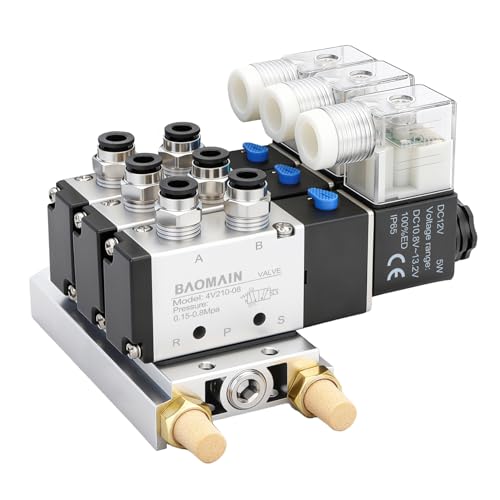
Best For: Simple, space-conscious projects needing a few actuators. With 12V DC operation and three valves, this compact manifold supports straightforward pneumatic control for small automation tasks.
Why selected: The 3-station design balances simplicity and efficiency. Quick-connect fittings streamline installation, and the 5-way, 2-position design supports standard double-acting cylinders.
Caution: If your system requires higher pressure or more outputs later, this compact unit may need upgrading to a larger manifold.
Baomain 10 Station 24V DC Manifold
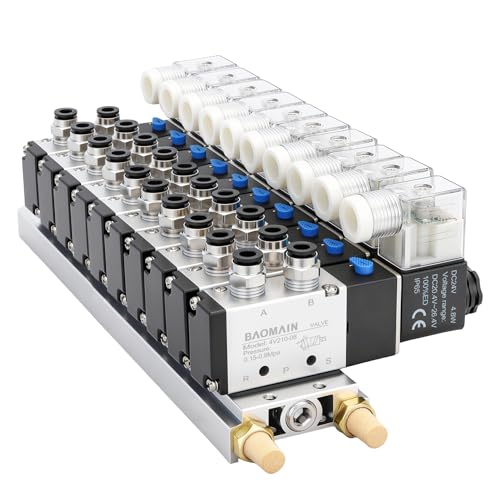
Best For: Larger automation tasks needing many independent valves while preserving a unified base. This 10-station model still uses a compact 1/4″ port design and 24V DC operation with standard pneumatic control.
Why selected: It offers scalability within a single footprint, allowing more complex control logic without expanding the installation area.
Caution: The wider manifold requires careful routing of air lines to avoid conduit clutter and potential cross-talk between channels.
Baomain 6 Station 12V DC Manifold

Best For: Projects demanding reliable 12V operation with multiple outputs, such as compact automation lines or retrofit projects with 12V control logic.
Why selected: This model combines a 6-station manifold with 12V DC control, offering flexibility in low-voltage environments while maintaining a compact footprint.
Caution: Ensure your power supply and control electronics can deliver stable 12V across all six valves, especially in longer cable runs.
Baomain 4 Station 110V AC Manifold

Best For: Industrial environments where 110V AC is standard and multiple actuators require centralized control on a single manifold.
Why selected: The 4-station configuration with AC input supports high-energy applications and reduces the need for adapters in fixed installations.
Caution: Ensure the electrical safety standards of the workspace are compatible with 110V AC devices and that proper isolation and grounding are observed.
Baomain 4 Station 12V DC Manifold

Best For: Projects needing a balanced mix of valve outputs with 12V control in a compact array. Suitable for small to mid-sized automation tasks.
Why selected: Combines four valves on a single base with standard 12V DC control, aiding quick installation in constrained spaces.
Caution: Check availability of space for routing air lines and power connections around the manifold to avoid interference with moving parts.
TAILONZ PNEUMATIC 300M 2-Position Manifold

Best For: Aluminum-bodied manifolds for light-to-moderate duty pneumatic systems, suitable for custom builds and educational projects.
Why selected: Offers a robust base, with 2-position operation and compatible form factor for straightforward integration into existing air lines.
Caution: Material and finish are designed for general automation; verify compatibility with your media and operating temperature ranges.
Buying Guide
What should you consider when choosing a pneumatic solenoid valve manifold?
- Number of stations: Match the number of valves to your current and near-future control needs. A larger base can simplify expansions.
- Voltage and power: DC options (common 12V or 24V) are typical for compact systems; AC options exist for industrial environments. Confirm compatibility with your control circuitry.
- Port size and fittings: Most manifolds use 1/4″ PT ports with quick-connect fittings for tool-free installation. Check port layout to prevent cross-connections.
- Control logic: Two-position, five-way design supports double-acting cylinders; consider whether you need normally open/closed behavior and how you’ll wire the coils.
- Material and mounting: Aluminum bodies are common for light to moderate duty; ensure mounting clearance and vibration tolerance for your application.
- Maintenance access: Integrated manifolds should provide straightforward mufflers and clean-out capability where needed.
FAQs
- What is a pneumatic solenoid valve manifold?
A manifold groups multiple solenoid valves onto a single base, simplifying wiring and air connections for multi-actuator systems.
- Why choose a 24V DC manifold over 12V DC?
24V DC often provides stronger actuation and lower current per channel, which can be advantageous for longer runs or higher-resistance coils.
- Can I retrofit a manifold into an existing setup?
Yes, if port sizes, mounting patterns, and electrical wiring match your system. Verify air supply pressure and cylinder compatibility.
- What maintenance is needed for these manifolds?
Regularly inspect for air leaks, clean mufflers, and ensure coils remain within rated temperature ranges. Replace worn seals as needed.
- How do I choose the right number of stations?
Assess current valve count and expected future expansions. A larger manifold can reduce future rework, but ensure space and wiring remain manageable.
- Are these manifolds compatible with all air pressures?
Most are designed for typical pneumatic systems; always verify the working pressure range in the product specs and your system requirements.
Add a Comment