Finding the right pipe roller welding positioner depends on the size of your workpieces, the required load capacity, and how you plan to weld. This guide highlights five top options that balance power, versatility, and ease of use for common pipe, tank, and vessel welding tasks. Each product is suited to different shop needs—from heavy fabrication to lighter pipe work—so you can compare at a glance and choose confidently.
| Product | Max Load | Diameter Range | Notes |
|---|---|---|---|
| VEVOR Linkage Roller (2205 lbs) | 2205 lbs | 2″–24″ | Great for tanks and long pipes; solid all-around performance |
| VEVOR 110V Linkage Roller | 2205 lbs | 25–1400 mm OD (≈1″–55″) | High-torque motor and wide size adaptability |
| HayWHNKN 110V Turning Rolls | 2200 lbs | 50–600 mm | Digital control with foot pedal for precise operation |
| TECHTONGDA 110V Linkage Roller | 2200 lbs | 50–600 mm | Manual + foot switch operation for flexible control |
| Yokoma 6600 lbs Linkage Roller | 6600 lbs | 2.75″–47.24″ | High torque and wide compatibility for large workpieces |
VEVOR 110V Linkage Roller for Welding

The VEVOR 110V Linkage Roller supports up to 2205 lbs, with a large 9.84-inch PU roller and adjustable inner/outer holes to fit a broad range of workpiece sizes. A robust 600W motor provides stable rotation across defined speeds. Best for shops handling varied pipe diameters and mid-to-large workpieces where consistent, high-load rotation is essential.
Best for: shops needing strong load capacity with flexible diameter options and a dedicated torch stand for welding efficiency.
Caution: The higher power and wider range require proper setup and secure mounting to avoid misalignment during rotation.
VEVOR Turning Rolls Linkage Roller (2205 lbs)

This linkage roller handles up to 2205 lbs and features a 120W drive motor with a broad speed range of 3.15–63 in/min. It’s well-suited for welding long pipes and tanks where smooth, steady rotation improves weld consistency. Best for professional welders dealing with heavy tubes or rectangular tanks that require precise positioning.
Best for: heavy-duty rotation with steady torque for uniform welds on tanks or long pipes.
Limitation: Narrower diameter range than some multi-size models, which may require additional tooling for very small workpieces.
HayWHNKN Digital Welding Turning Rolls
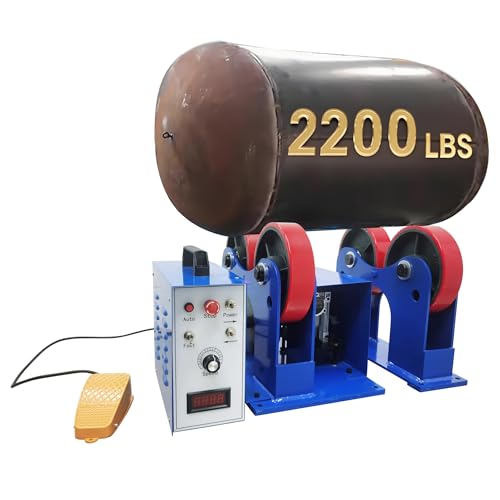
HayWHNKN offers a 2200 lbs capacity with a precise digital control system and a foot pedal for hands-free operation. The unit supports pipe diameters from 50 mm to 600 mm and uses PU rollers for improved grip. Best for operations requiring accurate speed control and the ability to start/stop with minimal movement around the workspace.
Best for: precise, programmable speed control and convenient foot-pedal operation for vessel and pipe welding.
Limitation: Some users may prefer larger diameter ranges for even broader compatibility.
TECHTONGDA 110V Tank Turning Welding Rolls

TECHTONGDA’s model provides a 2200 lbs capacity with adjustable inner/outer holes, enabling diameters from 50–600 mm. It includes a manual control box and a foot switch, delivering straightforward on-the-fly adjustments and a reliable grip via PU wheels. Best for shops needing predictable manual control and quick setup for varying pipe sizes.
Best for: flexible diameter handling with simple manual control for quick, repeatable weld setups.
Limitation: Manual operation means less automation than fully digital counterparts.
Yokoma 6600 lbs Linkage Roller

Yokoma’s heavy-duty linkage roller supports up to 6600 lbs with a wide diameter range of 2.75″–47.24″ (70–1200 mm). It features a high-torque motor and eight PU wheels for superior grip and anti-slip performance, plus adjustable active/driven rollers. Best for very large pipes and vessels in demanding fabrication environments.
Best for: extreme load applications and wide diameter ranges where precise, stable rotation is critical.
Caution: Heavier units require robust mounting and may demand more space and anchoring in the shop.
Buying Guide: How To Choose The Right Pipe Roller Welding Positioner
- What load capacity do you need? Match the maximum weight of the largest workpiece to avoid overloading the unit. Higher capacities provide more margin for safety and future projects.
- What diameter range must be covered? Consider both inner/outer hole configurations and overall roller spacing. Wider ranges reduce setup time when switching between pipe sizes.
- Should you prioritize speed control? Digital controls and variable speeds offer refined weld pacing, while manual controls simplify operation and maintenance.
- What power and motor type matter? Higher-torque motors enable stable rotation with heavy pieces; ensure the power supply in your shop supports continuous operation.
- Are ancillary features important? Torch stands, adjustable roller gaps, and magnetic bases can boost workflow efficiency and safety on complex welds.
Frequently Asked Questions
- What is a pipe roller welding positioner used for? It supports and rotates pipes, tanks, or vessels to facilitate circumferential welding and beveling.
- How do you choose the right diameter range? Pick a model with inner/outer hole options that cover the smallest to largest pipes you weld frequently.
- Are digital controls better than manual? Digital controls offer precise speed control and repeatable settings, while manual controls are simpler and may be sufficient for straightforward tasks.
- Can these machines handle tanks and long pipes? Yes, many models are designed for tanks and long pipe work, with stable rotation and heavy load capacity.
- What maintenance is required? Regularly inspect PU rollers for wear, verify mounting integrity, and ensure the motor and controls are clean and dry.
- Is space a concern? Heavier units with wide diameter ranges require adequate floor space and secure anchoring in a workshop.
Add a Comment