Looking for a reliable pet bottle crushing machine to recycle plastics at home or in a small workshop? This guide highlights five top picks designed to crush PET bottles and other plastics efficiently. Each option targets different needs—from compact, quiet devices for home use to heavier, high-capacity units for small businesses. The best choice depends on your volume, budget, and whether you also need to process other materials.
Summary table of selected products:
| Product | Best For | Motor Power | Approximate Capacity | Key Advantage |
|---|---|---|---|---|
| INTBUYING Electric Plastic Shredder Grinder 2.2KW | Small workshop, PET bottles, mixed plastics | 2.2KW | 50-100 kg/h | All-copper motor, solid steel construction |
| EQCOTWEA Plastic Shredder Recycling Machine 2.2KW | Home and light industrial use | 2.2KW | 50-100 kg/h | Robust grinding with sharp blades |
| INTBUYING Electric Plastic Shredder Recycling Machine 4KW | Higher-volume PET recycling | 4KW | 100-200 kg/h | Wider feed and larger throughput |
| INTSUPERMAI 2.2KW Plastic Shredder Crusher | Small business or workshop PET/PVC/ABS | 2.2KW | 50-100 kg/h | Extra-durable 9+2 blade set |
| THUXEON 4KW Shredder Crusher | Medium-scale recycling | 4KW | 150-200 kg/h | High-capacity with alloy blades |
INTBUYING Electric Plastic Shredder Grinder 2.2KW
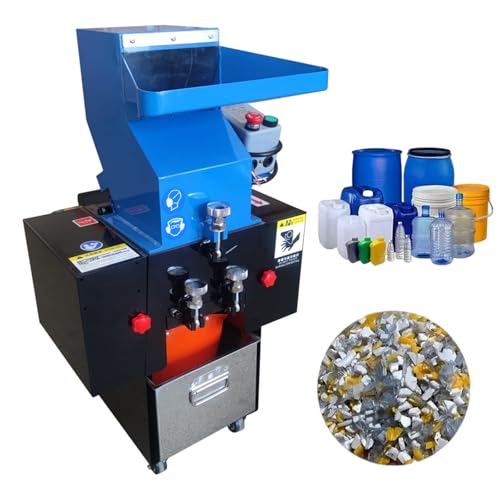
Best for: hobbyists and small workshops that process PET bottles and other soft and hard plastics. This model operates on 220V with a 2.2KW pure copper motor and a 110×180 mm feed port, enabling quick material processing into 6 mm granules. It features high-strength steel knives for efficient crushing and robust all-copper construction for long operation.
Why selected: It combines a compact footprint with solid capability, suitable for moderate throughput and mixed plastics. The 6 mm mesh supports uniform particle sizes ideal for recycling or resale of scrap material.
Caution: Suitable for a variety of plastics, but extremely thick or highly dense materials may require pre-cutting to maintain throughput.
EQCOTWEA Plastic Shredder Recycling Machine 2.2KW

Best for: users who need a dependable 2.2KW unit with wide material versatility, including PET bottles, cardboard, and other soft to mid-hard plastics. It’s designed to reduce thick materials into uniform granules efficiently with a 110×180 mm feed and 6 mm mesh.
Why selected: Its robust construction and sharp steel knives ensure dependable operation for ongoing recycling tasks in small facilities or home setups.
Caution: Like similar shredders, expect some noise and require proper dust and debris management in confined spaces.
INTBUYING Electric Plastic Shredder Recycling Machine 4KW

Best for: higher-demand environments where 100-200 kg/h throughput is needed, such as small manufacturing or recycling hubs. This 4KW unit uses a 250×160 mm feed and an 8 mm mesh to handle larger volumes of PET, PC, PVC, and other plastics.
Why selected: It offers a solid balance of throughput and robustness, with steel knives engineered for heavy-duty crushing and prolonged operation.
Caution: Higher power consumption requires appropriate electrical setup and ventilation in busy facilities.
INTSUPERMAI 11KW Heavy-Duty Shredder (Selected Alternative)

Best for: users seeking very high capacity and broader material handling, including bottles, wood, rubber, and more. Notable for large-scale recycling tasks, but requires more space and power.
Why selected: Demonstrates the upper end of plastic processing capability with powerful drive and sizable throughput.
Caution: Not ideal for tight spaces or low-budget setups due to size and power needs.
THUXEON Electric Plastic Shredder Crusher Machine

Best for: medium-scale recycling operations needing 150-200 KG/H of throughput with durable alloy blades. The 4KW, 3-phase motor supports sustained shredding of PET, PVC, ABS, and more.
Why selected: Combines high capacity with solid blade construction and a design aimed at reducing noise compared to some industrial shredders.
Caution: Three-phase power is required in many settings; verify electrical readiness before purchase.
Buying Guide
Key considerations when choosing a pet bottle crushing machine:
- Throughput needs: Estimate daily volume (kg/h) to avoid under- or over-sizing. Higher throughput units typically require more power and space.
- Material range: If you plan to process PET bottles alongside other plastics, look for machines advertised as versatile with broad compatibility.
- Feed size and mesh: Larger feed ports speed up loading but may require bigger blades and sturdier frames. Mesh size controls final particle size.
- Power and electrical requirements: Single-phase (often 220V) units suit home and small shops; three-phase configurations fit larger setups and reduce downtime.
- Noise and safety: Machines with sound insulation and safety interlocks help in shared spaces and prevent accidents during operation.
- Maintenance: Blade life, knife sharpness, and access for cleaning affect long-term costs and uptime.
- Footprint and installation: Ensure adequate space for loading, feeding, and material disposal, along with proper ventilation where needed.
Practical questions buyers frequently ask
- Can these machines shred PET bottles with labels and caps?
- Do they require special tooling or adapters for different plastics?
- Is pre-cutting recommended for very thick plastics?
- What kind of power supply is needed for high-capacity units?
- How easy is it to replace or sharpen the blades?
- Are these units suitable for DIY home use or only professional environments?
FAQ
What is the best PET bottle shredder for home use?
For home use with moderate volumes, a 2.2KW unit like the INTBUYING or EQCOTWEA models offers a good balance of size, capacity, and cost. They handle PET bottles and other plastics well in smaller batches.
What should I consider for higher-volume PET recycling?
Choose a 4KW unit or higher with a larger feed port (e.g., 250×160 mm) and an 8 mm mesh to sustain 100-200 kg/h. Look for robust blades and an all-copper motor for reliability.
Are three-phase shredders necessary?
Three-phase power is common in larger setups where continuous operation and higher throughput are essential. Single-phase units are generally sufficient for light-to-moderate use.
Do these machines handle other plastics?
Yes. Many models advertise compatibility with PC, PVC, ABS, PET, EPS, PU, and HDPE, along with other materials. Always verify compatibility in the product features before purchasing.
What maintenance is required?
Regular blade inspection, sharpening or replacement as needed, cleaning of the feed area, and checking for loose screws help maintain performance and safety over time.
Add a Comment