For welders and hobbyists, choosing the right oxygen and acetylene regulator gauges is essential for safe, steady flame control. This guide highlights top options that balance accuracy, ease of use, and compatibility. Best for professional shop use, versatile home setups, or fieldwork where reliable pressure control matters most.
| Product | Best For | Key Benefit |
|---|---|---|
| RX WELD CGA540 & CGA510 Regulator Set | Professional and serious hobbyists | Dual gauges with wide pressure ranges for both oxygen and acetylene |
| JZWELD Oxygen Acetylene Regulators | Users needing dual-dial clarity | Dual easy-to-read gauges with robust construction |
| Victor 350 Regulators (ESAB) | Color-coded, ergonomic control | Ergonomic, color-coded knobs for quick adjustments |
| RX WELD Medium Duty Regulator Set | Small to mid-size operations | Medium-duty set with reliable delivery ranges |
| RX WELD Oxy Acetylene Regulator Set CGA540 & CGA200 | Small tanks and MC configurations | Compact fit for MC tanks with CGA200 |
Product comparisons focus on regulator inlet/outlet compatibility, pressure ranges, and user clarity. The following sections break down each option to help you pick the right gauge set for your welding or cutting tasks.
RX WELD CGA540 & CGA510 Regulator Set

Inlet connections cover Oxygen CGA-540 and Acetylene CGA-510. Outlet connectors use 9/16″-18 threads for 1/4 inch B fittings twin welding hose. The oxygen regulator offers 0-4000 PSI inlet and 0-200 PSI output; the acetylene regulator provides 0-400 PSI inlet and 0-30 PSI output. Best for professional shops or serious hobbyists who need a complete dual-gauge setup with wide delivery ranges. Choose this if you require robust dual regulation for frequent torch operation.
Best for: Shop professionals, large-batch projects, and users requiring precise dual-gauge control. Limitation: Larger footprint may be less ideal for very compact setups.
JZWELD Oxygen Acetylene Regulators
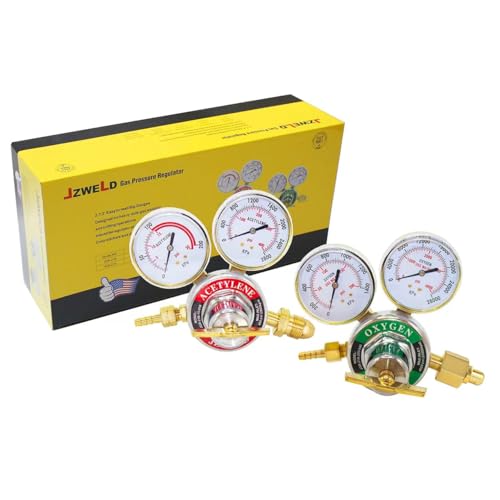
Dual regulators with oxygen CGA-540 and acetylene CGA-510 compatibility. Oxygen regulator: 0-4000 PSI inlet, 0-200 PSI output; acetylene regulator: 0-400 PSI inlet, 0-30 PSI output. Features dual dials for straightforward monitoring, plus a larger diaphragm design to maintain stable pressure during cylinder changes. Best for users who value clearly visible gauges and dependable performance. Caution: The acetylene regulator is not suited for very large tanks without checking cylinder compatibility.
Victor 350 Oxygen & Acetylene Regulators

G250-15-510 Acetylene regulator and G250-150-540 Oxygen regulator feature ergonomic color-coded adjustment knobs for quick swapping between gases. The set targets professional environments where fast, repeatable adjustments are essential. Best for shops needing a cohesive, color-guided approach to regulator adjustments. Limitation: Aesthetic cues are helpful, but users should verify hose compatibility for their hose fittings.
RX WELD Medium Duty Oxygen Acetylene Regulator Set

This medium-duty set covers oxygen CGA-540 and acetylene CGA200 connections for small to mid-size operations. It features 0-4000 PSI inlet and 0-100 PSI output on the oxygen regulator, plus 0-400 PSI inlet and 0-30 PSI output on the acetylene regulator. Best for users needing a compact yet capable dual-regulator arrangement for MC tanks. Caution: Not ideal for high-volume production where maximum flow is required.
RX WELD Oxy Acetylene Regulator Set CGA540 & CGA200

Inlet connections align Oxygen CGA-540 and Acetylene CGA200. Outlet connections use 9/16″-18 for 1/4 Inch B fittings twin welding hose. Two dials provide 0-4000 PSI inlet and 0-100 PSI oxygen output, along with 0-400 PSI inlet and 0-30 PSI acetylene output. Best for setups requiring CGA200 compatibility with smaller acetylene cylinders. Limitation: The acetylene regulator’s lower maximum pressure may restrict some heavy cutting tasks.
Buying Guide: Key Considerations For Regulator Gauges
- Tank compatibility: Check CGA valve types (CGA-540 for most oxygen tanks, CGA-510 or CGA-200 for acetylene tanks). Ensure the regulator’s inlet matches your tanks.
- Pressure ranges: Oxygen regulators typically deliver higher flow (up to 200 PSI output); acetylene regulators have lower outputs (up to 30 PSI). Match ranges to your torch or cutting torch requirements.
- Dual vs single regulator: Dual-dial units simplify setup and monitoring, especially for beginners or busy shops. Consider whether you need independent gauges or one combined unit.
- Hose and thread compatibility: Ensure outlet threads and hose connectors fit your welding hoses (common 9/16″-18 for twin B-size hoses).
- Dial clarity and design: Large diaphragms and easy-to-read dials reduce error during cylinder changes. Color coding can speed gas identification.
- Size and weight: For field work or small shops, a compact regulator may be preferable even if it has a lower maximum output.
- Safety and maintenance: Regular inspection of gauges, hoses, and fittings is essential for safe operation. Look for sets with robust construction and accessible replacement parts.
Frequently Asked Questions
- What does CGA stand for? Compressed Gas Association; it defines valve and regulator connections for specific gas cylinders.
- Should I buy a dual-gauge regulator? Dual gauges simplify monitoring oxygen and acetylene pressure simultaneously, which is helpful for most welding tasks.
- What’s a typical oxygen output range? Common oxygen regulators deliver up to about 0-200 PSI, though some have higher ranges for industrial use.
- Can I use any regulator on any torch? Not always. Ensure hose fittings, thread types, and gas compatibility match your torch and hose assemblies.
- How often should regulators be inspected? Periodic checks are recommended, especially after cylinder changes or impact. Look for leaks and gauge accuracy.
- Is an adapter necessary? If your cylinder valves or hoses don’t match, adapters may be required, but verify compatibility to avoid unsafe connections.
Add a Comment