Choosing the right NEMA 23 servo motor can dramatically impact accuracy, speed, and reliability in CNC routers, laser engravers, and robotic arms. The following selections emphasize integrated solutions with encoders, closed-loop control, and robust CAN/RS232 interfaces. Each option balances torque, voltage range, and control flexibility to suit American workshop environments. Read on to compare five top choices and follow our buying guide to tailor performance to your application.
| Product | Brand | Torque | Encoder | Voltage | Interface |
|---|---|---|---|---|---|
| UIROBOT UIM5756CA | UIROBOT | 1.26 Nm | Multi-Turn Absolute Encoder | 24-48VDC | CAN Bus |
| UIROBOT UIM5756CM | UIROBOT | 1.26 Nm | Integrated Encoder | 24-48VDC | CAN Bus |
| TOSEASTARS 3.2 Nm Kit | TOSEASTARS | 3.2 Nm | 1000-line Encoder | 20-48V | CAN Interface |
| CNCTOPBAOS JSS57P2N | CNCTOPBAOS | 2 Nm | 1000-line Encoder | 24-48V | Hybrid Closed-Loop DSP |
| TOSEASTARS 1.2 Nm Kit | TOSEASTARS | 1.2 Nm | 1000-line Encoder | 20-48V | CAN Interface |
UIROBOT NEMA 23 With Multi-Turn Encoder (B0DK4LRC2H)

This motor integrates a NEMA 23 Absolute Multi-Turn Encoder with 17-bit single-turn and 32-bit multi-turn resolution. Power-off memory preserves exact positioning after shutdown, saving time and boosting efficiency. A CAN interface provides strong anti-interference performance, enabling stable operation in noisy environments. The closed-loop system offers precise positioning and fast response, with speeds up to 2000 RPM. Control options include speed, position, backlash compensation, and stall detection.
Technical support features a robust DSP core with fault tolerance and a full SDK, including libraries, DLLs, and example codes in C++ and C#. The device supports a comprehensive control suite and debug tools to ease integration into custom automation projects.
UIROBOT NEMA 23 Integrated Servo With CAN (B0CNRF8M4P)

This fully integrated NEMA 23 stepper motor features an encoder, motor driver, and motion controller in a compact aluminum housing. Using CANBUS, multiple motors can communicate to coordinate complex motion control. It includes a DSP core with fault tolerance and a complete SDK with sample C++ and C# code. The unit delivers a holding torque of 1.26 Nm with micro-stepping options (1-128), suitable for smooth, precise control at 24-48 VDC.
Designed for low vibration and quiet operation, this model is a strong substitute for traditional servo systems at moderate speeds, offering robust performance in robotics and CNC tasks requiring reliable closed-loop behavior.
TOSEASTARS Nema 23 Closed-Loop Kit (B0DSHYY1NS)
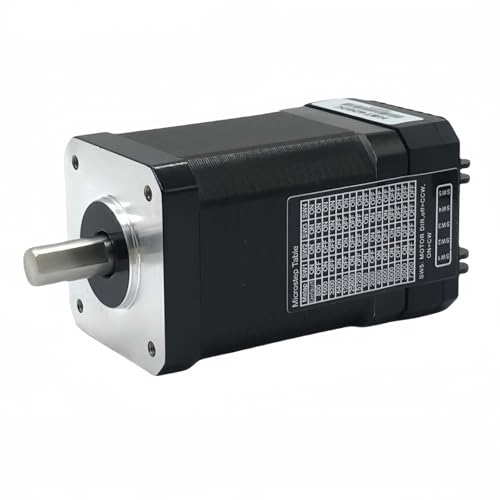
This 3.2 Nm closed-loop stepper delivers high torque with minimal vibration, ideal for CNC routers and engraving machines. It features a NEMA23 (57x57mm) housing, encoder, motor driver, and a coolant-tolerant aluminum case. Specifications show 1000 encoder lines, 24-50 VDC operation, and a 3.5 A current range. The CAN interface supports reliable networked control while reducing missteps and stalls in demanding tasks.
With a robust design, the TOSEASTARS kit offers strong performance in high-precision applications, combining torque and closed-loop feedback to maintain accuracy at varying loads and speeds.
CNCTOPBAOS JSS57P2N Closed-Loop Nema23 (B07235MBM6)

CNCTOPBAOS presents a closed-loop Nema23 motor with 2 Nm holding torque, 1000 encoder lines, and a 24-48V DC supply. The $32-bit DSP control enables precise, out-of-step prevention and high-speed torque performance. Features include 16 microstep modes (up to 51200 microsteps/rev), RS232 Modbus RTU, and advanced vector control to improve motor output torque at higher speeds. This kit is well-suited for CNC milling, cutting, and marking tasks requiring tight control and reliability.
TOSEASTARS Integrated Servo System (B0DSHWCXLV)

This model offers a compact, integrated CAN-based servo system for CNC routers and 3D printers. It presents a 2 Nm torque specification, 1000 encoder lines, and a 24-48 VDC input. The all-in-one design simplifies wiring and setup, delivering reliable closed-loop performance with high positioning accuracy for demanding tasks such as engraving and cutting. Its robust aluminum housing supports demanding workshop environments.
Buying Guide: Key Factors For Choosing The Best Nema 23 Servo Motor
- Torque and load requirements: Higher torque supports heavier workpieces and faster speeds, but may require more power and cooling. Match the motor’s holding torque to the worst-case load in your application.
- Encoder type and resolution: Multi-turn absolute encoders preserve position across power cycles; single-turn encoders offer precise relative positioning. Higher encoder resolution improves accuracy but may increase cost and processing demands.
- Closed-loop vs open-loop: Closed-loop systems detect and correct missed steps, improving reliability at high speeds and under load. Open-loop can be simpler and cheaper for consistent, light duties.
- Voltage and current range: Ensure the motor’s DC voltage aligns with your drive, controller, and power supply. Check current settings and whether microstepping is supported to balance torque and smoothness.
- Interface and integration: CAN Bus and RS232/Modbus enable networked control and integration with existing control systems. Consider the availability of SDKs, documentation, and sample code.
- Physical form and mounting: Confirm NEMA 23 footprint, shaft diameter, and overall dimensions. Aluminum housings help with heat dissipation in continuous-duty applications.
- Thermal management: Higher torque motors generate more heat. Plan for adequate cooling or intermittent duty cycles to maintain performance and longevity.
- Software and support: Look for vendors offering debugging tools, libraries, and example projects. Strong technical support reduces integration risk.
- System compatibility: If replacing a servo or stepper in an existing system, verify compatibility with your controller’s closed-loop features and encoder protocol.
By evaluating torque, encoder capabilities, control interfaces, and vendor support, you can select a NEMA 23 motor that aligns with your workflow, whether you’re upgrading a CNC router, a laser engraver, or a robotic arm. Each option above provides a balance of integrated components and robust control features to fit American workshop demands.
Add a Comment