This guide helps buyers find effective spill containment trays for labs, workshops, and industrial settings. The focus is on trays that protect floors from drips and leaks, with a spotlight on products suitable for small to medium spills and temporary storage. Best choices are selected for reliability, durability, and ease of use. The top picks below are ideal for manufacturers, lab technicians, maintenance crews, and facility managers seeking practical containment solutions.
Summary table of selected products:
| Product | Best For | Key Benefit | Sump/Capacity |
|---|---|---|---|
| Eagle Containment Utility Tray 36.25″ x 18.25″ | Countertop lab work and small-spill tasks | Low-profile, affordable containment | Up to 5 gallons |
| PIG Rim-to-Rim Containment Tray 52.25″ x 28.25″ | Temporary storage of small containers | Thick-wall, keeps liquids away from floor | 23.93 gal |
| Modular 2 Drum Spill Pallet | Industrial oil and chemical handling | 20-gallon sump, modular stacking | 20 gal |
| PIG Rim-to-Rim 40.25″ x 28.25″ | Temporary container storage | Rigid construction with ribs | 17.95 gal |
| Eagle 1677 HDPE Containment Tray 36″ x 18″ | Countertop lab and dispensers | Affordable, small-spill containment | Up to 5 gallons |
Eagle 1677BLK Containment Utility Tray

The Eagle 1677BLK is a compact containment tray designed for small spill control on counter tops and workstations. Best for laboratory technicians and maintenance staff who manage minor chemical drips or dispenser drips in a controlled area. The tray’s size makes it easy to place beneath benches or under dispensers, catching drips before they reach the floor. It’s especially suitable for quick, affordable spill control in busy workspaces.
Why it’s selected: It provides a simple, cost-effective way to contain spills up to about 5 gallons, reducing floor contamination and simplifying cleanup. The low height helps with visibility and access. A potential limitation is that it may not be ideal for large spills or heavy-duty chemical storage due to its modest capacity.
Best for: Labs, counters, and light-duty spill control where quick setup and easy disposal are priorities.
Limitation: Not designed for heavy-duty industrial spills or long-term storage of large containers.
PIG Containment Tray – Rim to Rim

The PIG Rim-to-Rim containment tray offers a larger footprint suitable for temporary storage of small containers that may leak or drip. It is described as thick-walled and chemical-resistant, with ribbed bottom surfaces improving stiffness and elevating items away from trapped liquids. This tray is well-suited for workshops and production lines where occasional spills occur and where a robust, static containment surface is needed.
Why it’s selected: Its generous dimensions and sturdy construction make it a better choice for workstations with multiple small containers and frequent leaks. It provides substantial sump capacity for moderate spill scenarios.
Best for: Temporary container storage in manufacturing, paint rooms, or maintenance bays where a durable, roomy tray is advantageous.
Caution: Large trays require more floor space and may be heavier to relocate when full or after cleaning.
Modular 2 Drum Spill Pallet

The Modular 2 Drum Spill Pallet is designed for heavy-duty industrial use, with a 20-gallon sump capacity and a low 4-inch height. It supports two standard 55-gallon drums and includes an angled drain outlet for easy recovery and disposal of captured liquids. The interlocking modular design enables vertical stacking for space-saving storage, making it a strong choice where floor cleanliness and workflow efficiency are priorities.
Why it’s selected: It is better for facilities that handle oils and solvents and require both higher capacity and modularity for expanding containment as operations grow. The angled drain and 2000 lb class performance support more demanding environments.
Best for: Industrial shops, maintenance depots, and chemical plants needing scalable containment for drum-based operations.
Limitation: Heavier and larger footprint than smaller trays, requiring more storage area and handling when not in use.
PIG Containment Tray – Rim to Rim (40.25″ x 28.25″)

This PIG containment tray sits between compact and large, providing 17.95 gallons of sump capacity with thick-walled construction and ribbed bottom support. It’s designed to protect floors from drips and minor spills, making it suitable for temporary storage of small containers that might leak.
Why it’s selected: It balances size and capacity for workplaces that need reliable spill containment without dedicating a large footprint. It’s a solid choice where containment needs exist but space is constrained.
Best for: Small to medium operations where a sturdy, mid-sized tray fits under benches or near dispensers.
Caution: Like all plastic trays, it may not withstand prolonged exposure to extremely aggressive chemicals without appropriate compatibility checks.
LTCANOPY Containment Tray Folding Duck Pond

The LTCANOPY folding containment tray is a collapsible, durable option designed for ease of storage and quick deployment in spill scenarios. It uses a PVC-coated material for durability and waterproofing, with a foldable frame that speeds up setup and takedown. It’s well-suited for temporary containment needs in machine spill events, workshop drips, or industrial applications where quick response and portability matter.
Why it’s selected: Its foldable design supports space-constrained facilities and temporary spill responses. The waterproof secondary barrier helps prevent ground contamination during cleanup, and portability is a key advantage for mobile teams.
Best for: Mobile maintenance crews, temporary spill containment at job sites, and workshops needing rapid deployment without heavy equipment.
Caution: Folding frames may require careful handling to avoid damage during repeated assembly and disassembly.
Eagle 1677 HDPE Containment Tray

The Eagle 1677 HDPE containment tray is a compact, affordable option for small spills and counter-top applications. Its easy-to-clean HDPE material and planar design make it a practical addition to laboratories and maintenance areas where drips from dispensers or small containers are common. The tray is designed to be a cost-effective layer of protection for work surfaces.
Who this is best for: Lab techs and facility staff seeking a simple, no-frills containment tray for daily, light-duty spills.
Limitation: Limited capacity—best for small-volume spills rather than large drips or heavy chemical handling.
Yellow Safety 4×4 Secondary Containment Berm

The Yellow Safety secondary containment berm provides a robust barrier to contain leaks, drips, and spills from drums, tanks, and machinery. It’s built from thick PVC and is designed for easy deployment and long-lasting performance in industrial settings. The lightweight, stackable design aids quick setup and storage.
Why it’s selected: Excellent for larger inventory or equipment where a more substantial containment field is helpful. Its chemical resistance and portability support both indoor and outdoor use.
Best for: Drums, tanks, and machinery in industrial environments requiring a durable, reusable containment barrier.
Caution: Larger berms require planful placement to ensure full containment without interfering with workflow.
2 Drum Modular Spill Containment Platform
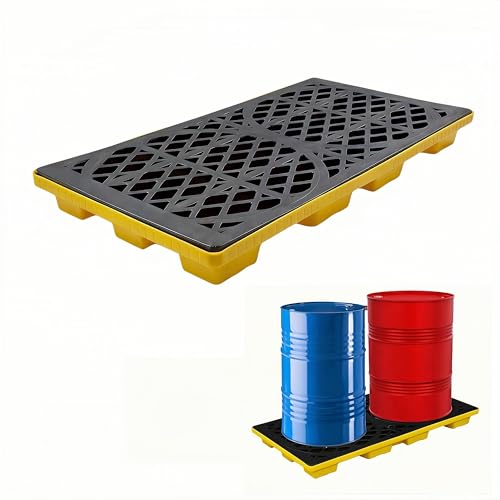
The 2 Drum Modular Spill Containment Platform offers 2000 lbs capacity and a compliant 20-gallon containment system with drain outlet and forklift pockets. Its interlocking, stackable design supports efficient space management in busy environments. This tray is suitable for garages, basements, and large workshops dealing with multiple containers and potential leaks.
Why it’s selected: It’s the most robust option among the listed products, ideal for facilities handling hazardous materials and requiring reliable secondary containment with ease of cross-use between shelves or caddies.
Best for: Industrial garages and workshops with high spill risk, needing a modular and scalable containment solution.
Caution: Heavier and larger than other trays, so installation and relocation should be planned to minimize strain or injury.
Buying Guide
- Capacity vs. footprint: Larger drums and more frequent spills require higher-capacity trays. Balance sump capacity with available floor space.
- Material compatibility: Chemical resistance matters. HDPE and thick-walled plastics perform well with many solvents, oils, and acids, but verify compatibility with your specific chemicals.
- Portability: Collapsible or modular designs help in spaces with limited storage or where trays must be relocated frequently.
- Access and maintenance: Look for trays with easy draining, cleanability, and straightforward replacement parts or liners if applicable.
- Durability: Heavy-duty trays and ribbed bottoms can extend lifespan in busy environments, reducing replacement costs over time.
- Footprint and layout: Measure workspace clearance under benches, near dispensers, or around machinery to ensure trays fit without obstructing operations.
FAQ
- What should I consider before buying a spill containment tray? – Evaluate spill size, frequency, chemical compatibility, space, and whether you need portability or modularity.
- Are metal spill containment trays necessary? – Metal trays exist, but many high-quality trays use corrosion-resistant plastics suitable for most industrial needs. Choose based on chemical compatibility and weight handling.
- Can these trays be used outdoors? – Some models are UV-stabilized or designed for indoor use; check the product details for outdoor suitability and environmental resistance.
- How do I maintain containment trays? – Regularly clean after spills, inspect for cracks or warping, and replace trays showing signs of wear to prevent leaks.
- Is higher capacity always better? – Not always. A higher capacity reduces spill risk, but it also increases footprint. Match capacity to spill potential and space constraints.
- What is a sump capacity? – Sump capacity refers to the volume the tray can hold before overflow, critical for planning spill response during work shifts.
Add a Comment