Direct, reliable liquid nitrogen containers are essential for labs, farms, clinics, and beauty facilities that require consistent cryogenic preservation. This guide highlights five top Magula, CGOLDENWALL, Treasea, U.S. Solid, and VEVOR options that balance durability, storage efficiency, and portability. Each product is evaluated for who benefits most, potential limitations, and why it stands out in its category.
| Product | Best For | Capacity | Notable Strength |
|---|---|---|---|
| Magula 10L | Small labs and clinics needing compact storage | 10 L | Aerospace aluminum with slow evaporation |
| CGOLDENWALL 20L | Laboratories needing longer-term storage with transport | 20 L | Dual purpose transport and storage, carry bag |
| Treasea 10L | Research facilities and farms requiring reliable cryogenic preservation | 10 L | 1.97-inch neck design for reduced evaporation |
| U.S. Solid 20 L | Large-volume storage with extended evaporation control | 20 L | Explicit evaporation-rate consideration |
| VEVOR 3 L | Beauty industry and small-scale sample handling | 3 L | Lightweight, six canisters included |
Magula 10L Liquid Nitrogen Container

- Compact 50 mm caliber supports longer storage cycles with reduced evaporation.
- Made from high-strength aerospace aluminum for durability and slower LN2 loss.
- Wide applicability across farms, research labs, hospitals, and beauty salons.
Best For: Small to mid-size facilities that need a durable, compact LN2 dewar for routine sample storage. The 10 L capacity balances space with practical run length. Caution: The design emphasizes slow evaporation, but proper lid sealing and regular level checks remain essential to minimize loss.
CGOLDENWALL 20L Liquid Nitrogen Container

- Dual-purpose design supports both transportation and storage with a carry bag.
- Compact 50mm caliber with slow LN2 dissipation, aided by Styrofoam under the lid.
- Aerospace-grade aluminum offers corrosion resistance and durability.
Best For: Labs or clinics needing longer-term storage plus occasional transport. If you require a larger capacity without sacrificing low evaporation, this model is a strong choice. Caution: Ensure the carry bag and lid insert are kept in good condition to maintain thermal efficiency.
Treasea 10L Liquid Nitrogen Container
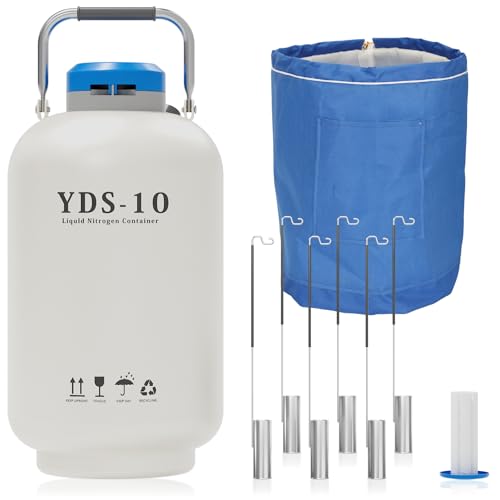
- 1.97-inch neck opening minimizes evaporation for longer storage cycles.
- Built from aerospace-grade aluminum to withstand demanding environments.
- Includes six canisters (four perforated, two sealed) for flexible sample handling.
Best For: Laboratories and farms handling biological samples, semen, or embryos where reducing nitrogen loss matters. Caution: The perforated canisters require careful handling to avoid sample exposure during retrieval.
20L Liquid Nitrogen Tank by ApexscnView

- Aerospace aluminum construction offers corrosion resistance and durability.
- Multi-layer insulation plus gas adsorbents extend internal vacuum storage.
- Includes six canisters with a compact 50 mm caliber for slow LN2 dissipation.
Best For: Entities requiring robust insulation and longer-term storage with a modest carry solution. Caution: Regularly verify the liquid nitrogen level to avoid dry-out in extended storage scenarios.
U.S. Solid 20 L Cryogenic Container

- Twenty-liter capacity designed for substantial storage needs.
- Construction emphasizes a slower evaporation rate to maximize storage time.
- Includes a six-canister system for flexible organization and retrieval.
Best For: Facilities handling larger sample banks or longer-term preservation. Caution: Higher capacity means larger footprint; ensure compatibility with available storage space.
VEVOR 3 L Liquid Nitrogen Tank

- Lightweight aluminum alloy for portability and resilience.
- Vacuum insulation with multiple layers to reduce heat transfer.
- Six canisters included, with two for direct extraction and four for sample storage.
Best For: Beauty industries, educators, or small-scale research where portability and quick sample access are priorities. Caution: The smaller capacity requires more frequent LN2 replenishment for larger workloads.
Buying Guide
What capacity should I choose?
Choose based on your typical storage volume and space constraints. 3 L to 10 L models suit small labs and clinics, while 20 L options serve larger sample banks or higher usage. For frequent transport, a 20 L with a carry bag offers a balance of capacity and mobility.
What materials improve performance?
Aerospace-grade aluminum provides strength and corrosion resistance, reducing evaporation and increasing lifespan. Look for models with multi-layer insulation and gas adsorbents to extend storage time.
How important are canister configurations?
Six-canister setups offer flexibility: perforated canisters for ongoing sampling and sealed ones for safe retrieval. Ensure the canister design matches your sampling workflow to minimize handling complexity.
Is portability a priority?
If you need to move LN2 between rooms or facilities, prioritize compact calibers (50 mm) and carry bags. Balance weight with capacity to avoid overly heavy units that slow workflows.
What are common limitations to watch for?
- Evaporation rate varies with lid seal integrity and ambient conditions; regular checks are essential.
- Smaller units refill more often; plan for supply planning to prevent interruptions.
- Storage organization matters; ensure canisters are clearly labeled and accessible.
Usage and safety considerations
Follow standard cryogenic safety practices. Use insulated gloves and face protection when handling LN2. Ensure proper ventilation to avoid nitrogen buildup in enclosed spaces. Regularly inspect seals, lids, and the carry system for wear.
FAQ
- What is the typical evaporation rate for these containers?
Evaporation rates depend on design and insulation; high-quality aluminum dewars with effective insulation typically show slower evaporation under proper use and maintenance.
- How often should I refill liquid nitrogen in a 20 L tank?
Refill frequency depends on usage and storage duration; monitor LN2 levels and refill when down to about one-third full to maintain stable storage conditions.
- Can these containers store biological samples like semen or embryos?
Many models are designed for such applications, but always follow institutional biosafety and cryogenic handling guidelines and verify compatibility for your specific samples.
- Are six canisters sufficient for most workflows?
Six canisters provide a flexible mix of perforated and sealed options, typically covering common sample handling needs, but complex workflows may require additional configurations.
- Which size is best for laboratories with limited space?
Smaller capacities (3–10 L) are preferable for tight spaces, while offering enough storage for routine tasks without overwhelming the area.
Add a Comment