Finding the right large wood CNC machine depends on your material needs, workspace, and upgrade plans. This guide highlights five machines that balance size, precision, and expandability for wood, acrylic, and composite projects. Each option targets different buyers: hobbyists seeking solid entry-level metal-framed builds, small shops needing reliable desktop-scale production, and makers aiming for expansion with 4th-axis or laser capabilities.
Summary of selected products (quick reference):
| Product | Best For | Key Benefit |
|---|---|---|
| FoxAlien Masuter Pro | Beginners and hobbyists | All-metal frame, flexible spindle options |
| TTC3018 Pro | Compact spaces, budget-conscious | All-metal Z-axis, lightweight, offline/online options |
| Twotrees TTC450 Pro | Growing makers | Capacitive touch, upgradable to 4th axis/laser |
| FoxAlien XE-Ultra 8080 | Large projects | Very large workspace, high-precision ball screws |
| Genmitsu PROVerXL 4030S | Professional hobbyists | 710W spindle, high stability, 130mm Z-height |
Note: This guide uses product data to compare capabilities and suitability. All links lead to the official Amazon product pages for reference.
FoxAlien Masuter Pro 3-Axis CNC Router

Best for hobbyists who want an all-metal build with flexible spindle options. The Masuter Pro features an all-aluminum structure with a robust Z-axis rail for better precision in wood, acrylic, MDF, and nylon. It supports 60W and 300W spindles via two clamps and offers upgrade paths like a 65mm router or a 1.5kW spindle for heavier carving tasks. Its dust-resistant controller with easy-access emergency stop improves safety during long sessions.
Who it’s best for: beginners aiming for reliable, expandable engraving and cutting at home or in a small shop. Why selected: strong metal framework and adaptable spindle system support a wide range of materials and project scales. Caution: the need to source a suitable spindle upgrade separately if higher power is desired.
TTC3018 Pro CNC Router

Best for compact spaces and light production. The TTC3018 Pro uses an all-metal Z-axis with backlash-eliminating lead screws and 0.1mm precision. It includes wireless transfer via 2.4G Wi-Fi and supports offline TF card engraving, USB connection, and desktop usage. Small footprint makes it ideal for classrooms, hobby studios, or small workshops.
Who it’s best for: students, educators, or makers needing a portable, upgrade-friendly machine. Why selected: combines precision with flexible connectivity in a compact form. Caution: working area is modest, so larger projects require a bigger model.
Twotrees TTC450 Pro All-Metal CNC Router

Best for ambitious makers expanding from entry-level setups. The TTC450 Pro offers a large 460 x 460 mm square working area and a high-precision 0.0025 mm Z-axis positioning. It supports GRBL open-source control and can be upgraded with a 4th axis or laser module, enabling more complex engravings and multi-material projects. The capacitive 3.5-inch touch screen aids usability.
Who it’s best for: buyers planning growth toward multi-axis work and higher-volume output. Why selected: strong upgrade potential and open-system compatibility. Caution: larger upgrades may require additional firmware and software configuration.
FoxAlien XE-Ultra 8080 CNC Router

Best for large-scale projects and serious fabrication. The XE-Ultra delivers a mega workspace of 33″ x 33″ x 4.72″ with 16 mm XY and 12 mm Z ball screws plus HG-15 rails for stability. Its 2.6 N.m closed-loop motors maintain torque and accuracy at higher speeds up to 5000 mm/min. The design targets demanding wood, aluminum, and composite tasks.
Who it’s best for: builders needing a big, stable platform for thick materials and extended runs. Why selected: exceptional size and closed-loop reliability. Caution: footprint and power needs are substantial, requiring a sizeable workshop and adequate ventilation for dust control.
Genmitsu PROVerXL 4030S CNC Router
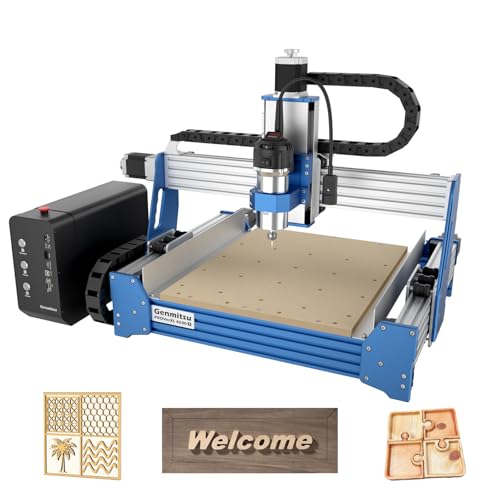
Best for professional hobbyists seeking high stability and power. The PROVerXL 4030S features a 710W spindle, upgraded Z-axis linear rails, and a large 130mm Z-height. It delivers repeatable, precise cuts suitable for wood, metal, and acrylic with a focus on long-term reliability. The wireless app control adds ease of operation.
Who it’s best for: users who require dependable precision and larger cutting heights without sacrificing workflow efficiency. Why selected: balance of power, stability, and user-friendly features. Caution: higher power spindles may demand proper setup and dust management in busy shops.
Buying Guide
What should I consider when choosing a large wood CNC machine?
Workspace size, spindle power, and Z-height determine what materials and projects you can handle. A larger working area enables bigger panels and thicker pieces, but it also requires more space and potentially more maintenance.
Should I pick all-metal or mixed-frame construction?
All-metal frames usually provide better rigidity and accuracy under load, which matters for high-speed or detailed carving. Mixed or aluminum frames can be lighter and easier to assemble but may show more flex under aggressive feeds.
What upgrades matter most for growth?
Consider machines with upgrade paths like 4th-axis rotation, laser modules, or higher-power spindles. A system with GRBL or open-source compatibility helps future software integration and community support.
How important is software compatibility?
Compatibility with popular CAD/CAM tools (ArtCam, Fusion 360, Easel, Carveco Maker) streamlines design-to-cut workflows and reduces setup time for complex projects.
What are practical cautions?
Higher-speed or larger machines demand stable mounting, proper enclosure for dust control, and adequate ventilation. Verify that your workspace can accommodate cable management and airflow needs during long runs.
FAQ
- Q: Do large CNC routers require dedicated dust collection? A: Yes, to maintain accuracy and longevity, a dust collection system helps keep routers clean and prevents debris from affecting moving parts.
- Q: Can I upgrade a hobby CNC to handle metals? A: Some machines support metal cutting with heavier spindles, but ensure the frame rigidity and spindle power meet the material requirements before attempting metal work.
- Q: Is wireless transfer common for desktop CNCs? A: Many models include Wi-Fi or USB connectivity to simplify file transfer from design software.
- Q: What is the typical learning curve? A: Beginners may take a few projects to optimize feeds, speeds, and toolpaths; community forums and vendor documentation accelerate this process.
- Q: Do these machines require professional installation? A: Most desktop-to-small-shop CNCs are user-assembled, with vendor guidelines for setup and safety checks.
Add a Comment