If you need reliable power during outages with natural gas as a preferred fuel option, these tri-fuel generators are designed to run on natural gas, propane, or gasoline. This guide helps buyers choose big-capacity units best suited for large homes, workshops, or job sites. The selections below are chosen for portability, runtime, and fuel flexibility, so you can balance power, convenience, and safety.
| Product | Best For | Fuel Options | Watt Range |
|---|---|---|---|
| Westinghouse 18000 Peak Watt Tri-Fuel Home Backup | Large homes needing serious backup capacity | Gas, Propane, Natural Gas | 18,000 peak / 14,500 running (gas) |
| Westinghouse 14500 Peak Watt Tri-Fuel | Homes upgrading from smaller units | Gas, Propane, Natural Gas | 14,500 peak / 11,500 running (gas) |
| DuroStar DS13000MXT 13,000-Watt Tri Fuel | Whole-home backup with flexible fuels | Gas, Propane, Natural Gas | 13,000 peak / varied running watts |
| WEN 14,500-Watt Tri-Fuel TF-1450X | Budget-friendly, transfer-switch ready | Gas, Propane, Natural Gas | 14,500 peak / 11,500 running (gas) |
| Generac 12,500 Starting Watt Tri-Fuel | Reliable versatility for mid-to-large homes | Gas, Propane, Natural Gas | 12,500 starting / 9,500 running (gas) |
Note: All selections provide multi-fuel capability with tri-fuel systems and are designed for use with transfer switches or home back-up setups. Each unit’s suitability depends on your home’s electrical load, fuel accessibility, and space for storage and operation.
Westinghouse 18000 Peak Watt Tri-Fuel Generator

Best for large homes and job sites requiring substantial backup power. This WGen18000 models a heavy-duty 713cc engine with a large 10.5-gallon gas tank for longer runtimes and tri-fuel flexibility (gas, propane, natural gas). It includes automatic low oil shutdown and a CO sensor to enhance safety. Use when you need the most power from a mobile generator setup. A potential limitation is the unit’s size and weight, which may require a dedicated setup and proper ventilation.
Westinghouse 14500 Peak Watt Tri-Fuel Generator
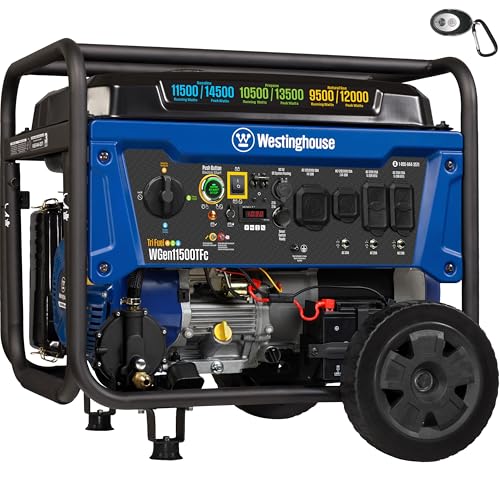
Best for larger homes seeking strong backup power with flexible fuel options. The 14,500 peak watts on gasoline and 13,500 peak on propane make it suitable for substantial loads. It runs up to 19 hours on a full 9.5-gallon tank and offers a turn-key remote start option. Choose this if you want a balance of high power and convenient starts, but consider fuel availability and storage space for a larger generator footprint.
DuroStar DS13000MXT Tri Fuel Portable Generator

Best for households needing solid tri-fuel capacity with a clear control layout. It supports gasoline, propane, and natural gas, and includes a robust 500cc engine. The unit is transfer-switch ready and designed for whole-home backup. A limitation is that exact run-time figures vary by fuel type and load, so plan based on your critical loads and expected outages.
WEN 14,500-Watt Tri-Fuel TF-1450X

Best for budget-conscious buyers needing transfer-switch readiness with multiple fuel choices. The TF-1450X allows seamless switching among gasoline, propane, and natural gas with a simple dial. It runs on a dual-voltage setup (120V/240V) for compatibility with most transfer switches. Limitations include a quieter operation design compared to premium models and varying runtime by fuel type.
Generac 12,500 Starting Watt Tri-Fuel

Best for mid-to-large homes needing strong tri-fuel capability with CO-sense safety features. It delivers 9,500 running watts on natural gas and offers a reliable electric-start system for quick power restoration. Choose this if you want the Generac reliability and a straightforward fuel-switching experience, but be mindful of space and maintenance needs in a regular backup setup.
Buying Guide: Large Natural Gas Generators
- Fuel flexibility: Tri-fuel models offer natural gas as a consistent, low-cost option when available, reducing the need for frequent refueling during outages.
- Power needs: Calculate essential and non-essential loads. For large homes, target models with 12,000+ running watts in natural gas mode.
- Transfer switch compatibility: Ensure the unit supports a compatible transfer switch and the proper outlets (including L14-30R and 14-50R if needed).
- Runtime and fuel Tank: Larger tanks extend runtime. Check run times at a representative load (e.g., 50% load) for each fuel type.
- Safety features: Look for CO sensors, low-oil shutdown, and automatic shutdown in abnormal conditions to protect the generator and home electronics.
- Starting method: Electric start is convenient, especially in cold weather. Have a backup pull-start option in case the battery fails.
- Noise and footprint: Inverter-based tri-fuel generators tend to be quieter and more fuel-efficient but can be smaller in peak output. Traditional generators may deliver more raw wattage but with higher noise.
FAQ
- Q: Do tri-fuel generators really run on natural gas? A: Yes. They are designed to operate on natural gas, propane, or gasoline, offering flexibility during outages.
- Q: What size generator should I choose for a large home? A: For large homes with critical loads, aim for 12,000+ running watts in natural gas mode and ensure a sufficient gas service line.
- Q: Is CO monitoring important? A: Yes. CO sensors help protect occupants by shutting down the generator if dangerous carbon monoxide is detected.
- Q: Can I run a large tri-fuel generator indoors? A: Generators should be used outdoors in a well-ventilated area to prevent carbon monoxide buildup.
- Q: How do I choose between a portable or stationary setup? A: Portable models offer flexibility for jobsites and events, while stationary setups with transfer switches are ideal for home backup in a fixed location.
- Q: Do these units require professional installation? A: Transfer switches and gas line connections often require licensed electricians and gas technicians to ensure code compliance and safety.
Add a Comment