Answering the need for reliable lab high speed dispersers, this article highlights five top options suitable for small- to mid-scale sample processing. These models cater to researchers and technicians working with liquids, emulsions, and tissue homogenization. The list emphasizes best-use scenarios, from rapid emulsification to gentle tissue disruption, so you can choose based on your sample type, viscosity, and desired throughput. Below you’ll find product-by-product comparisons, a quick buying guide, and answers to common questions.
| Product | Best For |
|---|---|
| MXBAOHENG High Speed Homogenizer Lab Disperser Emulsifier | Fine emulsions and rapid homogenization of water/oil systems; small- to medium-volume samples |
| DEJUN Lab High Speed Homogenizer | Wide speed range with two heads; versatile for diverse lab tasks |
| 4E’s USA Lab Handheld Homogenizer | Portable, one-handed operation for 1–250 mL samples |
| VISOSCI High Speed Lab Homogenizer | Low-to-medium viscosity liquids; adjustable speed with overload protection |
| IKA 3720001 T 18 Digital Ultra-Turrax | Precise digital control and quick-change dispersing elements for varied lab needs |
Buyer profiles: the MXBAOHENG model suits researchers needing fast emulsification of small volumes; DEJUN is ideal for labs requiring dual heads and broader voltage compatibility; 4E’s USA is great for fieldwork or compact benches; VISOSCI is preferred where protection features and moderate viscosity handling matter; IKA Ultra-Turrax fits labs seeking precise digital control and modular dispersers.
MXBAOHENG High Speed Homogenizer Lab Disperser Emulsifier

This model features a high-speed suction homogenate structure for efficient mixing and emulsification between two immiscible liquids. It supports sample sizes in the 5–1000 mL range and speeds from 6000 to 22000 rpm. Best for quick homogenization of water-fat or water-oil systems and basic cell disruption in smaller volumes. A key limitation is that performance depends on liquid viscosity and may require careful handling at higher speeds with delicate samples.
DEJUN Lab High Speed Homogenizer
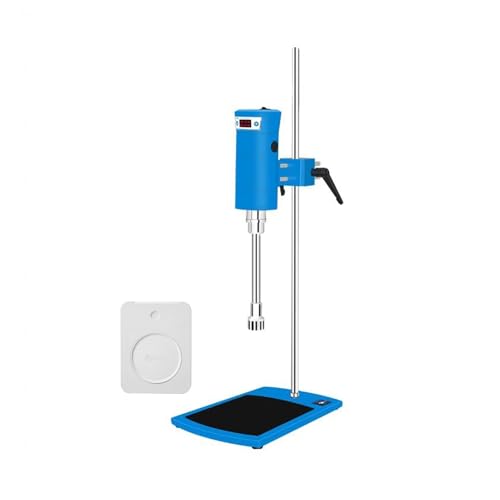
This homogenizer offers a wide speed range up to 18000 rpm and includes 18G and 36G working heads plus a 110V to 220V step-up transformer. It uses a stepless speed adjustment and a digital display for intuitive monitoring. Choose this if you need flexibility across samples and voltages, but be aware that setup varies with head choice and power conversion.
4E’s USA Lab Handheld Homogenizer

This lightweight, handheld unit weighs about 1.54 pounds and operates at 8,000–30,000 rpm. It uses a 316L stainless steel probe, available in 5 mm or 10 mm diameters, suitable for 0.1–250 mL samples. It is ideal for quick, one-handed use and bench flexibility but may be less stable for larger batches or prolonged operation without a stand.
VISOSCI High Speed Lab Homogenizer
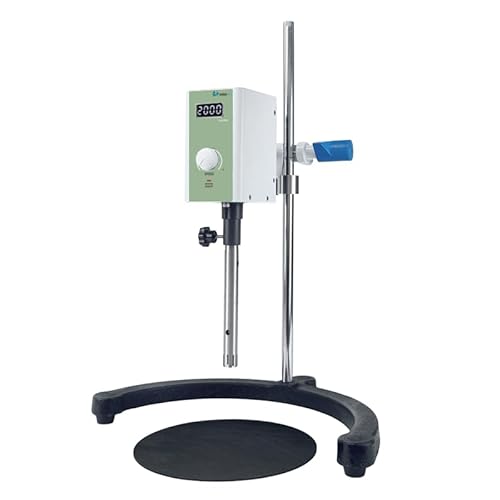
Designed for liquid processing with 2000–20000 rpm and an application range of 20–1200 mL, this unit handles low to medium viscosity samples (up to 5000 mPa·s). It includes auto overload protection to stop the machine under overload or when viscosity is too high. Best for routine dispersion of liquids, avoid using it with thick pastes or gels where protection may trigger frequently.
VISOSCI High Speed Lab Homogenizer With Two Heads
This version mirrors the same speed range and viscosity handling as the single-head VISOSCI, but includes two dispersing heads for flexibility with different container sizes. Best for labs that perform parallel experiments or need quick head changes between runs. Consider maintenance implications with additional heads and ensure compatibility with your vessels.
BIXIBIN 185W High-Speed Homogenizer

Equipped with an 185W motor and 8000–22000 rpm, this unit supports 0.17–33.81 oz (5–1000 mL) with two interchangeable heads and a complete kit. It emphasizes durability and versatility for varied lab tasks, including tissue disruption and emulsification. A potential limitation is the need for careful motor cooling during prolonged runs at higher speeds.
IKA 3720001 T 18 Digital Ultra-Turrax

IKA’s 18 Digital Ultra-Turrax offers a broad 3,000–25,000 rpm range with a digital LED display and quick-connect dispersing elements. It supports volumes from 0.001 to 1.5 L and is designed for easy element changes. Use this model when precise digital control and rapid element swaps are essential. Note that the base unit may require additional dispersing accessories for specialized tasks.
Buying Guide: Key Purchase Considerations
- Sample volume and viscosity: Match the unit’s rpm range and vessel compatibility to your typical batch size and liquid viscosity.
- Head design and versatility: Several models include multiple heads or interchangeable dispersers; assess how often you need to swap tools.
- Electrical compatibility: If you operate across voltages, consider units with built-in converters or dual-voltage support.
- Protection features: Auto overload protection and motor cooling help prevent damage during extended runs with viscous samples.
- Portability vs. bench stability: Handheld units offer mobility, while larger units or units with stands provide stability for continuous operation.
- Maintenance and accessories: Plan for cleaning, autoclaving (where applicable), and replacement heads or cups matching your volumes.
Frequently Asked Questions
- What is a lab high speed disperser used for?
– It emulsifies, disperses, and homogenizes liquids and tissues to create uniform mixtures or break down cells during sample preparation. - How do I choose between single-head and dual-head designs?
– Dual heads offer faster processing of different containers or parallel experiments; single-head units are simpler and compact for small spaces. - Can these devices handle high-viscosity samples?
– Most are optimized for low to medium viscosity; check the maximum viscosity rating and overload protections before use. - Are digital displays important?
– Yes, for precise speed control, repeatable results, and easy monitoring during experiments. - Do these units require special cleaning?
– Yes, follow manufacturer guidance for disassembly, cleaning, and sterilization to prevent cross-contamination.
Add a Comment