Choosing the right welding fume extractor is essential to maintain air quality in metalwork, laser cutting, and 3D printing spaces. This guide highlights five high-performing models that balance suction power, filtration, and user-friendly features. Each product is evaluated on filtration efficiency, filter lifespan, noise, and ease of use. The following table provides a quick summary of the featured units.
| Product | Brand | Air Volume | Filtration | Special Features |
|---|---|---|---|---|
| KQZ 150W Solder Fume Extractor | KQZ | 280 m³/h | 3-layer filtration + activated carbon | LED display, remote control, anti-clog alarm |
| KQZ-W1 Solder Fume Extractor | KQZ | 168 m³/h | H13 HEPA + activated carbon | Dual-layer filter design, wide voltage range |
| Adjustable180W Fume Extractor | CINDENDOOUNK | 378 m³/h | 5-stage filters | High-iodine carbon, adjustable power |
| LVCHEN Solder Fume Extractor | LVCHEN | 194 cfm (~550 m³/h) | 3-stage with activated carbon | Compact footprint, strong suction |
| KINGSOM Solder Fume Extractor | KINGSOM | 180 m³/h | 2-in-1 HEPA + carbon | 3 speeds, compact desktop |
Below are five top picks designed to protect workers from welding fumes, solder gases, and fine particulates generated during laser engraving, 3D printing, and metalwork. Each section provides a concise overview with key specifications drawn from the product features.
KQZ 150W Solder Fume Extractor

The KQZ 150W Solder Fume Extractor delivers 280 m³/h with a brushless motor rated up to 6036 RPM for strong, stable airflow. Its three-layer filtration includes a high-iodine-value activated coconut shell carbon layer to target odors and gases, achieving high purification efficiency. An LED display and remote control enable precise speed adjustments, timers, and anti-clog alerts to help manage maintenance and ensure consistent performance in busy workspaces. Suitable for laser engraving, 3D printing, and DIY soldering environments.
KQZ-W1 Solder Fume Extractor

The KQZ W1 combines 168 m³/h suction with a dual-layer filtration setup: H13 HEPA plus coal-based activated carbon for odors. Its design emphasizes professional reliability with inverter-powered operation, a simple one-button start, and broad voltage compatibility, making it well-suited for small shops and studios where multiple tasks generate fumes, such as welding and 3D printing.
Adjustable180W Fume Extractor
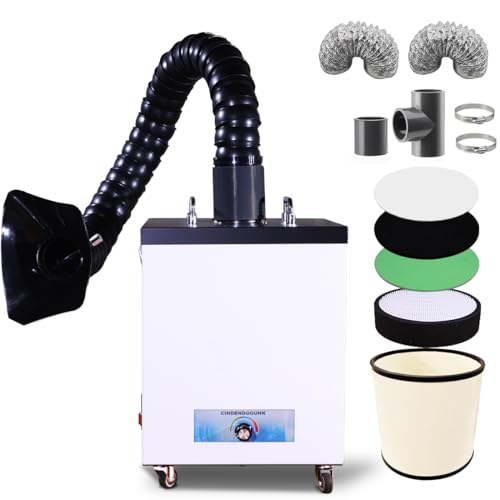
This unit offers 378 m³/h airflow with an adjustable power range from 10W to 180W, making it versatile for laser engraving, DTF printing, and soldering. It uses five-stage filtration with replaceable carbon and HEPA elements, plus a high-iodine coconut carbon pack that enhances deodorization. The system is designed for long filter life and flexible operation in workshops that require stronger odor and particle control without sacrificing energy efficiency.
LVCHEN Solder Fume Extractor

The LVCHEN model provides about 194 cfm of suction, combining a 3-stage filtration system with activated carbon to deliver 99.97% particle filtration and effective odor removal. A compact footprint makes it easy to place near laser engravers, solder stations, or CNC machines, offering robust extraction without taking up valuable bench space. It suits mid-size operations that require consistent filtration across multiple devices.
KINGSOM Solder Fume Extractor

The KINGSOM unit delivers up to 180 m³/h with a 2-in-1 filter approach, combining HEPA and activated carbon for enhanced purification. With three adjustable speeds and a desktop-friendly design, it is a practical choice for compact soldering, small-scale welding, or DIY projects in shared spaces. The integrated filtration supports safer indoor air while maintaining a portable footprint.
Buying Guide: Key Purchase Considerations
- Filtration performance: Look for units offering HEPA (H13 or better) plus activated carbon filtration to address both particulates and gases or odors. Multi-stage filtration typically improves purification efficiency and extends filter life.
- Airflow and coverage: Measure the required air changes per hour for your workspace. Higher CFM or m³/h is beneficial for larger or more emission-intensive tasks, such as welding or laser cutting.
- Filters and replacement costs: Understand filter lifespans and replacement intervals. Some models include extra filter packs; factor ongoing maintenance into total cost of ownership.
- Noise level: For continuous use in busy workshops, consider units with low dB ratings or adjustable speed to balance performance and comfort.
- Electrical requirements: Check voltage compatibility (110V–240V ranges are common) and whether the unit includes surge protection or fuse features.
- Footprint and portability: Choose a unit with a compact footprint or wheels if you need to move it between stations. Desktop models are suitable for tight spaces, while larger units suit open shops.
- Smart features: LED displays, timers, auto alarms for clogged filters, and remote control can improve ease of use and maintenance scheduling.
- Intended use: Align the model with your specific activities—soldering, welding, laser engraving, or 3D printing—as some units optimize for gas adsorption as well as particle capture.
When selecting an industrial welding fume extractor, balance initial cost with filtration quality, maintenance needs, and how the unit fits into your workflow. For studios with multiple processes, models offering robust odor control, high filtration efficiency, and easy filter replacement will deliver the most consistent air quality over time.
Add a Comment