Answering the question “which water softener fits an industrial-grade need in a home setting?” this guide highlights five reliable systems designed to reduce hardness, protect plumbing, and improve water quality for different household sizes. These options are best for buyers seeking continuous soft water, appliance protection, and easy maintenance. The top picks cover 1–2 bathrooms up to 4–6 bathrooms, with one strong salt-free option for scale concerns. The following table offers quick at-a-glance comparisons of the chosen models.
| Product | Best For | Grain Capacity | Key Benefit |
|---|---|---|---|
| Aquasure Harmony Series 32,000 | Small homes (1–2 baths) | 32,000 | Delivers ultra-softened water outlet-wide |
| Aquasure Harmony Series 48,000 | Medium homes (3–4 baths) | 48,000 | Efficient filtration + pre-filter for contaminants |
| Aquasure Harmony Series 50,000 | Medium-large homes (3–4 baths) | 50,000 | Pre-filter plus appliance protection |
| Kenmore 350 | Family households (1–4 people) | 32,000 | IntelliSoft AI-based regeneration |
| PRO+AQUA Elite 5-Stage | Well water or mixed sources | Various (system combo) | 5-stage filtration for heavy metals and contaminants |
Aquasure Harmony Series 32,000 Grains

The Aquasure Harmony Series 32,000 Grains Whole House Water Softener is designed for 1–2 bathroom homes. It delivers ultra-softened water to every outlet and helps protect appliances by reducing hardness and scale buildup. This model is best for buyers seeking straightforward, whole-house softening with reliable, automatic operation. A potential limitation is the lower grain capacity, which may require more frequent regeneration in harder water areas or larger households.
Aquasure Harmony Series 48,000 Grains

Designed for 3–4 bathroom homes, the Harmony 48,000 Grains system combines high efficiency with a robust pre-filter that removes 99% of common contaminants. It’s well-suited for households that want both soft water and cleaner water across the home. The triple-purpose pre-filter adds value by tackling chlorine, VOCs, odors, and sediment. If your water has moderate contaminants in addition to hardness, this model offers a strong balance of softening and filtration. A minor note: pre-filter maintenance is required to retain peak performance.
Aquasure Harmony Series 50,000 Grains
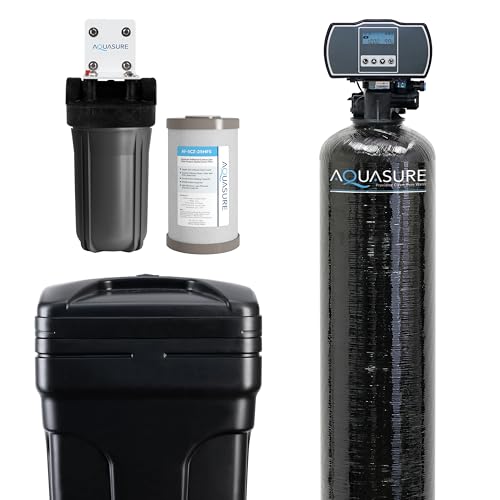
This model tackles 3–4 bathroom homes with a 50,000-grain capacity and includes a triple-filter setup that removes 99% of contaminants, plus hard minerals that can irritate skin. It protects appliances and plumbing by eliminating scale. Choose this if you want strong mineral removal and better odor/taste control across the house. A limitation to consider is the added filtration stage, which may require more regular filter changes and part replacements over time.
Kenmore 350 Water Softener System

The Kenmore 350 system is compact and designed for households 1–4 people, offering 32,000 grain capacity and salt-saving technology. It’s best for smaller homes seeking a smart, efficient approach to soften hardness and reduce iron. The IntelliSoft technology learns usage patterns to optimize regeneration. The caveat is that its AI-based regeneration is only as effective as its programming and may not match systems with more aggressive regeneration schedules in very hard water areas.
PRO+AQUA Elite 5-Stage Whole House
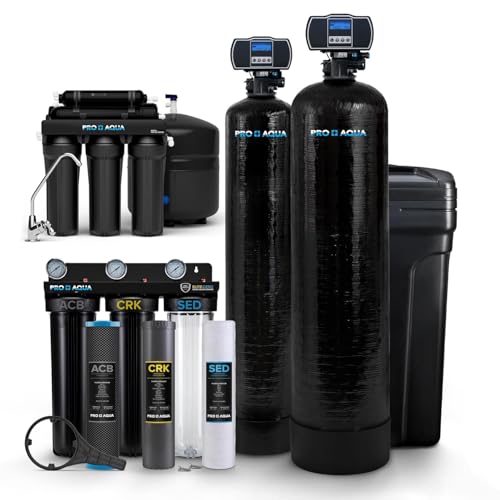
The PRO+AQUA Elite 5-Stage system targets well water and uses a comprehensive 5-stage filtration approach to remove heavy metals, iron, sulfur, sediment, chlorine, and more. This makes it suitable for homes with well water or those seeking maximum contaminant reduction in addition to hardness control. It’s best for buyers who want a filtration-forward solution that supplements softening. The limit to note is that it may be more complex to install and maintain than simpler softeners.
Buying Guide
What should you consider when choosing a water softener or conditioner?
- Water hardness level: Higher grains require larger capacities for longer intervals between regenerations.
- Household size and water usage: Regeneration frequency should align with daily consumption to avoid waste.
- Filtration needs: If contaminants such as chlorine, organic compounds, or metals are a concern, a pre-filter or multi-stage filtration can add value.
- Salt use and maintenance: Salt-based systems require ongoing replenishment; salt-free or dual-function systems reduce mineral buildup without adding salt.
- Installation and space: Compact models fit smaller utility rooms; larger homes may benefit from high-capacity systems with automated control heads.
Frequently Asked Questions
- What is the difference between a water softener and a water conditioner?
– A water softener reduces hardness by removing minerals like calcium and magnesium, while a water conditioner may remove or otherwise mitigate scale buildup without salt-based softening. - Do I need a pre-filter with my softener?
– A pre-filter helps remove sediment, chlorine, and contaminants that can buildup in resin, improving system efficiency and water quality. - Is a higher grain capacity always better?
– Not always. Capacity should match water hardness, usage, and regeneration preferences to avoid waste and ensure consistent soft water. - Can a salt-free system soften water?
– Salt-free systems typically condition water to reduce scale but do not remove minerals that cause true hardness. - How often should I service a multi-stage filtration system?
– Filters and media should be inspected and changed according to manufacturer recommendations, usually annually or as flow decreases.
Add a Comment