Direct answer: For reliable spot welding across metals, plastics, and battery packs, choose machines offering adjustable power, pulse control, and durable tips. This guide highlights top picks for automotive repair, electronics fabrication, jewelry work, and battery pack assembly.
Who should consider these machines: professionals needing industrial-level performance, hobbyists building custom battery packs, jewelers requiring precise heat control, and small workshops seeking portable options. Below is a quick comparison of the five selected products to help buyers decide at a glance.
| Product | Best for | |
|---|---|---|
| Dual-Probe Ultrasonic Spot Welder | Adjustable frequency, amplitude, pressure; high bonding strength | Textile, non-woven, plastics, electronics |
| VEVOR Portable Spot Welder | 1/8″ welding, 1.5KVA, 6500A, handheld; durable copper tips | Steel sheets, small fabrication tasks |
| Jewelry Spot Welding Machine | Dual-mode power; 0.4–1.0 mm wires; high-frequency discharge | Gold, silver, jewelry wiring |
| Stark USA Portable Spot Welder | 1/8″ capacity, 1.5KVA, 5500A; copper tips | Metal fabrication and electronics repair |
| Capacitor Spot Welder for Battery Pack | 10.5 kW, auto + foot pedal modes; nickel strip welding | Lithium battery packs, 18650/21700 |
Dual-Probe Ultrasonic Spot Welder for Textiles and Plastics

Best for: textile and non-woven fabric applications, plastics, electronics, and automotive components. This model emphasizes adjustable frequency, amplitude, and pressure to fit different material thicknesses, producing strong bonds with molecular-level fusion. It is well-suited for shops needing precise control over heat input and joint strength.
- Adjustable parameters: frequency, amplitude, pressure
- High bonding strength: fusion approaches 85%–95% of base material
Caution: suitable primarily for thermoplastics and fabrics; may require materials-specific setup for rigid plastics or metals.
VEVOR Portable Spot Welder 1/8″ Capacity

Best for: small fabrication tasks involving steel sheets up to 1/8″ thick. This portable welder provides strong welds with a 1.5KVA input and up to 6500A output, making it suitable for quick field repairs and workshop use with copper tips for durability.
- Welds up to 1/8″ steel
- High output current for reliable welds
Caution: not suitable for aluminum or stainless steel; best used on carbon steel and similar metals.
Jewelry Spot Welding Machine

Best for: precision jewelry work, including gold, silver, and other precious metal wires. Its dual-mode power and fine control enable delicate heat input for small-diameter wires, with high-frequency discharge aiding stable welds.
- Dual-mode power: coarse and fine adjustment
- Welds 0.4–1.0 mm wires
Caution: designed for jewelry-grade materials; may not handle larger or thicker metal workpieces efficiently.
Stark USA Portable Spot Welder
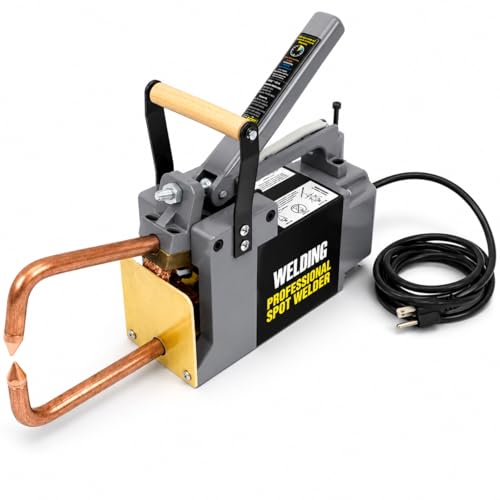
Best for: metal fabrication and electronics repair with a robust output. The unit features a 1.5KVA input and up to 5500A output, offering reliable performance for sheet metal and light automotive tasks, complemented by durable copper welding tips.
- Large-scale output: 5500A
- 1.5KVA input power
Caution: intended for metal projects; precision and control depend on operator technique and material type.
Capacitor Spot Welder for Battery Packs

Best for: building and repairing battery packs with nickel strip connections. The 10.5 kW capacitor-based welder supports stable pulses and offers auto and foot pedal modes for control.
- 10.5 kW welding power
- Automatic and foot pedal modes
Caution: primarily designed for battery-related welding; not ideal for large metal sheet welding tasks.
Buying Guide
- What material will you weld? Consider the base metals (steel, aluminum, copper) and whether the job involves plastics or textiles. Some machines are optimized for carbon steel, while others are better for plastics or jewelry.
- Power and pulse control Guidance: Look for adjustable voltage, amperage, and pulse duration. Pulse control improves weld quality on thin materials and fragile components.
- Portability vs. power Trade-offs: Portable units are convenient for field work but may offer lower welding capacity than bench models. Choose based on your job site needs.
- Tip life and accessories Consider copper or alloy tips and the availability of compatible accessories like nickel strips and welding pens for longevity and performance.
- Safety and controls Ensure built-in protections and user-friendly controls. Overheat protection and clear operation modes help maintain consistent results.
- Budget and maintenance Balance initial cost with expected usage. Durable construction and replaceable parts reduce long-term maintenance costs.
FAQ
- What is a spot welder best used for? It creates strong joints by fusing metal at a small, focused area, commonly used for battery packs, metal sheets, and jewelry wiring.
- Can I weld aluminum with these machines? Some models are designed for steel only; check material compatibility before use.
- Is portable or bench-top better for beginners? Portable units are easier for beginners to handle, while bench-top machines offer higher power for demanding work.
- What safety gear is recommended? Use eye protection, gloves, and proper ventilation when welding to reduce exposure to fumes and heat.
- Do these welders require external power? Many need external power; cordless models exist but may have limited weld duration and power.
- How do I choose the right welding capacity? Match the material thickness and type. Thinner materials benefit from finer control; thicker materials need higher current and robust tips.
Add a Comment