Need a reliable industrial sewing machine for heavy fabrics or upholstery projects? This guide highlights five top options and who they’re best for. Each pick is analyzed for power, speed, durability, and practical limitations, helping you choose confidently for professional work, home shop projects, or ongoing upholstery tasks. The products below are selected to balance performance with value, making it easier to compare core features at a glance.
| Product | Best For | Why It Stands Out |
|---|---|---|
| VEVOR Industrial Sewing Machine | Upholstery and denim work | Powerful 550W servo motor, 5000 SPM, clear LCD control, energy-saving start/stop |
| Juki DDL-8100 Lockstitch | High-speed, single-needle stitching | Up to 5500 SPM, large arm space, long stitch capability |
| CONSEW Upholstery Walking Foot | Leather, canvas, vehicle interiors | Drop feed with walking foot for heavy materials, table included |
| SINGER Heavy Duty 4411 | Heavy fabrics and quick home projects | 1100 SPM, strong motor, versatile with 69 stitches |
| SINGER Heavy Duty 4452 | Thick fabrics and robust sewing | 50% more power, 1100 SPM, metal frame |
VEVOR Industrial Sewing Machine

- Brand: VEVOR
- Motor: 550W servo motor
- Speed: Up to 5000 stitches per minute
- Material handling: Up to 0.4″ / 9 mm thick (about 15 layers of denim)
- Controls: LCD touchscreen panel for speed, direction, up/down needle position, slow-start
Best for: Upholstery and denim-heavy projects where power and precision matters. The energy-saving smart start/stop helps reduce running costs, and the needle position controls aid tricky corners. Caution: The unit relies on its electronics for start/stop and may require familiarization with the touchscreen if you’re transitioning from older machines.
Juki DDL-8100 Lockstitch Industrial Sewing Machine

- Brand: JUKI
- Stitch rate: Up to 5500 SPM
- Arm space: Large working area for long stitches and quilts
- Stitch length: Up to 5.0 mm
- Note: Machine head is part of a larger system with optional scooter assembly; assembly is required for full setup
Best for: High-speed single-needle work where quilted or large-format projects are common. Choose this if you need fast throughput and generous arm space. Limitation: Requires assembling components as part of a broader table system, which adds setup time.
CONSEW Upholstery Walking Foot Industrial Sewing Machine
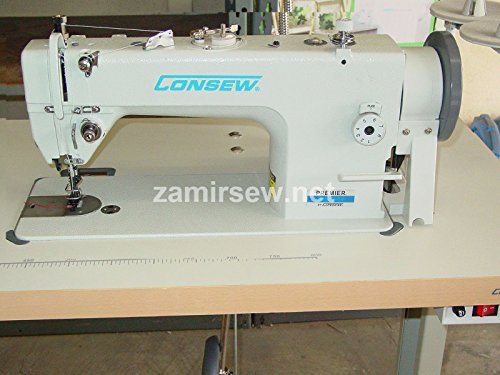
- Brand: CONSEW
- Specialization: Walking foot with drop feed for leather, vinyl, canvas
- Use cases: Furniture upholstery, auto and marine interiors, tarpaulins, covers, sails
- Table included with the setup for stable long runs
Best for: Heavy materials and upholstery tasks requiring reliable feeding and stitch consistency. Better for: projects that demand accurate fabric tracking and a walking foot. Caution: Primarily designed for heavier fabrics; lighter fabrics may not benefit as much from the walking foot feature.
SINGER Heavy Duty 4411

- Brand: SINGER
- Stitches: 69 built-in stitches
- Speed: Up to 1100 SPM
- Power: 50% more stitching power compared to standard models
- Frame: Metal frame, 4-step buttonhole
Best for: Users handling thick fabrics like denim and canvas with a reliable, fast workflow. Choose this if you want a durable, versatile machine for both repairs and creative projects. Limitation: While versatile, it lacks the advanced features of high-end industrial systems and may not handle extreme industrial workloads continuously.
SINGER Heavy Duty 4452

- Brand: SINGER
- Power: 50% more than standard machines
- Speed: Up to 1100 SPM
- Stitch options: Robust set for a variety of projects
- Frame: Metal
Best for: Heavy fabrics and robust daily use in a home shop or small business. Choose this if you need a sturdy metal-frame machine with strong performance and practical stitch variety. Caution: Like other domestic-to-light-industrial hybrids, this is not a full commercial-grade industrial unit for nonstop production runs.
Buying Guide: Making the Right Choice
- Project type and fabric weight: Choose a machine with the right motor power and feed system for denim, leather, vinyl, or canvas.
- Speed and control: Look for high stitch-per-minute rates with stable operation and precise needle control for corners and corners.
- Table and stand compatibility: Some models include a table; others require separate stand setups. Consider workspace and vibration control.
- Needle and foot compatibility: Ensure the machine supports walking feet, trolleys, or specialized feet if upholstering or leatherwork is common.
- Maintenance and parts availability: Brands with readily available parts and service reduce downtime and costs over time.
- Electric requirements and energy efficiency: Servo motors and smart start/stop features can reduce operating costs in the long run.
Frequently Asked Questions
- What is the difference between an industrial sewing machine and a domestic machine?
– Industrial machines are built for heavy fabrics, faster speeds, longer runtimes, and durable components; domestic machines emphasize versatility for lighter tasks and home use. - Do all industrial machines require a table stand?
– Most do, but some come with integrated stands or are designed to be mounted; check assembly requirements for the model you choose. - Is a walking foot necessary for upholstery?
– A walking foot helps feed thick materials evenly, improving stitch consistency on leather and heavy canvases. - Can a serger replace an industrial sewing machine?
– Sergers (overlock machines) complement sewing machines by finishing edges, not replacing heavy-stitch tasks or straight seams. - What maintenance steps are essential for longevity?
– Regular oiling, cleaning lint, checking needle alignment, and periodic professional servicing keep performance steady in demanding workloads. - Which machine balances performance and value for a mid-sized shop?
– Machines like the VEVOR, Juki DDL-8100, and CONSEW walking-foot models offer solid performance for durable, frequent use while maintaining reasonable cost.
Add a Comment