For businesses that demand high-capacity, dependable water filtration, a robust reverse osmosis (RO) system is essential. The following selections emphasize commercial-grade performance, ease of monitoring, and durable components suitable for restaurants, small businesses, and light industrial use. This article highlights five top options, with quick-reference details and practical buying guidance to help you choose the right system for your water quality goals and throughput needs.
| Product | Brand | Capacity (GPD) | Key Benefit |
|---|---|---|---|
| iSpring CRO1000 4-Stage Tankless Commercial RO | iSpring | 1000 | High flow, on-demand filtration for commercial use |
| iSpring RCS5T+T20M | iSpring | 500 | Tank pre-pressurized storage with booster pump |
| iSpring RCB3P Tankless RO Filtration System | iSpring | 300 | Compact under-sink setup with robust filtration |
| Waterdrop G3P600 RO System | Waterdrop | 600 | Eight-stage filtration with tankless design and smart features |
| APEC ROES-PH75 Essence Series | APEC | 75 | Alkaline remineralization for improved taste and pH |
iSpring CRO1000 Four-Stage Tankless Commercial RO

The CRO1000 is designed for high-output commercial use, delivering up to 1,000 gallons per day with a flow of about 0.7 GPM. Its tankless configuration supports on-demand purified water, minimizing storage requirements for busy kitchens or small-scale industrial setups. Built-in inlet and outlet gauges simplify pressure monitoring, while the optional PMP1000 booster pump helps address pressures below 80 psi. The system employs a large, high-efficiency RO membrane and a 4-stage filtration train, including a transparent sediment filter housing for straightforward monitoring. This combination supports consistent contaminant removal and reliable performance in demanding environments.
Key advantages include continuous supply without a large reservoir, a durable stainless steel membrane housing, and filter stages that target lead, chlorine, fluoride, arsenic, and other common contaminants. The PIR-compatible booster option gives operators flexibility to optimize production without overhauling plumbing. For businesses with fluctuating water pressure or intermittent demand, the CRO1000 provides scalable filtration that can adapt to daily throughput while maintaining high water purity.
iSpring RCS5T+T20M 500 GPD RO with Tank

The RCS5T+T20M is a 500 GPD, five-stage RO system designed for light commercial use where space is at a premium. It includes a pre-pressurized 20-gallon tank, which helps ensure a quick response to demand while maintaining consistent water production. The five stages typically incorporate sediment and carbon filtration to reduce particulates and taste-impairing compounds ahead of the RO membrane. The system is engineered to remove PFAS, heavy metals, chlorine, and other common contaminants, delivering safer, better-tasting water for small offices, salons, labs, or restaurant prep areas. The built-in booster pump helps maintain production even when water pressure is variable.
Operational considerations include ensuring adequate wastewater management, routine filter changes, and monitoring for reduction in flow as the sediment and carbon pre-filters load over time. The RCS5T+T20M’s compact footprint makes it ideal for under-sink or closet installations where space constraints exist but consistent production remains essential.
Waterdrop G3P600 Eight-Stage RO System

The Waterdrop G3P600 is a tankless, eight-stage RO system designed to deliver 600 GPD with a compact footprint suitable for under-sink installation in commercial kitchens or staff areas. It carries NSF/ANSI 58 and 42/53 certifications, reflecting strong performance in reducing TDS, chlorine, lead, and other contaminants. The system emphasizes safety and user-friendly operation, with smart filtration indicators and a tankless design that saves space while providing a reliable supply of purified water. On the sustainability side, it helps minimize wastewater relative to traditional systems and supports stable production under variable demand.
Notable features include third-party verification of contaminant reduction, a robust stainless-steel frame, and a modern faucet with a digital or visual status indicator. The G3P600’s remote filter life tracking and easy-access filter housings can simplify maintenance in small business environments where staff turnover or part-time operation is common. The system is well-suited for beverage preparation, small-scale food service, and remote office water stations that require consistent purity and taste.
APEC ROES-PH75 Essence Alkaline RO System
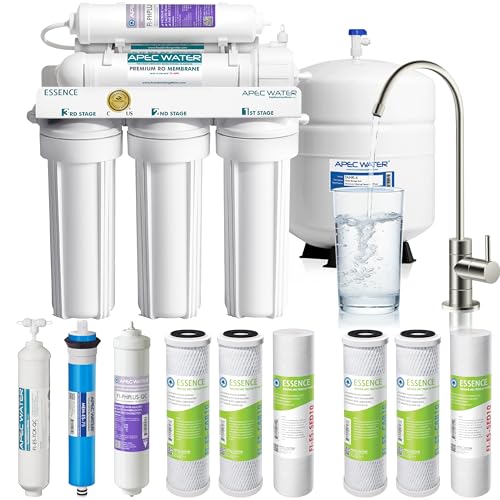
The APEC ROES-PH75 Essence Series is a compact 75 GPD, six-stage system designed to deliver premium quality drinking water with a remineralized final product. It features a pH+ remineralization stage that adds calcium for balance and taste, along with standard RO stages for chlorine, contaminants, and heavy metals removal. The system is WQA certified and built with a focus on reliability and long-term durability. Although its capacity is lower than larger commercial units, it remains a robust option for smaller commercial kitchens, offices, or break rooms that prioritize water quality and mineral-enhanced taste without occupying significant space.
From a maintenance perspective, the PH75 benefits from standard pre-filter replacement and membrane care, with filtration sets designed to maintain performance over time. For operations seeking to offer consistently high-quality drinking water without large-scale infrastructure, this unit provides a reliable balance between filtration depth and footprint. It is particularly attractive for locations where enhanced mineral content improves beverage quality or where staff training emphasizes simple, dependable filtration.
Buying Guide: Key Considerations for Industrial RO Purchases
Selecting the right industrial RO system requires weighing capacity, reliability, and installation realities. Consider the following factors to align a system with your facility’s needs:
- Throughput requirements: Assess daily water demand and peak flow. Larger restaurants, catering facilities, and light industrial setups benefit from higher GPD ratings and tankless designs that respond to demand without oversizing storage.
- Water pressure and feed reliability: Many commercial RO units assume adequate feed pressure. A booster pump can stabilize production when incoming pressure is inconsistent.
- System configuration: Tankless versus pre-pressurized tanks affect space, maintenance cycles, and startup behavior. Tankless systems save space but may require more frequent filter checks in high-usage environments.
- Filtration stages: Multistage configurations improve contaminant removal and taste. Examine each stage’s purpose—from sediment removal to carbon filtration and membrane quality—to ensure it targets your water concerns (lead, PFAS, chlorine, hardness, etc.).
- Certification and safety: Look for NSF/ANSI certifications relevant to the contaminants you aim to reduce. For drinking-water safety, certifications on materials and finishes help ensure compliance with health standards.
- Maintenance and access: Consider how easy filter changes are, whether housings are transparent, and whether you can monitor performance via gauges or digital indicators. This reduces downtime and ensures ongoing filtration integrity.
- Footprint and installation: Ensure space constraints are compatible with under-sink or closet installations. Tankless designs are space-efficient but may necessitate additional plumbing considerations.
- Operational costs: While not listing prices here, evaluate filter life, membrane replacement intervals, and wastewater ratios. Systems that minimize waste and extend membrane life can lower long-term costs.
- Support and compatibility: Choose brands with robust technical support, readily available replacement cartridges, and compatibility with optional boosters or pre-filters to adapt to water quality changes.
In practice, commercial-grade RO systems like the iSpring CRO1000 offer high output and continuous filtration for busy facilities, while models such as the Waterdrop G3P600 provide strong performance with modern monitoring and a compact form. For smaller commercial environments, the RCS5T+T20M and the RCB3P deliver reliable filtration with scalable storage options. The APEC PH75 provides a remineralized option when mineral balance and taste are priorities, especially for drinking water stations inside offices or cafés.
When selecting, align your choice with your facility’s daily water consumption, space constraints, and the level of contaminant reduction required. A combination of tanked storage for peak periods and a robust tankless system for continuous supply can offer optimal reliability in many commercial settings.
Add a Comment