When choosing an industrial HEPA air scrubber, select models that balance filtration depth, airflow, and durability for the intended space. This guide highlights five top options suitable for home renovations, commercial job sites, and restoration projects. Each entry explains who it’s best for, why it was chosen, and any practical limitations to consider.
Summary of selected products:
| Product | Best For | Key Benefit |
|---|---|---|
| VEVOR Air Scrubber (550 CFM) | Small-to-medium jobs, home renovations | Balanced three-stage filtration and easy controls |
| CADPXS Shield-550 | Commercial sites, restoration | Heavy-duty build with strong odor/VOC reduction |
| ALORAIR 3-Stage Classic | Stackable large-area projects | Stackable design with daisy-chain capability |
| BlueDri Air Shield 550 | Construction sites, remediation | High CFM with rugged construction |
| ALORAIR PureAiro 970 | Large-scale industrial cleanups | Advanced filtration with long-term support |
VEVOR Air Scrubber With 3-Stage Filtration

Best for: small-to-mid sized renovation projects and commercial spaces needing reliable, all-around filtration. This unit combines a pre-filter (MERV-10), carbon filter, and an H13 HEPA filter to capture 99.97% of particles down to 0.3 microns, while also tackling odors and smoke. The 550 CFM airflow supports moderate rooms with stable performance.
Why selected: The 3-stage filtration provides a practical balance of efficiency and maintenance, and the control panel supports adjustable airflow and a filter-change indicator. Its compact footprint is suitable for portable use on job sites.
Limitation: While capable, it may not fully service very large open spaces without daisy-chaining or additional units on exceptionally high-CFM requirements.
CADPXS Shield-550 Air Scrubber

Best for: professional restoration and commercial sites needing robust odor and VOC control. Its 3-stage filtration includes a MERV-10 pre-filter and carbon filter to reduce odors from paint, solvents, and cleaning agents while maintaining strong particle capture with HEPA filtration.
Why selected: Designed for water and fire damage restoration and other demanding environments, it focuses on odor/VOC reduction alongside debris filtration, helping workers maintain safer air on job sites.
Caution: Ensure adequate electrical and space clearance on larger sites to maximize its 550 CFM capacity without overloading circuits.
ALORAIR 3-Stage Heavy Duty Air Scrubber
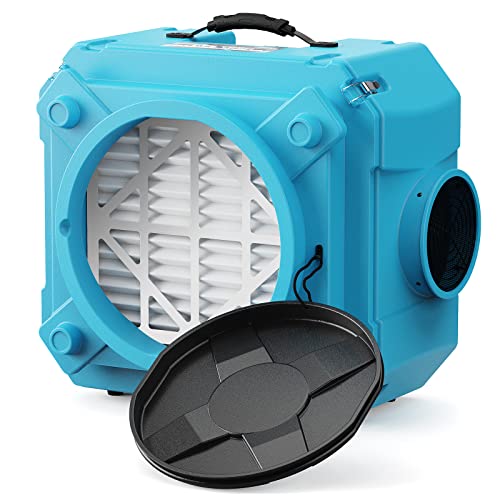
Best for: stackable, large-area industrial and commercial worksites. This unit uses a 3-stage filtration system with MERV-10, carbon, and HEPA filters and supports stacking up to three units for extensive airflow when needed.
Why selected: The rotomolded shell offers durability, and the ability to daisy-chain up to three scrubbers enables scaling airflow to meet larger room requirements. Indicator lights help monitor filter status, aiding maintenance planning.
Limitation: Heavier units may require multiple operators or lifting equipment for relocation within a worksite.
BlueDri Air Shield 550 HEPA

Best for: construction cleanup, sewage remediation, and other restoration tasks requiring high CFM and durable construction. The unit delivers superior particle removal with a HEPA filter capturing 99.97% of particles at 0.3 microns.
Why selected: It offers a strong three-stage purification process with enhanced airflow and rugged design, making it well-suited for frequent, demanding projects and environments such as renovation sites and facilities that require rapid air turnover.
Caution: Check for proper venting and clearance, as higher CFM units demand adequate space to maximize efficiency and avoid recirculating air near occupants.
ALORAIR 3 Stage Stackable (Yellow)

Best for: versatile industrial sites needing reliable filtration with stackable configuration. The unit uses a MERV-10 pre-filter, carbon filter, and HEPA filtration to deliver comprehensive air cleaning while allowing horizontal or vertical stacking for higher total airflow.
Why selected: Its stackable design supports scalable airflow up to 1650 CFM when three units are chained, making it ideal for larger restoration or construction zones that require rapid air turnover.
Limitation: The larger footprint and weight may impact mobility between rooms without assistance.
MOUNTO HEPA500 Commercial Scrubber
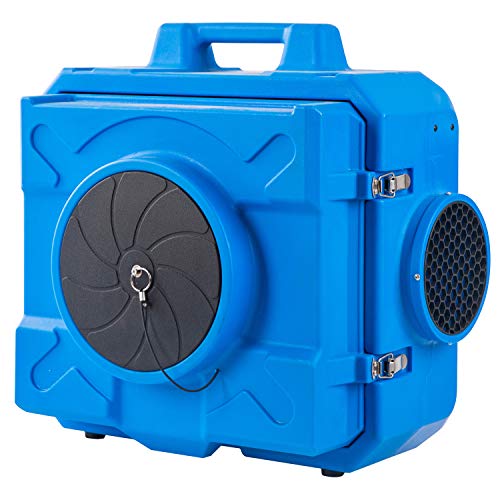
Best for: compact yet portable cleanup on home repairs and smaller commercial jobs. The MOUNTO MT500 offers a 500 CFM capacity with rotomolded durability and quick filter access for efficient maintenance on the go.
Why selected: Its portability and ease of use make it suitable for moving between rooms during renovations, water/fires restoration, and light construction projects. It is a practical choice where space efficiency matters.
Limitation: Slightly lower airflow compared to larger 550–800 CFM units, which may limit performance in very large spaces or highly polluted environments without additional units.
Buying Guide: Key Considerations For Industrial HEPA Air Scrubbers
- Airflow capacity (CFM): Match CFM to room size. Larger spaces benefit from higher CFM or multiple units.
- Filtration depth: A true HEPA filter (0.3 microns) plus a carbon stage reduces particulates, odors, and VOCs effectively for restoration and renovation jobs.
- Filtration stages: A three-stage system (pre-filter, carbon, HEPA) balances debris capture and odor control with filter lifespan.
- Durability and build: Rotomolded shells and rugged cabinets withstand job-site conditions and frequent movement.
- Stackability and daisy-chaining: For large sites, the ability to stack or chain units increases total airflow quickly.
- Maintenance indicators: Filter-change lights and hour meters help plan maintenance and minimize downtime.
- Electrical requirements: Ensure outlets and circuit protection (GFCI) support the unit’s power needs and any additional devices on-site.
- Portability: Weight and handle design affect the ease of moving units between rooms or across sites.
- Application fit: For odor-heavy environments (paint, solvents), prioritize activated carbon filtration; for fine particulates, emphasize HEPA performance.
Frequently Asked Questions
- What is an air scrubber and how does it differ from a typical air purifier?
An air scrubber is designed for larger spaces and job sites with multi-stage filtration to handle dust, smoke, odors, and VOCs. It often includes a durable housing and features suitable for continuous use on restoration or construction projects, unlike consumer-grade air purifiers.
- How many CFM do I need for a given room size?
As a rule of thumb, estimate approximately 5–8 air exchanges per hour for occupied spaces and 8–12 for construction or remediation zones. Multiply room volume (cubic feet) by the desired exchanges per hour, and divide by 60 to get required CFM per unit or total units.
- Is a 3-stage filtration system always better?
Typically yes for restoration and renovation, as it combines particulate capture with odor and VOC reduction. The right balance depends on space size, filtration needs, and maintenance capacity.
- Can air scrubbers be placed in occupied spaces?
Yes, but ensure proper ventilation, follow manufacturer guidelines, and use in well-ventilated areas to minimize occupant exposure during high-activity filtration.
- How often should filters be replaced?
Replacement frequency depends on usage, contaminants, and filter type. Indicators on the unit provide guidance, but plan for routine inspection and scheduled changes during long projects.
- Are these units safe to operate near electrical equipment?
Most models include circuit protection and protective housings. Always follow the manufacturer’s electrical specifications and ensure devices are grounded and compliant with on-site safety standards.
Add a Comment