Industrial air drying systems remove moisture, oil, and particulates from compressed air, preserving tools, improving finish quality, and reducing downtime. This guide highlights five top picks compatible with demanding environments like paint spraying and plasma cutting. Each option offers multi-stage filtration, coalescing, and desiccant drying to deliver clean, dry air under varying pressures. Read on to compare features, maintenance indicators, and installation considerations to help you choose the right system for your shop.
| Product | Port Size | Stage Breakdown | Best For |
|---|---|---|---|
| NANPU 3/4″ NPT Industrial Grade 3 Stage Air Drying System | 3/4″ NPT | Filter/Regulator -> Coalescing Filter -> Desiccant Dryer | |
| 3/4″ NPT Industrial Air Dryer For Compressor (CATArt) | 3/4″ NPT | 5µm filter -> 0.01µm filter -> Desiccant dryer | |
| EDGE Industrial 3 Stage Heavy Duty Filter Regulator Coalescing Desiccant Dryer (1/2″ NPT) | 1/2″ NPT | Water trap/Regulator -> Coalescing -> Desiccant | |
| NANPU Industrial Grade Heavy Duty Desiccant Dryer (1/2″ NPT) | 1/2″ NPT | Desiccant dryer with metal bowl | |
| TAILONZ Pneumatic 0-240 PSI 1/2″ NPT 4-Stage Drying System | 1/2″ NPT | Regulator/Filter -> Coalescing -> Desiccant (4-stage) |
Note: All products support automatic drains or indicator alerts for maintenance, helping ensure consistent dry air delivery in demanding workshops.
NANPU 3/4″ NPT Industrial Grade 3 Stage Air Drying System

The NANPU system integrates a three-stage approach: Stage 1 filters and regulates with a 5-micron water trap filter and pressure regulator; Stage 2 employs a coalescing filter with a 0.01-micron element to remove up to 99.9% of moisture and oil; a visible metal bowl with a sight glass enhances safety, and a red indicator signals when to replace the element. Designed for pressures from 30 to 175 psi, it supports high-flow operations at up to 141 CFM, making it suitable for paint spray and plasma cutting tasks.
3/4″ NPT Industrial Air Dryer For Compressor (CATArt)

CATArt’s three-stage system handles high-pressure environments (up to 240 psi) with a 5-micron first stage, a 0.01-micron second stage, and a desiccant third stage. It features a visual indicator and a durable metal bowl with a sight glass. The unit is designed for easy maintenance and quick filament changes, supporting clean, dry air for sensitive applications such as plasma cutting and automotive finishing, while monitoring filters through color-coded indicators.
EDGE Industrial 3 Stage Heavy Duty Filter Regulator Coalescing Desiccant Dryer System (1/2″ NPT)
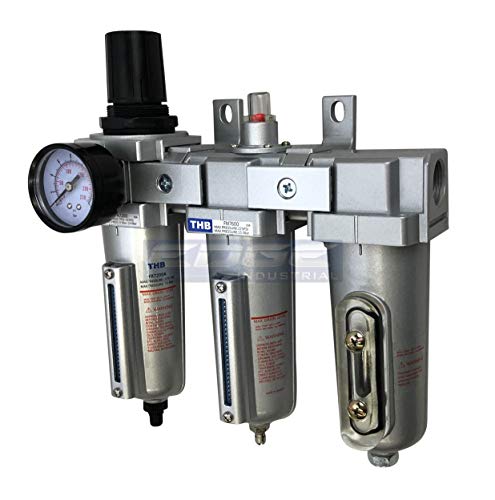
This EDGE Industrial unit combines a 1/2″ NPT pipeline with a three-stage filtration package and a wall-mountable design. Stage 1 uses a 5-micron element to remove moisture and debris, followed by a regulator that stabilizes pressure between 7 and 175 psi. Stage 2 uses a 0.01-micron coalescing filter for deep cleaning, and an in-line desiccant dryer completes the process. A 5-ounce metal bowl with a sight glass aids visual checks during operation.
NANPU Industrial Grade Heavy Duty Desiccant Dryer (1/2″ NPT)

NANPU’s heavy-duty inline desiccant dryer focuses on thorough drying before pneumatic tool use. It features a metal bowl with a sight glass for each stage and a clear indicator when desiccant beads need replacement (blue to pink). Designed to operate within a pressure range of 7–215 psi, this unit suits applications requiring highly dry air for painting and cutting processes and supports straightforward bead maintenance for ongoing performance.
TAILONZ Pneumatic 0-240 PSI 4-Stage Drying System (1/2″ NPT)

Tailonz offers a four-stage filtration suite with 5-micron stage 1 filtration to remove moisture and particles, followed by a 0.01-micron stage 2 coalescing filter for near-total contaminant removal. A red-indicator window shows when replacement is needed. The regulator supports precise pressure control in a 0–240 psi range, and a 1/2″ NPT connection makes it compatible with common shop compressors used in painting and cutting operations.
EDGE Industrial Heavy Duty In-Line Desiccant Dryer (1/2″ NPT)

This unit focuses on delivering clean, dry air via a heavy-duty inline desiccant dryer with a metal bowl and sight glass. It is designed to operate in typical shop environments, with straightforward maintenance and a compact footprint suitable for limited spaces. It supports general-purpose spray and cutting tasks requiring moisture-free air streams.
Buying Guide
- Port size and compatibility: Choose a model with 1/2″ or 3/4″ NPT connections that match your compressor output and piping. Verify gauge ports and regulator ranges to ensure proper pressure management for your tools.
- Filtration depth: A 5-micron stage removes most particles, while a 0.01-micron stage captures fine moisture and oil. For demanding finishes, prioritize three-stage or four-stage systems with desiccant drying.
- Desiccant indicators: Look for color-changing beads or automated indicators showing when beads need replacement. Maintenance indicators help prevent moisture breakthrough.
- Moisture and oil management: Coalescing filters work with desiccant dryers to provide ultra-dry air. Systems designed for high psi (up to 240 psi) support heavy equipment and demanding workflows.
- Safety features: Metal bowls with sight glasses reduce spill risk during draining. Auto drains and red/green indicator alerts improve maintenance timing and system safety.
- Maintenance and accessibility: Consider wall-mounted units or compact vertical designs for space-limited shops. Easy access to filters and bowls reduces downtime during service.
- Application fit: For paint spraying, choose systems with reliable moisture and oil removal and stable pressure control to achieve consistent finishes. For plasma cutting, prioritize high-psi capability and robust filtration to prevent tool wear and overheating.
All five options provide multi-stage filtration, visible safety features, and maintenance indicators designed for professional environments. When selecting, align the system’s maximum pressure, flow rate, and stage configuration with your specific tools and production requirements to maintain consistent air quality across your operations.
Add a Comment